You're probably in a familiar spot. Revenue is real, customers are buying, and marketing activity exists, but growth feels uneven. Campaigns go out, your website gets updates, someone posts on LinkedIn, maybe an agency runs ads, yet nobody is clearly accountable for turning all of that into a focused growth plan.
That's when the search for a marketing manager for hire starts. The problem is that most companies ask the wrong question. They ask, “Who should we hire?” The better question is, “What kind of marketing leadership fits our business right now?” A full-time manager, a freelance operator, and a fractional team-backed lead can all be the right answer. They can also all be expensive mistakes if the fit is wrong.
Table of Contents
- The Core Decision Facing Growing Businesses
- The Three Marketing Manager Models Defined
- A Decision Framework for Choosing Your Model
- Cost vs Value A Realistic Financial Comparison
- Hiring and Onboarding What to Expect
- The SharedTEAMS Model A Hybrid Solution
- Making Your Final Decision and Next Steps
The Core Decision Facing Growing Businesses
A business usually looks for a marketing manager after hitting a ceiling. Sales are no longer collapsing, but they're not compounding either. Founders are still approving campaigns, sales is asking for better leads, and nobody owns the full picture from positioning to pipeline.
That's why this decision deserves more rigor than a quick job post. A marketing manager is not a lightweight hire. The median annual wage for marketing managers reached $161,030 by May 2024, and projected job growth is 6% through 2034, according to a summary of U.S. Bureau of Labor Statistics marketing hiring data. That tells you two things. Good talent is expensive, and demand isn't easing.
Practical rule: If your business can't clearly define the growth problem you need solved, you're not ready to hire a person. You're only ready to create confusion.
Most companies don't need “more marketing.” They need one of three things:
- Strategic coordination: Someone has to connect PPC, email, content, web updates, and CRM activity into one plan.
- Execution pressure relief: Your team knows what to do, but they can't ship fast enough.
- Specialized decision-making: You need a senior operator who can set priorities, measure channel performance, and stop random acts of marketing.
The hiring model should follow the problem. If you need daily ownership, a full-time employee may fit. If you need short-term channel expertise, a freelancer may be enough. If you need senior direction plus execution support without building a whole department, a fractional model often makes more sense.
That's the core decision. Not whether to hire marketing leadership, but which version of it your business can use well.
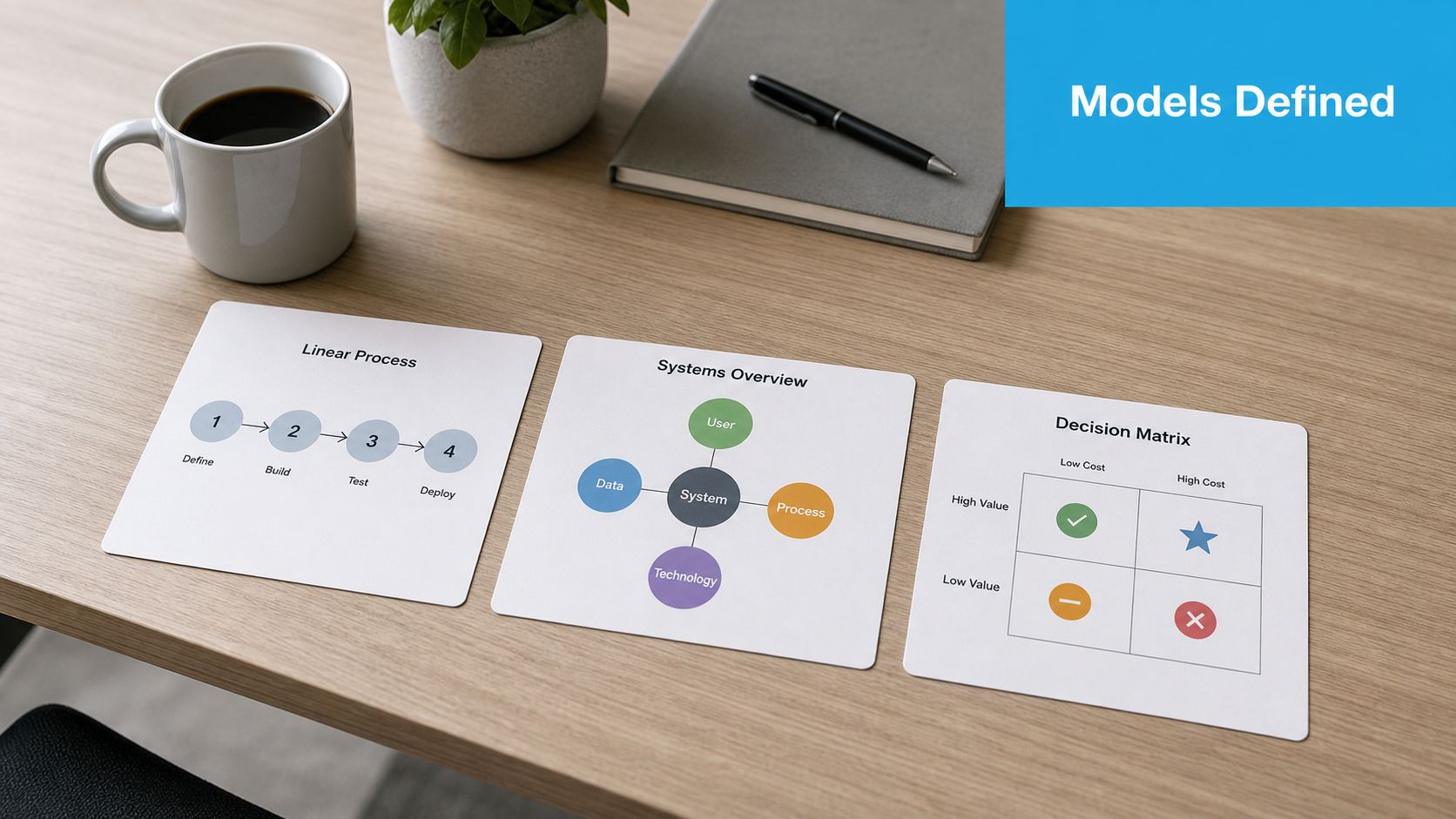
The Three Marketing Manager Models Defined
The market has moved away from treating full-time employment as the only serious option. In the first half of 2025, 72% of marketing and creative leaders reported increasing their use of contract talent, according to marketing jobs and hiring trend data. That shift makes sense. Businesses want expertise, but they don't always want fixed headcount.
Full-time employee
A full-time marketing manager is the classic hire. This person joins your payroll, attends leadership meetings, works inside your systems, and becomes part of the company's operating rhythm.
That model works best when marketing is already a core function with enough daily work to justify constant ownership. It's strongest when you need internal alignment across sales, leadership, customer service, product, and external vendors. A full-time manager can absorb context quickly because they live inside the business.
The downside is obvious. You're making a long-term commitment before you fully know whether one person can solve the problem.
Independent contractor or freelancer
A freelance marketing manager is usually a narrower resource. They might run paid search, manage launch planning, coordinate campaigns, or clean up a reporting mess. They can be highly effective when the scope is specific and the business already has someone internally making strategic calls.
Many founders make a costly mistake. They hire a freelancer and expect executive-level thinking, cross-functional coordination, team management, and channel execution at the same time. That rarely ends well.
A contractor works best when you can answer three questions clearly:
- What channel or outcome matters most right now
- Who will make final strategic decisions internally
- What work is in scope, and what is not
Fractional or agency-backed manager
A fractional marketing manager sits between a hire and an outside vendor. This person usually brings senior judgment, limited but focused weekly involvement, and often broader access to specialists.
Typical fractional support requires 10 to 20 hours per week of a senior leader's time, according to fractional marketing engagement guidance. That's enough to create direction, review performance, and drive priorities without carrying full-time payroll.
A strong fractional leader doesn't pretend to do every job. They decide what matters, then make sure the right work gets done.
This model is best for companies that need leadership more than supervision. It fits businesses that are too complex for founder-led marketing, but not ready to justify a full internal department.
A Decision Framework for Choosing Your Model
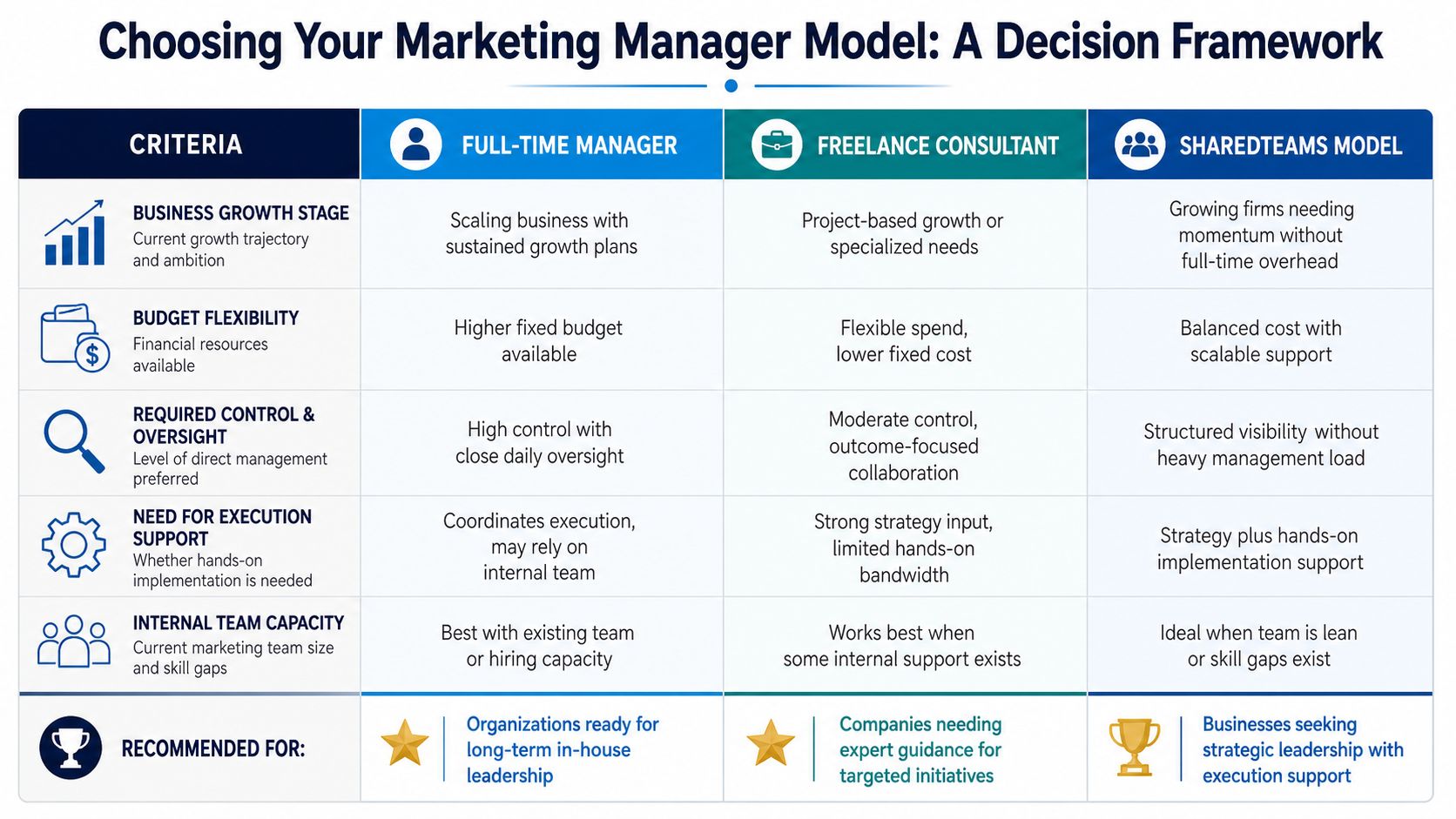
The right model depends on business stage, leadership needs, budget flexibility, and speed. It's not about the “best” option. It's about the best fit for your current operating reality.
Early comparison table
| Criteria | Full-Time Manager | Freelance Consultant | SharedTEAMS Model |
|---|---|---|---|
| Best fit by stage | Mature marketing function with steady ongoing workload | Short-term need or narrow channel problem | Growing company that needs leadership plus execution support |
| Revenue fit | Usually stronger once marketing volume supports full internal ownership | Works at many stages when the scope is tightly defined | Fractional support is most effective for businesses generating $2 million to $50 million in annual revenue, based on fractional marketing support guidance |
| Budget style | Highest commitment and least flexible | Variable spend, but scope can drift | Flexible operating model without full-time headcount |
| Control and oversight | Highest internal control | Moderate control, depends on contractor structure | Strong strategic oversight with external delivery support |
| Execution capacity | Depends on one person's skills and bandwidth | Usually limited to stated scope | Broader support across channels and projects |
| Speed to start | Slower due to hiring and ramp-up | Faster than full-time in many cases | Designed for faster activation and ongoing support |
| Risk profile | Highest risk if the hire is wrong | Lower commitment, but fragmented if not managed well | Lower hiring risk when you need breadth more than a single employee |
Match the model to your stage
If you're under the point where marketing still behaves like ad hoc founder energy, don't overhire. You probably need focused execution, tighter messaging, and one or two channels managed well. A broad leadership hire can become expensive overhead if the business hasn't yet built enough repeatable demand to justify it.
For businesses in the $2 million to $50 million range, fractional support is often the cleanest fit, as noted in the data above. This is the stage where founder-led marketing starts to break down and the business needs a more predictable pipeline and clearer priorities.
If you're beyond that range and marketing already touches multiple departments, a full-time manager becomes more defensible. At that point, integration, internal accountability, and daily coordination matter more.
For a practical example of how businesses structure this kind of oversight, review fractional marketing guidance and support options.
A quick visual can help if you're weighing these trade-offs with a leadership team:
Use four filters before you decide
Don't choose based on title alone. Use these filters.
Business stage and revenue
Smaller firms usually need a strategic push, not org charts. Mid-market firms need operating structure. Larger firms need internal ownership.Strategic need versus execution need
If nobody can set direction, hire leadership. If direction exists but work isn't getting shipped, buy execution capacity.Budget and risk tolerance
A full-time hire commits you before results are visible. A contractor limits cost, but also limits ownership. A fractional model splits the difference.Required speed and scalability
If you need action this week, traditional hiring won't help. If your needs fluctuate across PPC, content, design, and web, one generalist won't carry that load well.
Cost vs Value A Realistic Financial Comparison
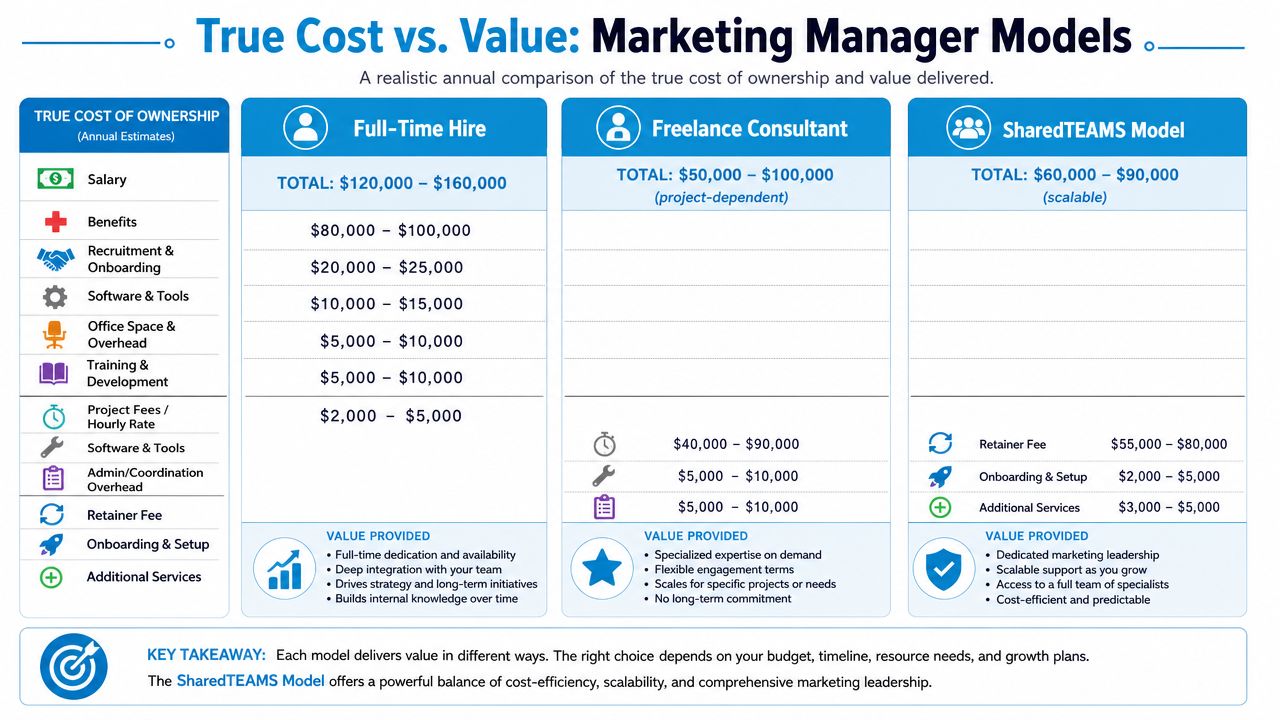
The salary is never the full cost. That's the first thing owners get wrong when they compare hiring models.
What you are really paying for
A full-time marketing manager comes with payroll, recruiting effort, onboarding time, software access, management oversight, and the cost of getting the role definition wrong. Even before results show up, your business has already committed meaningful cash and internal attention.
A contractor looks cleaner on paper because the invoice is visible and the hidden costs are lower. But contractor value drops fast when the scope is vague. If you need strategy, analytics, copy review, reporting discipline, and cross-functional coordination, you'll often end up managing several freelancers or asking one person to do too much.
At this point, many companies should slow down and ask a harder question. Are you paying for labor, or are you paying for usable momentum?
The cheaper option is often the one that starts fast, sets priorities clearly, and avoids six months of internal drift.
Where time-to-value changes the math
A dedicated fractional marketing manager can start projects in approximately 1 day, while a full-time hire averages 42 days to fill and then often needs another 3 to 6 months to reach full productivity, based on recruitment marketing metrics and hiring benchmarks. The same source notes that this model reduces cost per hire by removing 20% to 30% overhead tied to internal recruitment.
That matters because delay has a cost. If your website conversion path is broken, your ad account lacks discipline, or your campaign calendar is inconsistent, every slow week compounds waste.
Use this simple lens when comparing options:
| Question | Full-Time Hire | Freelancer | Fractional Team-Backed Model |
|---|---|---|---|
| How quickly can useful work begin | Slowest | Usually fast | Fast |
| How much internal management is required | Moderate to high | High if scope is broad | Moderate |
| How much specialist support is built in | Limited to one person | Usually narrow | Broader |
| How easy is it to scale up or down | Harder | Moderate | Easier |
If you want a cleaner financial review of ongoing service structures, compare marketing pricing models and engagement options.
The calculation is simple. If you need immediate direction and ongoing output, time-to-value often matters more than theoretical annual cost.
Hiring and Onboarding What to Expect
Once you know the model, the hiring process gets easier. Most hiring mistakes come from writing a vague role and then interviewing for personality instead of operating ability.
What to put in the role description
A good marketing manager job description should focus on outcomes, not task spam.
For a full-time role, write for ownership:
- Primary mission: Build and manage the company's marketing plan across channels.
- Success definition: Own pipeline-related reporting, campaign coordination, and cross-functional alignment.
- Key requirement: Can manage internal priorities, external vendors, and performance reporting.
For a freelance role, write for scope:
- Primary mission: Improve one channel, campaign type, or launch process.
- Success definition: Deliver execution and reporting within a defined scope.
- Key requirement: Proven ability in the exact discipline you need.
For a fractional role, write for leadership:
- Primary mission: Create strategic direction, define priorities, and improve marketing accountability.
- Success definition: Establish roadmap, reporting cadence, and decision-making discipline.
- Key requirement: Senior-level judgment across channel strategy, measurement, and team coordination.
Interview questions that expose real capability
High-impact marketing managers should define success with 3 to 5 metrics tied to revenue, such as CAC and conversion rate, and they should use rolling 90-day averages for metrics like CPL to establish a realistic performance floor, according to guidance on marketing manager performance metrics.
Ask questions that force candidates to think that way:
- What 3 to 5 metrics would you use to evaluate this role in the first 90 days, and why?
- Tell me about a channel that looked healthy on the surface but was failing the business. How did you diagnose it?
- How would you set baselines for CAC, conversion rate, CPL, MQL volume, or pipeline contribution if the data is messy?
- If you inherited our current marketing mix tomorrow, what would you audit first and what would you leave alone?
Hiring advice: If a candidate talks mostly about activity volume and barely mentions measurement quality, keep looking.
Onboarding without wasting the first month
Onboarding should be structured, even for a contractor. The first month usually determines whether the relationship becomes productive or chaotic.
Use this checklist:
- Give access early: Analytics, CRM, ad platforms, CMS, brand guidelines, prior reports, and campaign history.
- Clarify decision rights: Who approves budgets, messaging changes, landing pages, and campaign launches.
- Set one reporting rhythm: Weekly is usually enough early on. More meetings rarely fix unclear priorities.
- Define the first win: Choose one practical target, such as campaign cleanup, dashboard discipline, or offer alignment.
For remote teams, operational clarity matters even more. A practical resource on building a remote marketing team can help owners avoid common coordination mistakes.
The SharedTEAMS Model A Hybrid Solution
The strongest argument for a hybrid model is simple. One marketing manager rarely has deep expertise in every channel your business depends on. Expecting one person to handle strategy, paid media, SEO, content, design feedback, email planning, and web updates usually creates a bottleneck.
Why hybrid beats the specialist bottleneck
The more practical model is a dedicated strategic lead backed by specialists. That structure gives you one point of accountability without forcing one person to pretend they are equally strong in Google Ads, landing page UX, content systems, analytics, and brand execution.
The specialist versus generalist problem isn't theoretical. Hiring guidance for modern marketing teams increasingly points toward solving the most important channel problem first instead of expecting one broad generalist to master everything. A hybrid team-backed model addresses that directly. It lets a senior manager prioritize what matters while specialists execute the work properly.
There's also a cultural advantage here. A hybrid model works best when the lead can align with your leadership style, communication habits, and pace of decision-making.
You don't need one superhero marketer. You need a system that makes good decisions and gets good work shipped.
Where this model fits best
This model tends to fit businesses that have outgrown ad hoc marketing but don't want the rigidity of a full internal department. It's a strong option when:
- The founder still owns too much marketing judgment
- The team needs more output across several disciplines
- Campaigns stall because no one can coordinate specialists
- You want expert oversight without long-term headcount risk
It also works for companies that already have an internal coordinator or junior marketer but need stronger senior direction. In those situations, a hybrid structure can improve focus without forcing a premature senior full-time hire.
The key benefit is operational. Instead of buying one person's skill set, you buy a managed decision layer plus flexible execution capacity. For many growing firms, that's a better fit than hiring a generalist and discovering six months later that the bottleneck was specialist support.
Making Your Final Decision and Next Steps
A marketing manager for hire is not one decision. It's three distinct paths, and each fits a different kind of business. If you're still small and the need is narrow, use a freelancer. If marketing is central to daily operations and you need deep internal ownership, hire full-time. If your company is in the messy middle where growth depends on better strategy, tighter coordination, and more execution capacity than one person can provide, a fractional or hybrid model usually makes the most sense.
Don't start with resumes. Start with diagnosis. Look at your revenue stage, your internal team capacity, how quickly you need results, and whether the problem itself is leadership, execution, or both. Then choose the model that fits your current reality, not the one that sounds most impressive on paper.
If you want a practical next step, review how SharedTEAMS pairs an accountable Marketing Director with a team of specialists. It’s a useful option for businesses that need senior direction plus flexible specialist capacity, without committing to a traditional full-time buildout.