Your marketing team probably isn't failing because of weak ideas. It's slowing down because nobody can find the right file, nobody is fully sure which version is approved, and every new campaign starts with avoidable cleanup work.
That problem gets worse when you rely on freelancers, specialists, or a fractional team. One designer has the current logo pack. Someone else has the latest sales deck. The social manager pulls an old banner from a shared drive. A contractor asks for brand guidelines that already exist, but nobody knows where the final copy lives. Work still gets done, but it takes longer, costs more, and creates inconsistency that customers notice.
Marketing asset management fixes that operational drag. Done well, it gives growing businesses a central system for storing, approving, finding, reusing, and governing the assets that power real marketing execution. For small and mid-sized businesses, especially those working with on-demand talent, it's less about software for its own sake and more about building a reliable operating system for brand execution.
Table of Contents
- Why Your Marketing Feels Inefficient and Disorganized
- What Exactly Is Marketing Asset Management
- MAM vs DAM and Other Content Systems
- Key Business Benefits of a Centralized System
- Essential Governance and Best Practices
- How to Implement MAM with a Fractional Team
- Building Your Foundation for Scalable Marketing
Why Your Marketing Feels Inefficient and Disorganized
A familiar pattern shows up in growing businesses. The founder keeps files in Google Drive. A marketer uses Dropbox. A designer sends finals through email. Sales downloads assets into a local folder. Six months later, the company has four versions of the same brochure, two logo folders, and no clear answer to a simple question like, “Which headline and visual are approved for this campaign?”

The hidden cost of file chaos
This doesn't just create annoyance. It creates measurable waste. Marketing teams operating without a dedicated Marketing Asset Management system waste 20–30% of their total working time on asset-related tasks such as searching for files, recreating lost assets, and manually reformatting content, according to Acquia's overview of digital asset management.
That lost time usually hides inside ordinary tasks:
- Searching for basics: A team member spends too long finding the right headshot, deck, logo lockup, or ad size.
- Recreating work: A contractor rebuilds a graphic that already exists because the source file isn't easy to locate.
- Using outdated assets: Someone publishes an old product screenshot or retired messaging because the current version wasn't clearly labeled.
- Reformatting manually: The same content gets resized or rewritten from scratch for email, social, web, and sales enablement instead of being prepared as part of a structured cross-channel content design process.
Practical rule: If your team has to ask where assets live before they can start work, you don't have an asset system. You have file storage.
Why this gets worse with fractional support
The problem compounds when work moves across multiple hands. Fractional marketers, freelance designers, agency partners, and internal stakeholders often join projects at different stages. Without a central source of truth, each person creates their own working set of files.
That's how a business ends up paying for coordination instead of execution. People wait for access, request missing assets, and second-guess approvals. Marketing asset management is the discipline that removes that friction. It gives the business one organized place for approved assets, brand standards, current versions, and usage rules, so work can move without repeated onboarding and correction.
What Exactly Is Marketing Asset Management
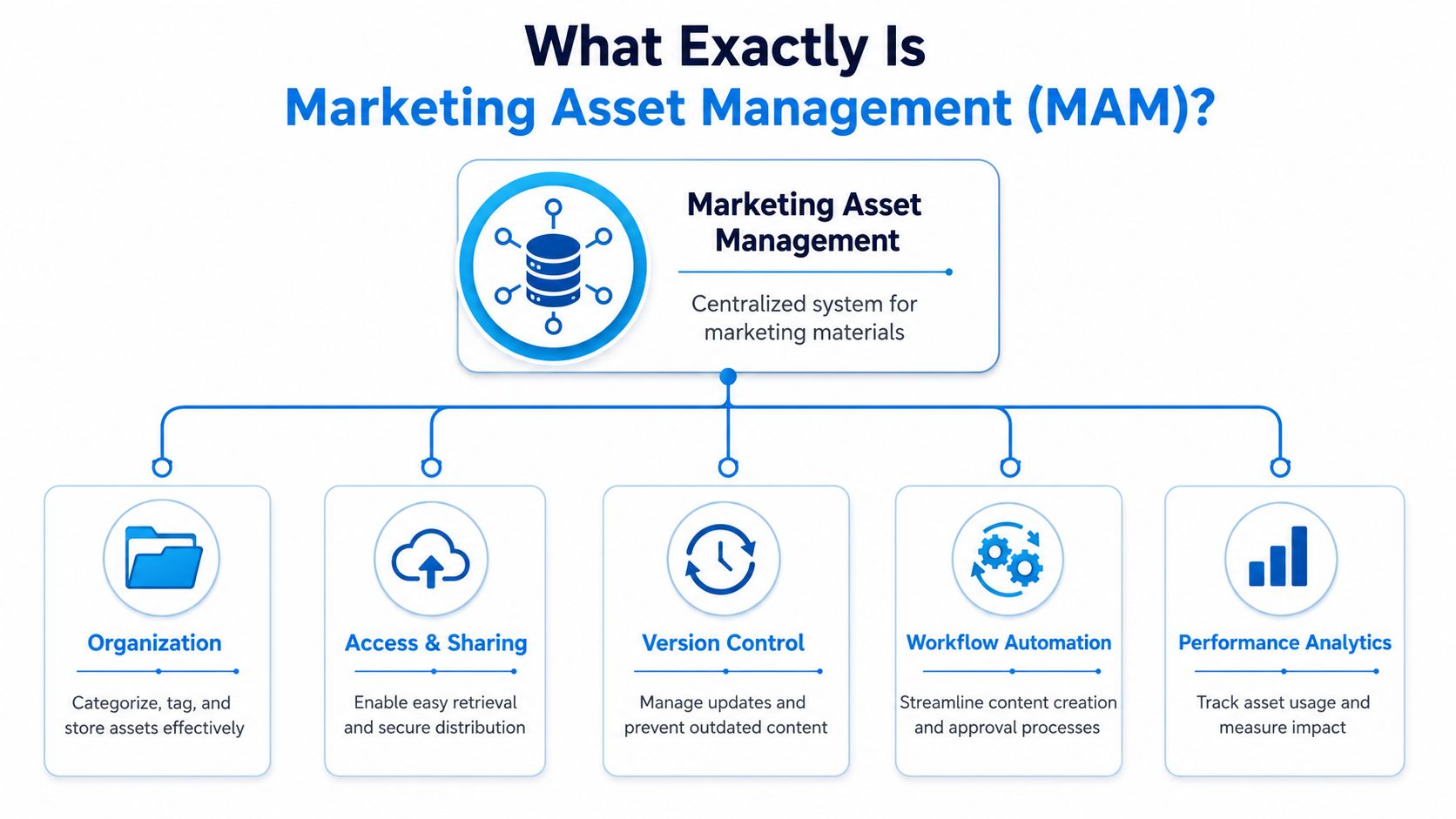
Marketing asset management is a structured system for storing, organizing, finding, sharing, governing, and tracking marketing assets across their lifecycle. Those assets can include logos, ad creative, social graphics, landing page visuals, videos, email templates, brand guidelines, campaign briefs, sales collateral, and approved copy blocks.
A useful way to think about it is this: cloud storage holds files, but marketing asset management tells your team which file to use, who can change it, where it belongs, and how it supports execution.
What a real MAM system does
A workable MAM setup usually includes a few core parts:
- Central library: One place for approved marketing materials, not scattered folders across personal accounts.
- Metadata and tagging: Labels that make assets searchable by campaign, audience, region, format, channel, status, or owner.
- Version control: A clear record of what is current, what is archived, and what should never be used again.
- Permissions: Rules for who can upload, edit, approve, or distribute assets.
- Workflow support: Simple handoffs for review, feedback, localization, and publishing.
- Usage insight: Visibility into which assets are used, reused, or tied to outcomes.
For teams that want a broader framework, The AI CMO's guide on mastering marketing asset management is a useful companion read because it helps connect file organization with actual campaign operations.
What it is not
Marketing asset management is not a messy shared drive with better intentions. It's also not just a folder called “Final Assets” that keeps getting filled with files named final_v2_revised_REAL.
A simple test helps separate the two.
| Question | Basic storage | Real MAM |
|---|---|---|
| Can the team find assets by campaign, audience, or channel? | Sometimes | Yes |
| Is the latest approved version obvious? | Often no | Yes |
| Can outside partners access only what they need? | Rarely cleanly | Yes |
| Are brand rules built into workflows? | Usually no | Yes |
| Can you see what gets reused or retired? | Limited | Yes |
The real value isn't storage capacity. It's decision clarity. Teams move faster when the system answers routine questions before anyone has to ask them.
For SMBs, that distinction matters. You don't need enterprise complexity. You need a system that makes daily execution easier and keeps your brand stable as more people touch the work.
MAM vs DAM and Other Content Systems
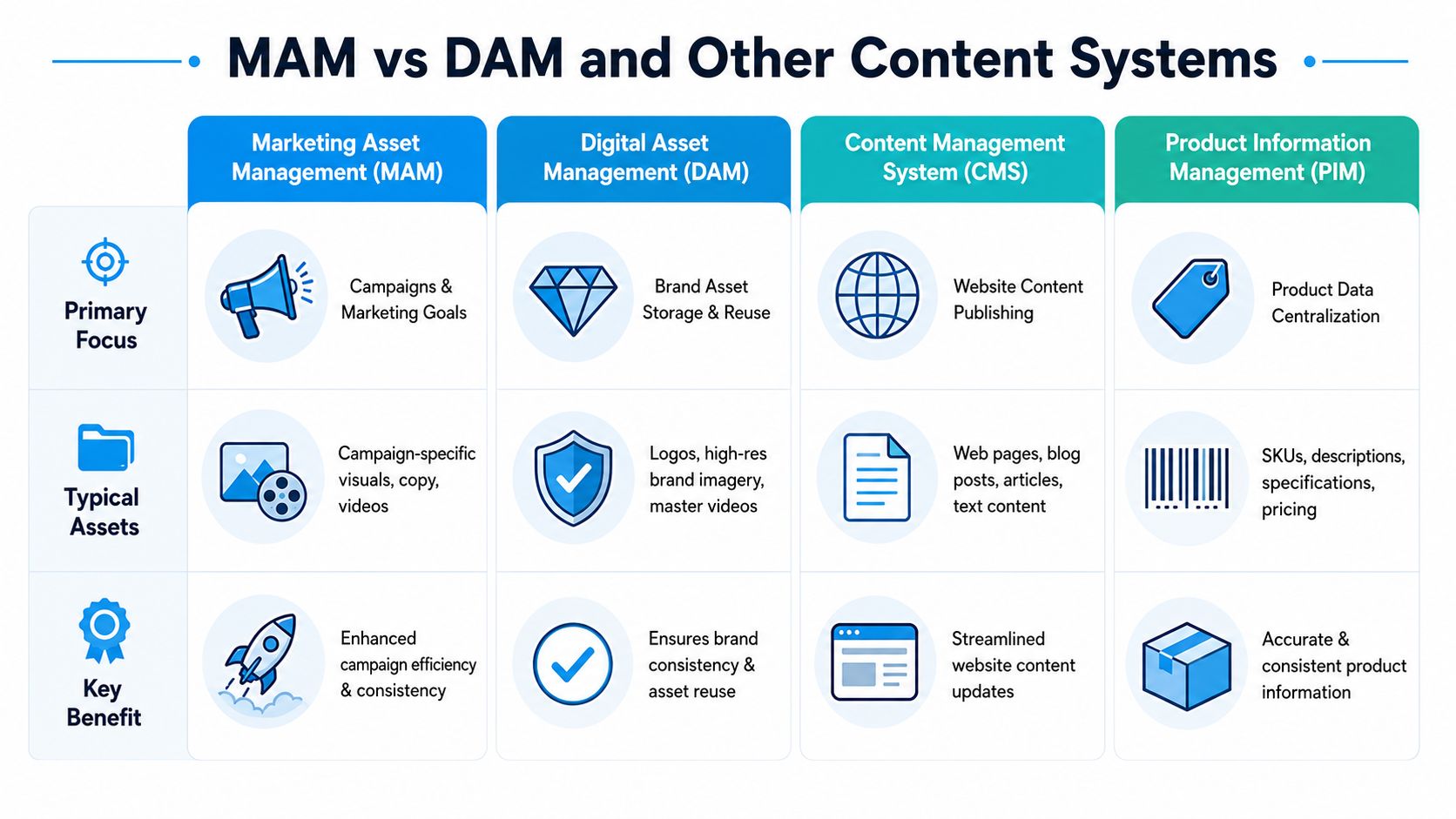
Business owners often hear MAM, DAM, CMS, and PIM used as if they mean the same thing. They do not. If you pick the wrong system, the result is usually familiar. Assets live in one place, approvals happen somewhere else, the website pulls from another tool, and outside freelancers keep asking which file is current.
Where MAM fits
Digital Asset Management, or DAM, is the broader category. It stores, organizes, and governs digital files across the company. That often includes marketing assets, along with sales collateral, product photos, training materials, legal files, and other business content.
Marketing Asset Management, or MAM, serves a narrower job. It is built for marketing production. That means campaign assets, review cycles, approved templates, channel variations, and controlled access for the people who create and distribute marketing. For an SMB, that distinction matters most when a fractional CMO, freelance designer, paid media contractor, and in-house coordinator all need to work from the same source without constant hand-holding.
A CMS and a PIM solve different problems again. A CMS manages published web content. A PIM manages product data such as descriptions, specs, pricing, and SKUs. Both can connect to marketing work, but neither is designed to run the full day-to-day process of creating, approving, updating, and reusing brand assets across campaigns.
How to choose the right system
Start with the operational bottleneck, not the software label.
| System | Best for | Typical owner | Common limitation |
|---|---|---|---|
| MAM | Campaign assets, brand execution, approvals, local adaptation | Marketing team | Usually limited to marketing use cases |
| DAM | Company-wide file governance and reuse | Operations, IT, marketing, brand | Can be broader and heavier than an SMB needs |
| CMS | Publishing website content | Marketing or web team | Poor fit as the master library for brand assets |
| PIM | Product data such as SKUs, descriptions, specs, pricing | Ecommerce or product teams | Does not manage creative workflow well |
In practice, SMBs usually do better with a marketing-first system if they run frequent campaigns and use outside support. Fractional teams need clear access, current files, and lightweight approval control. A broad DAM can still make sense, but only if multiple departments truly need shared governance and the business is ready to manage that added complexity.
The same logic applies to ecommerce. Product data and campaign creative are related, but they are not interchangeable. One system keeps the catalog accurate. The other keeps the brand usable.
The expensive mistake is expecting one tool to do every content job well. A CMS publishes. A PIM structures product information. A DAM governs digital files across the business. A MAM keeps marketing execution organized, especially when several part-time or external contributors touch the brand every week.
Key Business Benefits of a Centralized System
A centralized asset system pays for itself when a campaign no longer stalls because a freelancer has the wrong logo, a contractor is working from an old deck, or nobody can find the approved ad files before launch. That problem shows up fast in SMBs that use fractional support. Every handoff costs time unless one system holds the current assets, clear usage rules, and the latest approved versions.
Speed and campaign agility
The first gain is speed.
Time-to-market improves because the team starts from ready-to-use assets instead of rebuilding context on every project. Activo includes time-to-market among the core ways to measure asset management performance in its guide to tracking asset usage across marketing campaigns. In practice, that means a designer can pull the active brand kit, a media buyer can grab approved creative variations, and a writer can work from current messaging without chasing Slack threads or old email attachments.
This matters even more with a fractional model. Part-time specialists are efficient only if they can get in, do the work, and move. If they spend the first hour of every engagement asking which files are current, you are paying senior rates for admin work.
Consistency and cost control
Consistency is usually treated like a brand issue. It is really an operating issue.
A centralized system makes the approved version the easiest version to use. That reduces the small, expensive mistakes that add up over a quarter. Wrong logo lockups. Outdated pricing sheets. Sales decks with old positioning. Paid ads built from stale offers. Each one creates rework, approval churn, and avoidable spend.
Asset reuse is where the cost benefit becomes obvious. When teams can find and adapt what already exists, they produce fewer one-off files that get used once and forgotten. For an SMB, that often matters more than buying another tool or adding another contractor. Reusing proven creative, templates, and messaging stretches the value of work you have already paid for.
Businesses with multiple locations, service lines, or recurring campaigns see another benefit. Central templates let local or channel-specific contributors customize within approved boundaries instead of requesting net-new design work for every variation. If you have not documented those boundaries yet, WaveGen.ai's brand strategy guide is a useful reference for turning brand standards into something outside contributors can apply correctly.
Measurement and smarter decisions
A centralized system also makes performance review more useful because assets are easier to track across campaigns. Teams can examine which files were reused, which formats supported conversion paths, and which pieces consumed budget without producing much downstream value.
That changes the conversation from taste to output.
Instead of debating whether a creative concept "felt strong," the team can review what was used, what kept appearing in successful campaigns, and what should be retired. For SMB owners, that is the advantage. Better asset management is not about building an enterprise content operation. It is about giving a lean internal team and a rotating bench of fractional support one source of truth, so marketing runs faster, stays on-brand, and wastes less money.
Essential Governance and Best Practices
A MAM tool won't stay useful unless you pair it with rules people follow under pressure. Governance sounds heavy, but for most SMBs it comes down to a small set of standards that remove ambiguity.
Set rules people can actually follow
Start with file naming. Airtable recommends naming conventions that include campaign identifiers, asset type, version number, and date, so final or most recent versions are always clearly identifiable in its marketing asset management guide. That sounds simple because it is simple, and it works.
For example, a file name like:
- SpringLaunch PaidSocial 1×1 V03 2026-02-14
- BrandOverview SalesDeck V05 2026-02-14
- ClientOnboarding EmailHeader V02 2026-02-14
is far more useful than graphic-final-new or deck-latest.
Access control matters just as much. Aprimo notes that MAM systems need granular access controls that define who can upload, edit, or download assets to prevent unauthorized changes and protect brand integrity. The same piece says 3.39% of decision-makers identify siloed asset management systems as the top challenge in building consistent customer experiences in Aprimo's best practices overview.
Build governance into daily work
The most effective setups usually include these working rules:
- Define asset states: Draft, in review, approved, archived, and retired should mean something specific.
- Limit edit access: Not everyone should be able to replace a logo master, update brand copy, or overwrite a template.
- Use metadata consistently: Tag by campaign, audience, region, format, owner, and status so search works the way people think.
- Archive aggressively: Old files shouldn't compete with active ones in primary folders.
- Document brand standards: Voice, color, typography, imagery, usage rules, and exceptions need a living reference point. For teams formalizing that work, WaveGen.ai's brand strategy guide is a practical resource.
A clean system is easier to maintain than to rescue. Most asset libraries become messy because teams postpone decisions about naming, permissions, and approval ownership.
What doesn't work is overengineering. SMBs don't need a governance committee for every banner ad. They need a short set of rules, clear ownership, and a workflow that makes the right action the easiest one.
How to Implement MAM with a Fractional Team
A fractional designer starts on Monday. By Tuesday, they have asked for the current logo, the latest pitch deck, the approved product screenshots, and the right version of your brand voice guide. If those files live across inboxes, shared drives, and old project threads, you pay for the same orientation work every time someone joins a project.
That cost shows up fast in SMBs. Fractional support is supposed to give you senior execution without carrying a full in-house team. Without a central asset system, outside specialists spend billable hours reconstructing context instead of producing campaigns.
Start with the assets tied to active revenue work
A good rollout begins with the files your team uses every week, not with a full historical migration. That usually means brand guidelines, logo files, sales decks, landing page visuals, ad creative, email templates, approved headshots, product screenshots, messaging documents, and current campaign assets.
The goal is simple. Give every contributor one place to find approved materials and one place to return finished assets that are ready for reuse.
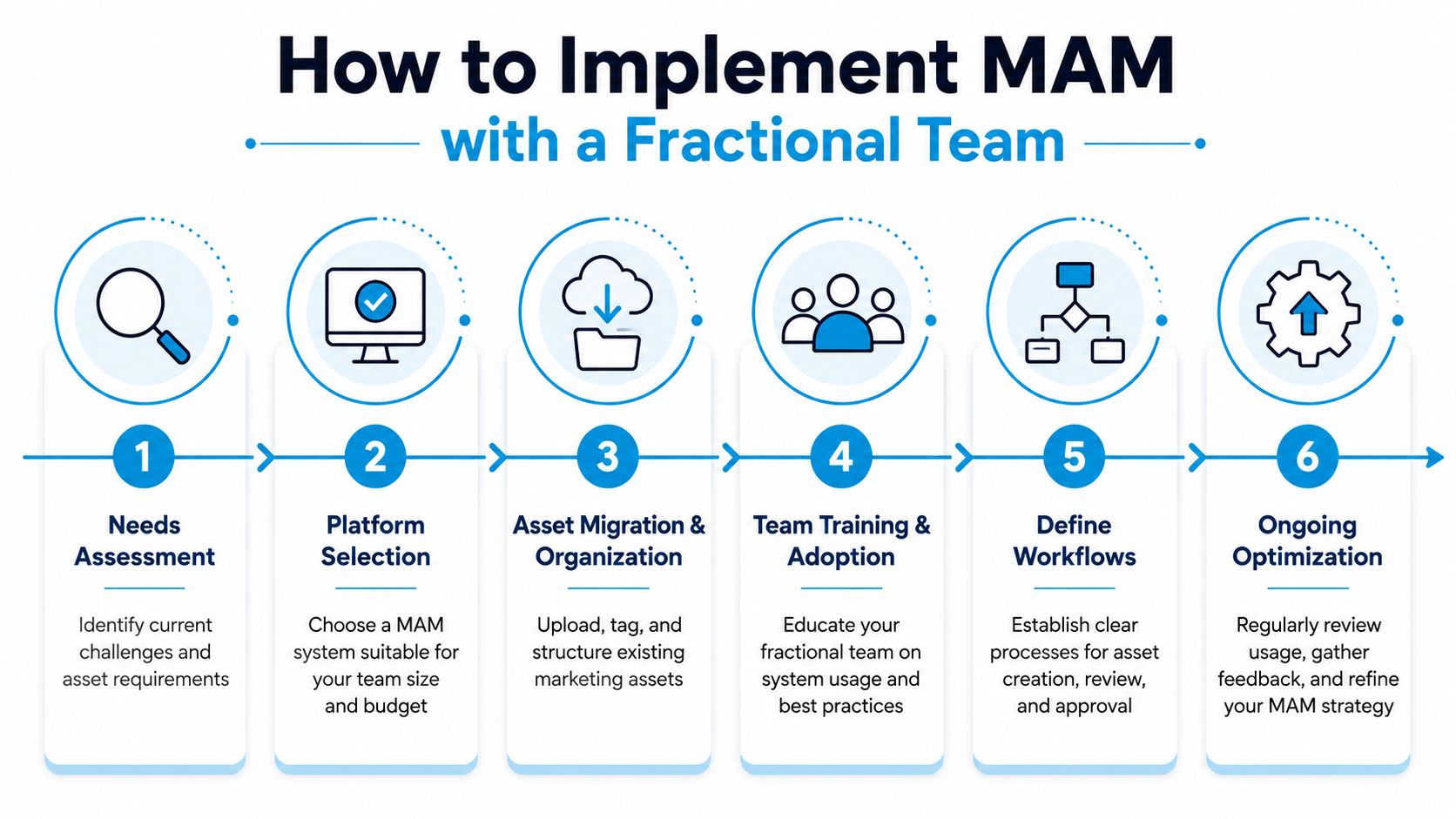
A practical implementation usually follows three steps:
Audit the working library
Pull together the assets connected to current campaigns, sales enablement, and ongoing content production. Leave deep archives alone until the live system is stable.Set the operating model
Define naming rules, metadata fields, folder structure, ownership, approval status, and permissions. SMB teams do better with a system that is easy to follow than one that tries to anticipate every exception.Build it into production work
Require writers, designers, contractors, and channel specialists to start from the MAM and save approved outputs back into it. If the system sits outside daily work, people will bypass it.
For businesses building a distributed support model, this remote marketing team ebook for reducing handoff friction across remote contributors is a useful companion resource.
Design the system for people who do not know your history
Internal teams can work around messy asset storage because they already know where the exceptions are. Fractional teams cannot. They need a structure that explains the brand quickly and reduces avoidable back-and-forth.
I usually look for five things:
- A clear starting point: One top-level brand hub that explains the company, audience, offer, messaging, and current priorities.
- Protected master files: Source files should be separate from exports so no one overwrites the originals.
- Usage guidance next to the asset: Place notes on channel fit, approval status, dimensions, and expiry dates with the files people will download.
- Visible ownership: Every major folder, campaign set, or template library needs one person responsible for accuracy.
- Fast orientation for new specialists: A new contractor should be able to find the right assets in minutes, not after three Slack threads.
That last point matters more than many SMB owners expect. The primary test of a MAM setup is not whether the current team understands it. The test is whether a new freelancer, agency partner, or fractional CMO can use it correctly on day one.
A visual workspace helps reinforce adoption when multiple people touch the same materials.
There is also a practical reason to prioritize video, webinar, and multimedia asset organization early. Cerulli reported that many firms already use webinars and audio or video content in digital marketing, while published ROI evidence for decentralized, on-demand execution models remains limited in its press release on digital marketing strategies. That fits what many SMB teams see in practice. The content mix is getting heavier, but the systems around it often lag behind.
Start simple, then tighten the system based on real usage. Teams adopt MAM faster when it saves time in the current quarter, not when it promises order someday.
Building Your Foundation for Scalable Marketing
Marketing asset management isn't an administrative side project. It's part of the foundation that lets a business market consistently without wasting time, budget, and attention.
When the system is working, campaigns move faster because the team starts with approved materials. Brand consistency improves because people aren't guessing which files are current. Outside specialists become easier to use because they can step into structured context instead of rebuilding it. That's especially important if your business relies on distributed execution and needs a dependable design system for brand consistency and conversion.
If your marketing still depends on scattered folders, informal approvals, and tribal knowledge, start with a simple audit. Identify your active assets, decide what the approved source of truth should be, and put a clear structure around how work gets created, stored, and reused. You don't need a massive platform rollout to get value. You need an operating system your team will use.
If you want help building a practical asset system that supports faster execution, cleaner brand governance, and smoother collaboration with a fractional team, SharedTEAMS offers a low-pressure way to evaluate your current setup and identify where asset chaos is slowing down your marketing.