You're probably in one of two situations right now. Either you're doing the marketing yourself between sales calls, client work, hiring, and payroll, or you already hired some help and still can't tell whether it's effectively moving the business forward.
That's where most small business owners get stuck. They don't need a prettier service list. They need a clear way to decide what kind of marketing support fits their budget, pace, and growth goals without getting trapped in a slow, expensive agency relationship that was built for a larger company.
A good marketing agency for small business should help you make better decisions, execute the right work, and improve business outcomes over time. It should also match the economics of your business. That part gets ignored far too often, and it's one of the main reasons small companies end up feeling underserved.
Table of Contents
- When to Hire a Marketing Agency for Your Small Business
- What a Small Business Marketing Agency Actually Does
- Comparing Agency Models Traditional Retainers vs Modern Memberships
- Common Service Bundles and Potential Outcomes
- A Practical Framework for Choosing Your Marketing Partner
- Your Hiring Checklist Questions Timelines and Costs
- Conclusion Making a Confident Decision
When to Hire a Marketing Agency for Your Small Business
A lot of owners wait too long.
They keep posting on social media when they have time. They update the website in bursts. They launch ads once, get mixed results, and stop. Then six months pass and the business has no consistent pipeline, no reliable reporting, and no real marketing system.
That doesn't mean they're lazy. It means they're busy running the company.
The right time to hire a marketing agency for small business isn't when you've “failed” at marketing. It's when your current approach is creating an obvious cost. Maybe leads have flattened. Maybe your brand looks different in every channel. Maybe you know what should happen next, but no one on the team has the time or skill to do it well.
Signs you've hit the limit of DIY
A few patterns show up again and again:
- You're the bottleneck: Campaigns only move when you personally review copy, chase vendors, or write the brief.
- Your marketing is inconsistent: One month you publish three pieces of content, the next month nothing goes out.
- You're reacting instead of planning: Promotions, email sends, landing pages, and ad launches happen late because there's no system.
- You can't evaluate performance: You get activity data, but you still can't answer whether marketing is helping revenue.
- Your team lacks specialist coverage: You may have a coordinator or designer, but not the strategic depth across paid media, messaging, SEO, and web conversion.
Practical rule: Hire outside help when the opportunity cost of waiting is higher than the cost of support.
What hiring should solve
A capable partner should remove friction, not add another management burden. That means clearer priorities, tighter execution, and a better connection between marketing work and business results.
If you're looking for someone to “handle marketing,” that's too vague. You need to know whether you're missing strategy, capacity, or performance improvement. That distinction matters because it shapes the kind of agency model you should choose.
What a Small Business Marketing Agency Actually Does
Most agency websites make this harder than it should be. They list SEO, PPC, content, social, email, and web design like menu items. That doesn't tell you what you're buying.
A useful way to evaluate a marketing agency for small business is to break the work into strategy, execution, and optimization. If an agency can't explain how it handles all three, expect gaps.
Existing content on this topic also misses a major issue. Existing content on "marketing agency for small business" rarely answers the critical question of how to distinguish between "vanity metric" reporting and revenue-locked outcomes, leaving SMBs vulnerable to agencies that prioritize activity over results according to Performance Marketing Advisors on how agencies underserve SMBs.
Strategy gives direction
Strategy is the decision layer. It answers what you're trying to achieve, who you're trying to reach, what message should lead, and which channels deserve attention first.
Without strategy, agencies become order takers. They'll build the landing page, launch the ads, write the blog post, and still leave you with a weak pipeline because no one challenged the plan.
Strong strategy usually includes:
- Goal definition: Lead volume, sales conversations, booked demos, qualified inquiries, or another business outcome that matters.
- Positioning and messaging: Why customers should choose you, not just what you sell.
- Channel prioritization: Where to focus now versus later.
- Measurement logic: What gets tracked, how results will be judged, and what counts as progress.
If that's the main gap in your business, you don't need random deliverables. You need strategic marketing guidance for planning and prioritization.
Execution turns plans into assets and campaigns
Execution is the production layer. It's the hands-on effort: ad setup, landing pages, web updates, article production, email sequences, design, creative versions, audience builds, reporting dashboards.
A significant pain point for many small businesses often emerges in the area of execution. They may know what needs to be done, but they can't get it out the door fast enough.
The best agencies don't treat execution as isolated tasks. They use systems, templates, review workflows, and practical tools to keep production moving.
Optimization is where results compound
Optimization is the improvement layer. A good agency proves its value here.
Launching a campaign isn't the hard part. Improving it is. Optimization means adjusting targeting, rewriting offers, testing landing pages, refining creative, fixing tracking, and tightening the conversion path after real data comes in.
One technical truth matters here. In paid acquisition, a 10% increase in conversion rate has the same impact on cost per acquisition as a 10% decrease in cost per click because CPA = CPC / CVR, as explained by Benchmarketing's performance marketing agency guide. That's why a serious agency doesn't separate paid media from conversion rate optimization. If they only talk about clicks and traffic, they're missing the business model.
Don't hire an agency that reports motion. Hire one that improves the system.
Comparing Agency Models Traditional Retainers vs Modern Memberships
The biggest mistake small businesses make isn't choosing the wrong service. It's choosing the wrong delivery model.
Some companies need a classic agency retainer. Others need flexible access to senior guidance and on-demand execution. Those are not the same thing, and they don't behave the same under pressure.
Why the model matters more than most owners realize
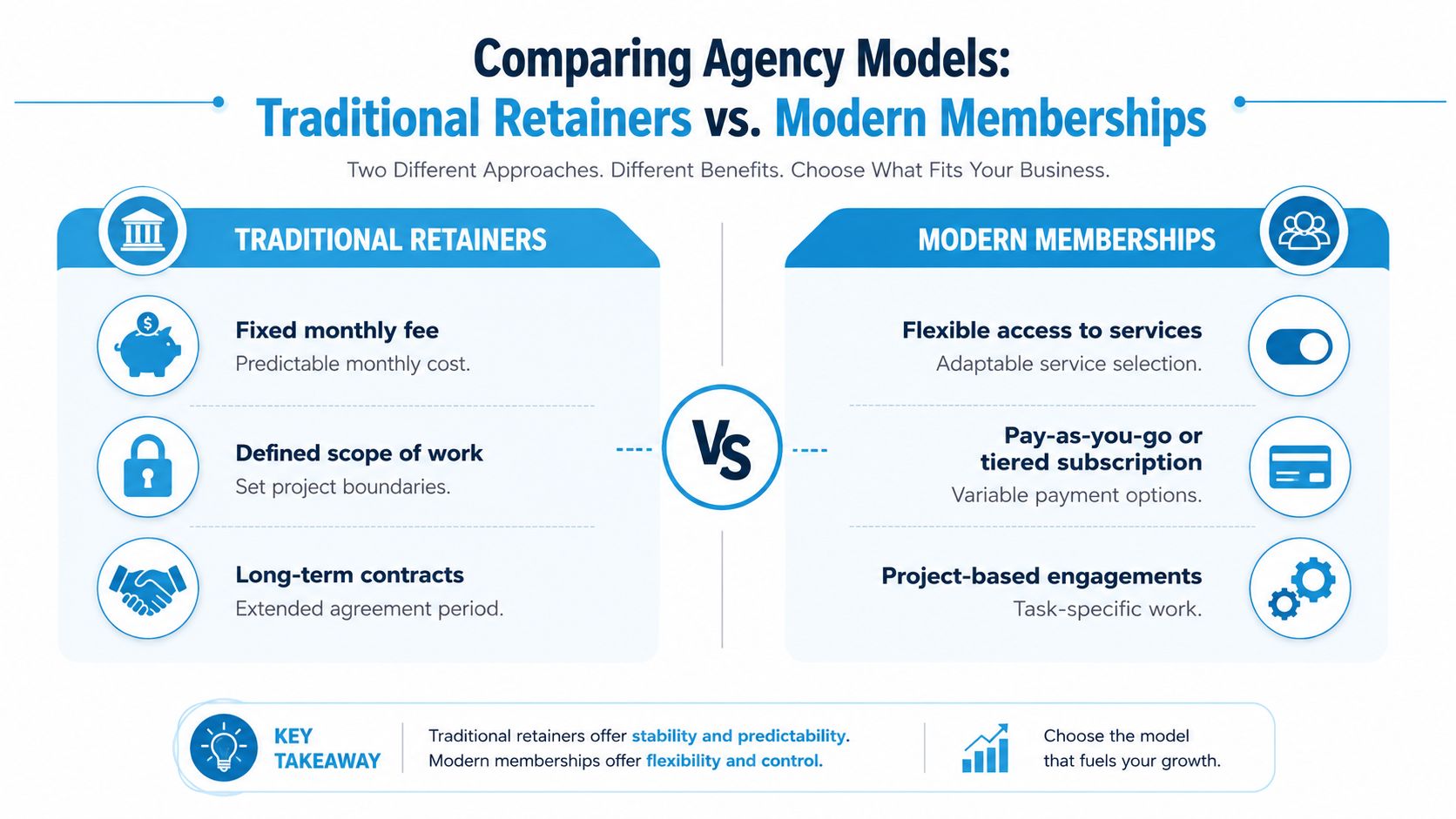
Traditional retainers usually work like this. You pay a fixed monthly fee, agree to a predefined scope, and commit for a longer period. That model can work well if your business has stable demand, clear priorities, and enough budget to support a broader engagement.
The downside is rigidity. If your priorities change next month, the agency may need a change order, a revised scope, or more billable time before anything shifts.
Membership or fractional models are built differently. They're designed for businesses that need access to a team without hiring full-time specialists or locking into a heavy retainer. That can be a better fit when your needs change month to month, your internal team needs overflow support, or you want projects to start quickly instead of waiting through a long onboarding cycle.
The market often underserves small accounts. A major underserved angle is the economics of service for SMBs. Industry analysis reveals that most providers fail to evaluate the economics of serving each segment, which results in a one-size-fits-all approach that inefficiently allocates resources and can lead to poor service for smaller accounts, according to Bain on the underserved small business market.
Agency Engagement Models Compared
| Attribute | Traditional Retainer Agency | Fractional/Membership Model (e.g., SharedTEAMS) |
|---|---|---|
| Commitment style | Longer-term agreement with fixed scope | Month-to-month or flexible engagement structure |
| Budget behavior | Predictable monthly fee, but less adaptable when priorities change | More flexible billing tied to projects, capacity, or tiered access |
| Best fit | Businesses with stable campaigns and a defined roadmap | Businesses that need changing support across channels and projects |
| Team access | Often filtered through an account manager and scoped deliverables | Broader access to cross-functional help as needs shift |
| Speed to start | Often slower due to onboarding and planning layers | Better suited for fast-moving execution and overflow support |
| Scope changes | Can require revisions or added fees | Usually easier to re-prioritize work within the model |
| Operational feel | Vendor relationship | Fractional team extension |
A few examples make the difference easier to see:
- A founder-led business launching a new service: A membership model often fits better because the work may jump from messaging to landing pages to paid testing within a short period.
- A company with a marketing manager but no bench strength: Fractional support works well when the internal lead needs designers, paid media help, content production, or web support without adding headcount.
- A business with stable spend and predictable campaigns: A retainer can work if the scope is clear and the agency has a strong process for execution and reporting.
One more operational point matters. High-performing agencies usually keep their utilization rate in the 70% to 85% range, with lower than 65% often signaling profitability issues, according to NetSuite's overview of marketing agency KPIs. You don't need to ask a provider for its exact utilization math, but you should pay attention to symptoms. Slow replies, constant handoffs, and delayed launches often mean the operating model is broken.
Common Service Bundles and Potential Outcomes
Buying isolated services is usually a mistake. Small businesses get better results when work is organized around a business objective.
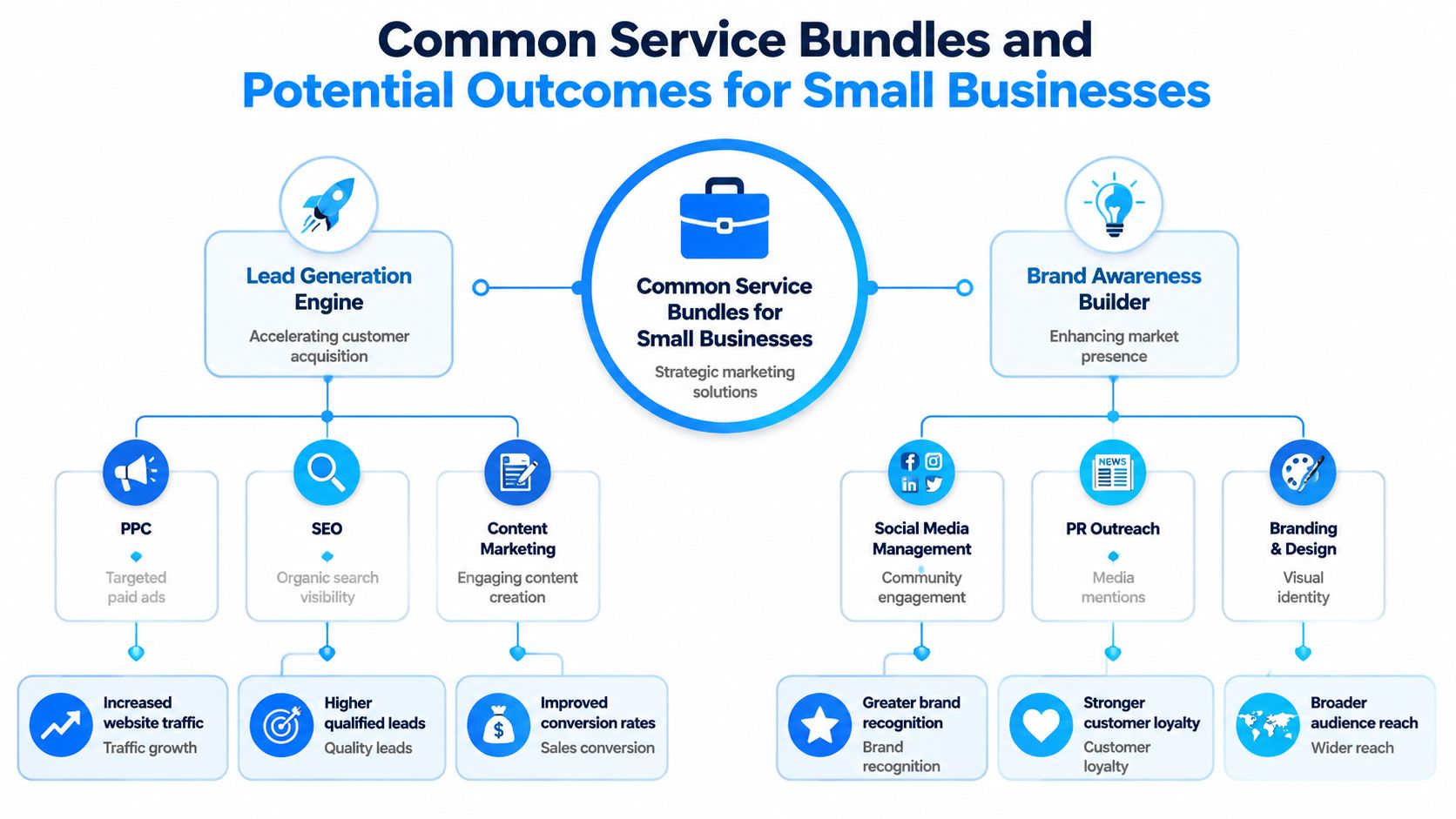
That's why service bundles matter. They force everyone to think in systems. Ads need landing pages. Content needs distribution. Brand work needs usable messaging and design standards. Otherwise, you get disconnected deliverables that look productive and don't change much.
Lead generation engine
This bundle usually includes paid search, SEO, landing pages, offer development, and follow-up content. The point isn't “doing PPC” or “publishing blogs.” The point is building a repeatable path from search intent to qualified inquiry.
This type of bundle is especially useful if you already know there's demand and need a cleaner acquisition system.
Potential outcomes include:
- More qualified inbound leads: Better alignment between search intent, ad copy, and landing page messaging.
- Lower acquisition friction: Cleaner forms, stronger offers, and better page structure can support stronger conversion performance.
- Faster learning cycles: Teams can test offers, headlines, and audiences instead of waiting months to make changes.
Modern agencies also execute this work differently than they did a few years ago. Approximately 67% of small businesses are already using AI for content marketing or SEO, according to Thrive Themes' roundup of small business marketing statistics. That matters because AI isn't replacing strategy. It's helping teams produce drafts, variations, optimization ideas, and campaign assets faster, which can support quicker iteration when an expert is still driving the decisions.
If you're comparing scopes, it helps to review project estimates for common marketing work so you can judge whether a proposal matches the amount of real execution involved.
Brand foundation and awareness bundle
Some businesses don't have a lead problem first. They have a clarity problem.
In that case, the right bundle may center on messaging, website structure, core pages, visual identity, social media planning, and content standards. The business outcome is a clearer market position and more consistent buyer experience across channels.
Owner mindset: If people reach your site and still don't understand what you do, buying more traffic won't solve the real issue.
This bundle often supports:
- Stronger positioning: Customers understand who you serve and why you're different.
- Better conversion readiness: Sales pages, service pages, and supporting content become easier to trust.
- More consistent execution: Designers, writers, and ad managers stop inventing the brand from scratch every week.
The practical takeaway is simple. Don't ask an agency what services it offers first. Ask what bundle of work will move your actual business problem.
A Practical Framework for Choosing Your Marketing Partner
A long service list doesn't tell you much. Process does.
If you want to choose a marketing agency for small business without wasting months, judge providers on fit, operating discipline, and business relevance. Most bad agency decisions happen because owners buy confidence instead of clarity.
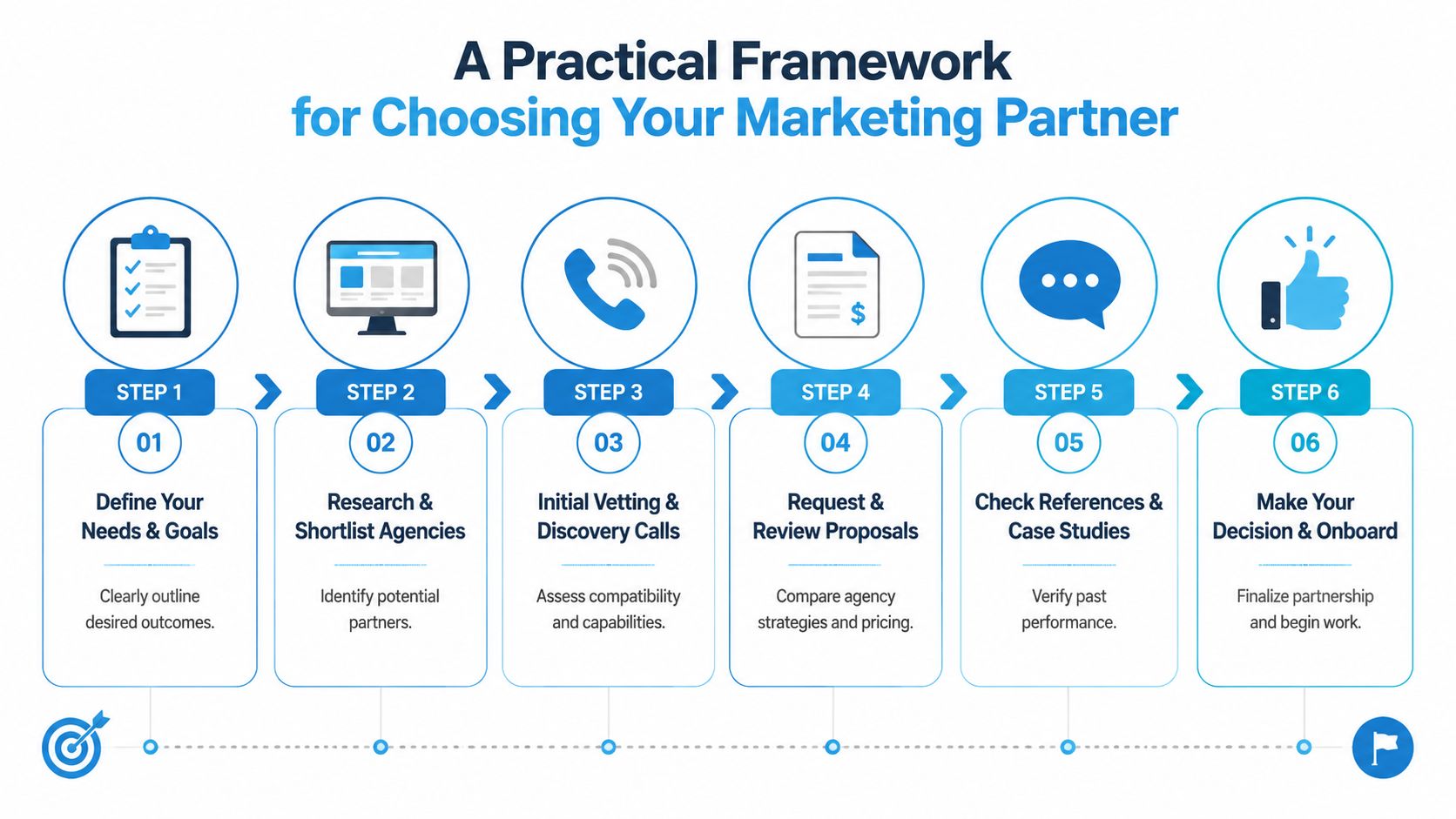
A visual framework helps when you're comparing options.
Start with your business constraints
Before you evaluate any agency, define three things internally.
First, decide what problem you need solved now. Not eventually. Now. Lead flow, positioning, campaign execution, website conversion, or internal capacity are different problems and they need different solutions.
Second, define your constraints. Budget matters, but so do response speed, approval bottlenecks, internal resources, and who will own the relationship on your side.
Third, decide how involved you want to be. Some owners want a thought partner. Others want a team that can run with approved priorities and reduce decision fatigue.
A short internal checklist helps:
- Primary goal: What business outcome matters most over the next stretch of work?
- Internal capacity: Who can review, approve, provide feedback, and supply source material?
- Buying preference: Do you need flexible project support or an ongoing fixed-scope arrangement?
Judge the process, not the pitch
A serious agency should be able to explain how work moves from intake to launch to refinement. If they can't describe that clearly, expect confusion later.
Look for process signals such as:
- Structured onboarding: You should hear a clear explanation of discovery, setup, access, brand review, and first priorities.
- Transparent scoping: Good partners define what's included, what isn't, and how changes are handled.
- Reporting tied to decisions: Reports should lead to next actions, not just summarize activity.
- Ownership clarity: You should know who handles strategy, project management, creative review, and optimization.
For example, SharedTEAMS provides a managed marketing team: an accountable Marketing Director, a network of specialists and an AI-enabled production engine, working through one platform so clients can see every project. That model fits companies that want strategic help plus on-demand execution without a long retainer. It won't fit every business, but it's a good example of how the operating model should be explicit.
Use the meeting to test how they think
A discovery call isn't just for them to qualify you. It's for you to test whether they think like operators or vendors.
Watch for these differences:
| What you hear | What it usually means |
|---|---|
| “We offer SEO, PPC, social, and web design.” | They're leading with services, not diagnosis. |
| “We'd want to understand your sales process, margins, and lead quality first.” | They're thinking about business outcomes. |
| “We'll send monthly reports.” | Neutral. Ask what decisions those reports support. |
| “We'll map goals to channel strategy, production needs, and optimization cadence.” | Better sign. That's operational thinking. |
A provider also needs to be realistic about speed. Traditional agency relationships don't usually move fast at the start. For an integrated campaign launched from scratch, planning to launch often takes 12 to 16 weeks, with onboarding alone typically taking two to four weeks, according to Ritner Digital's breakdown of realistic agency implementation timelines. If someone promises a full strategic buildout almost immediately, ask what's being skipped.
Here's a useful benchmark to compare against while you vet firms:
If the agency can't explain how decisions get made after the report is delivered, the report isn't doing much for you.
Your Hiring Checklist Questions Timelines and Costs
This is the part most owners need before they sign anything. You need questions that expose weak process, timelines that reset expectations, and pricing context that helps you compare proposals without guessing.
Questions worth asking before you sign
Ask direct questions. Don't worry about sounding demanding. A good agency should welcome this.
- Who will do the work? Ask whether strategy, production, and optimization are handled by senior specialists, junior staff, contractors, or a mix.
- How do you define success for an account like mine? You want business metrics and decision criteria, not vague language.
- What does onboarding look like? Listen for a real sequence, not “we'll get started right away.”
- How do scope changes work? This tells you how flexible the relationship really is.
- Who owns the accounts, creative files, and analytics setup? Ownership should stay with your business.
- What happens if results are slower than expected? Good partners talk about diagnosis and adjustment, not excuses.
Timelines you should treat as realistic
Marketing takes longer than most sales calls imply. That doesn't mean nothing happens early, but it does mean you should separate early signals from substantial outcomes.
According to Lucky Penny's guide to the first 90 days with a marketing agency, substantial results typically require 60 to 90 days for PPC, 3 to 6 months for SEO, and 6 to 9 months for content marketing.
That's one reason some small businesses prefer flexible models over long minimum commitments. They want to start with specific projects, validate fit, and build from there instead of buying a broad retainer before enough evidence exists.
What the pricing conversation should sound like
Cost is where many small businesses get misled. They compare a freelancer, a small retainer, a project quote, and a cross-functional agency proposal as if they're interchangeable. They aren't.
One useful benchmark: small-business marketing retainers in the U.S. typically land between $5,000 and $10,000 per month in 2026, with the median engagement for companies under 50 employees clustering at $5,000 to $8,000 monthly for multi-channel work, based on SearchLab's guide to marketing agency cost reality.
That doesn't mean every business should pay a retainer in that range. It means you should understand what a substantive agency engagement generally costs before judging proposals. If you want flexible access instead of a fixed monthly scope, compare that benchmark against SharedTEAMS pricing options and similar project-based or membership models.
A quick comparison lens helps:
- Traditional retainer: Better when you need steady, ongoing management within a defined scope.
- Project-based support: Better when you have a specific initiative such as a website rebuild, campaign launch, or messaging refresh.
- Membership or fractional support: Better when priorities change often and you need access to multiple skill sets without adding headcount.
Conclusion Making a Confident Decision
The right marketing agency for small business isn't the one with the longest menu of services. It's the one with an operating model that fits how your business works.
If you need stable, ongoing management with a fixed scope, a traditional retainer may fit. If you need flexibility, faster starts, and access to a broader bench without committing to a heavy agency structure, a fractional or membership model often makes more sense.
What matters most is alignment. You need a partner that can connect strategy to execution, measure the work against real business outcomes, and communicate clearly about process, priorities, and trade-offs. You also need realistic expectations. Substantial results from marketing agency engagements typically require 60 to 90 days for PPC campaigns, 3 to 6 months for SEO efforts, and 6 to 9 months of consistent work for content marketing to generate significant returns, as noted earlier in Lucky Penny's timeline guide.
Use the framework and checklist in this article to audit your current setup before you hire anyone. If you can clearly define your problem, your constraints, and the kind of partnership you want, you'll make a far better decision.
If you want a practical next step, review how SharedTEAMS structures its managed marketing team, compare it against your current needs, and decide whether you need a retainer, a project partner, or a managed team.