Most advice on testing and optimization starts too low in the funnel. It tells you to test button colors, swap headlines, or try a new image. Those things matter, but they don't fix a broken market position, a weak audience definition, or an offer that doesn't match buyer intent.
That's why many teams stay busy without getting meaningfully better results. They run tests, collect dashboards, and still watch acquisition costs climb. A stronger approach treats optimization as a business system. You validate the market first, sharpen the persona second, and refine creative third. Once that order is clear, testing becomes less random and far more useful.
Table of Contents
- The Foundation of Marketing Optimization
- Building a Repeatable Experiment Framework
- Channel-Specific Testing and Optimization Tactics
- Essential Tools and Analytics for Measurement
- Common Optimization Pitfalls and How to Avoid Them
- Operationalizing Rapid Iteration for SMBs
The Foundation of Marketing Optimization
The biggest mistake in testing and optimization is assuming that all tests are equal. They aren't. A copy tweak on a landing page doesn't carry the same business impact as a market shift, a persona correction, or a new value proposition.
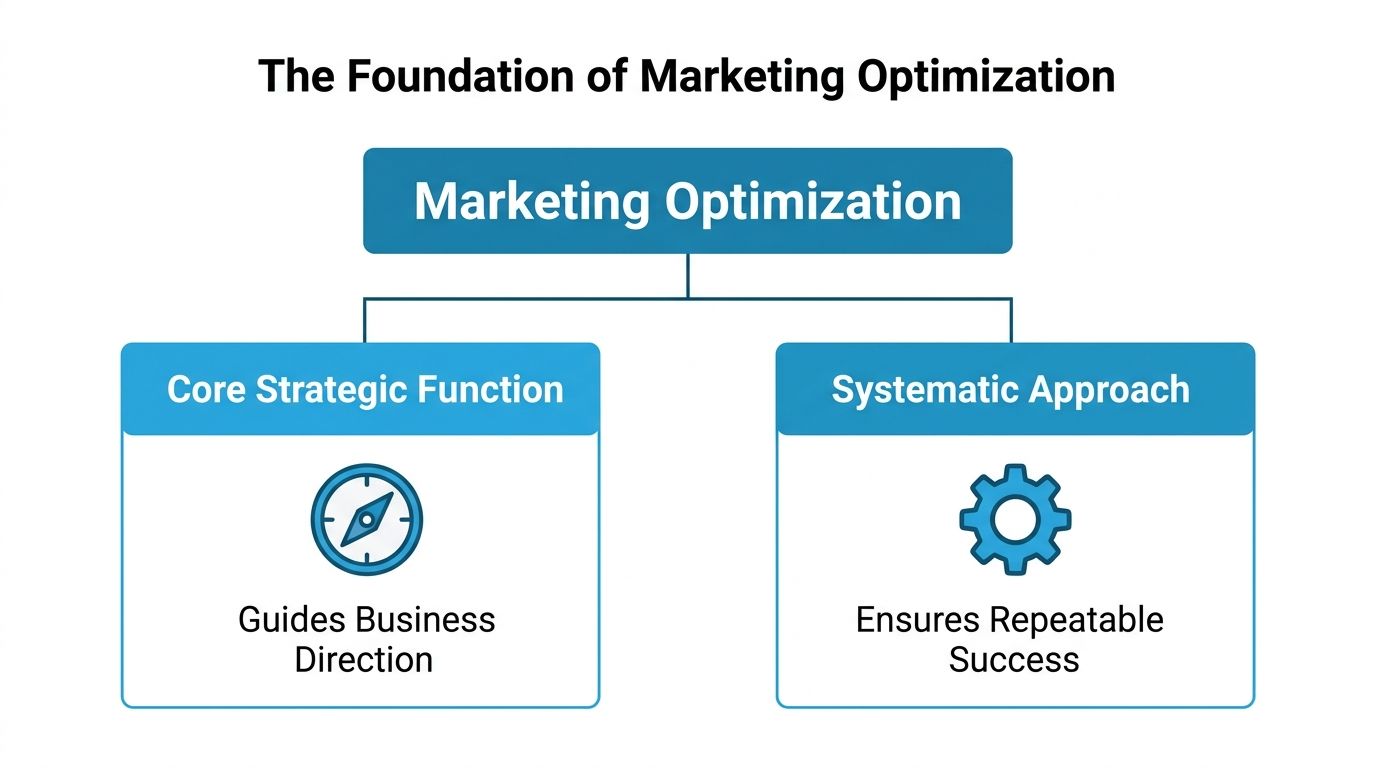
A useful framework starts with hierarchy. Market comes first. Persona comes second. Creative comes third. That order matters because creative can only amplify what's already strategically sound. If the wrong audience sees the ad, or the offer solves the wrong problem, a better headline won't save the campaign.
According to Peter Quadrel's analysis of testing hierarchy errors, most brands waste optimization resources by obsessively testing creative angles while ignoring foundational failures in market segment and persona validation, and 99% of brands skip the first two critical levels.
Start with the right layer
Here's what that hierarchy looks like in practice.
- Market validation: Are you targeting the right segment at all? A regional service business, B2B SaaS company, and ecommerce brand may all use paid media, but they don't win with the same offer structure or buyer journey.
- Persona validation: Within the right market, are you speaking to the right decision-maker, user, or influencer? Many campaigns underperform because the message is written for a generic audience instead of a defined buyer.
- Creative optimization: Only after the first two layers are stable does it make sense to test images, CTA language, layout, or ad formats.
This is why a lot of tactical CRO work disappoints leadership. The team improves click-through rate, but pipeline quality stays flat. Or form completion rises, but the leads don't convert to revenue. The test may have worked. The strategy underneath it didn't.
Practical rule: If performance is stagnant, test audience and offer assumptions before you test aesthetics.
A common example is lead generation. Teams often debate form length before they've clarified who the form is for and what commitment level is appropriate. Tactical work still matters, but only after the strategic layer is sound. If you're working through that problem in SaaS, this guide on optimizing lead forms for B2B SaaS is a useful reference because it connects form decisions to buyer intent instead of treating them as isolated design tweaks.
Optimization is a management discipline
Strong optimization programs don't run on opinions. They run on decision quality. The point isn't to produce more tests. The point is to make better calls about where to invest budget, what to change next, and when to stop pushing a weak concept.
That changes how leaders should evaluate performance. Instead of asking, "What should we test this week?" ask:
| Question | Why it matters |
|---|---|
| Are we in the right segment? | A flawed segment makes every downstream metric harder to interpret. |
| Are we addressing a real buyer problem? | Messaging only works when it maps to actual demand. |
| Is the offer aligned with intent? | A top-of-funnel audience won't respond like a bottom-of-funnel buyer. |
| Are creative tests happening too early? | Minor refinements can hide larger strategic failures. |
A mature testing and optimization process becomes a repeatable operating system. It reduces wasted spend, sharpens prioritization, and gives teams a cleaner path from insight to action.
Building a Repeatable Experiment Framework
Once the testing hierarchy is clear, the next issue is execution. Many teams say they test, but what they do is publish a change, wait a few days, and call the result a win or loss. That isn't an experiment. It's a guess with a dashboard attached.
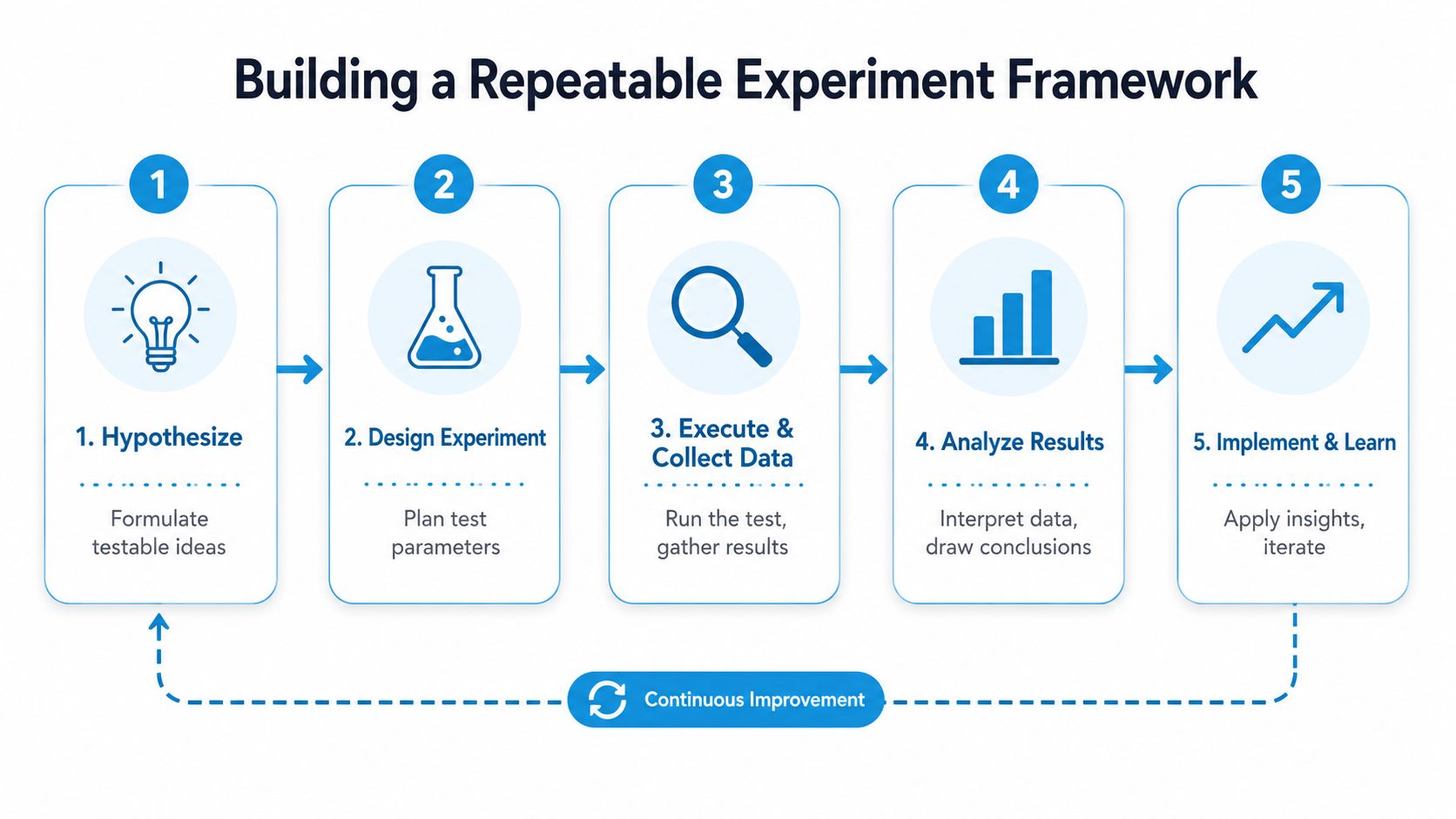
A more reliable process is simple. Start with a hypothesis, define the metric, protect the sample, and read the result carefully. That discipline is what makes testing useful.
Four decisions that make a test trustworthy
1. Write a clear hypothesis
A hypothesis should connect a change to an expected business outcome. Not "test new hero section." Better is: changing the CTA from general education to a more specific value offer may improve form submissions because it reduces ambiguity.
That structure forces the team to explain why the test deserves attention. It also makes post-test analysis easier. You aren't just comparing versions. You're validating or rejecting a business assumption.
2. Define success before launch
The KPI has to be chosen before traffic hits the experiment. In marketing, common measures include conversion rate, click-through rate, bounce rate, and revenue. In performance testing more broadly, teams define KPIs like response time, throughput, and resource utilization first because without a benchmark, they can't compare improvement against the original problem, as explained in Abstracta's guidance on benchmark software testing.
That logic applies to marketing too. If a landing page test is really about qualified lead generation, don't let the team declare victory based on clicks alone.
3. Use enough data to trust the outcome
A/B testing works because users are randomly assigned to control and variation, which helps isolate the effect of the change when the sample is large enough to support a sound read, as outlined in this A/B testing guide for marketing analytics. That same source notes that A/B testing can improve engagement and conversion rates by 10% to 30% or higher, depending on the element tested and the audience.
The important part for operators is practical, not mathematical. If the test hasn't gathered enough real traffic or conversions, the result is unstable. Early movement is not the same as a dependable pattern.
A helpful companion to this process is automating ad copy for Meta Ads conversion, especially when your team needs to generate structured variants quickly without improvising every new message by hand.
What statistical significance means in practice
Statistical significance gets overcomplicated. For most business leaders, it means one thing. Do we have enough evidence to believe this change caused the result, rather than random variation?
A clean experiment protects you from making expensive decisions based on noise.
That's why timing matters. Don't stop the test because one version looks better after a short run. Don't edit the page halfway through. Don't swap audiences or budgets midstream and then pretend the data is comparable.
This is also where agile planning helps. A team that works in short, structured cycles can test without turning every result into an emergency. The article on adaptive strategy and agile marketing frameworks offers a practical way to think about this operating rhythm.
Later in the process, use a simple five-step loop: hypothesize, design, execute, analyze, implement. Most organizations don't need more sophistication than that. They need consistency.
For a quick visual walkthrough, this video covers the basics in a practical format:
Channel-Specific Testing and Optimization Tactics
Once a team has a repeatable framework, channel testing becomes easier to manage. The principles stay the same, but the variables change. Paid search has different levers than email. Landing pages have different constraints than social campaigns.
That's where many optimization programs improve. They stop treating every channel as if it should be tested the same way.

PPC and paid search
A paid search account usually reveals problems faster than other channels because the feedback loop is tight. Ad copy, keyword intent, landing page alignment, and offer clarity all show up in performance quickly.
For Google Ads, WordStream's 2025 Google Ads benchmarks report an average CTR of 6.66% and an average conversion rate of 7.52%. Those benchmarks don't tell you what your account should do, but they do give you context. If CTR is healthy and conversions lag, the issue may sit on the landing page. If CTR is weak, start with the ad and audience match.
A practical PPC testing sequence looks like this:
- Begin with intent match: Test whether the keyword, ad promise, and landing page headline describe the same problem.
- Then test message angle: Compare a pain-point headline against a value-driven headline.
- Only after that test the asset details: CTA wording, sitelinks, form position, or page layout.
One useful pattern is to separate signal from polish. First validate the offer. Then refine the expression of the offer. Teams that skip this step often keep rewriting ads for a landing page that never had the right promise.
If your media team is evaluating automation in buying and bid strategy, this piece on AI media buying and predictive algorithms replacing manual optimization is worth reviewing because it frames where automation helps and where human judgment still matters.
Landing pages and UX
Landing page testing often gets reduced to cosmetic changes. In practice, the most important variables usually involve friction, trust, and relevance.
For B2B sites, Blueprint Digital's benchmark reference for B2B conversion performance states that the industry average website conversion rate is 2.9%, while high-performing B2B companies often exceed 5%. That makes landing page work easier to prioritize. If you're below that average, don't start by obsessing over button shape. Check whether the page clearly describes the offer, the audience, and the next step.
Useful hypotheses include:
| Variable to test | Strong hypothesis example | KPI to watch |
|---|---|---|
| Form length | Reducing unnecessary fields may improve completion rate if buyers view the offer as low commitment | Conversion rate |
| CTA placement | Moving the CTA higher may improve action rate when visitors already know what they want | Click-through rate and conversions |
| Page messaging | Rewriting the headline to match ad intent may reduce bounce and improve qualified inquiries | Bounce rate and lead quality |
| Trust elements | Adding proof points may help cautious buyers complete the form | Conversion rate |
Fix friction first. Visual polish should support clarity, not substitute for it.
Email marketing
Email testing is useful because it forces message discipline. You don't have much room, so every variable matters. Subject line, preview text, offer framing, and send timing all deserve attention, but not all at once.
Start with the most impactful question. If opens are weak, test subject line framing before send time. If opens are fine and clicks lag, test the body structure and CTA. If clicks are strong but conversions are poor, the core issue may sit on the destination page.
A sound email hypothesis might be: a more specific subject line will improve open quality because the audience can quickly assess relevance. Another could be: a shorter email with one primary CTA may improve click behavior because it reduces choice overload.
Social media
Social testing often goes wrong because teams focus entirely on creative output. More videos. More hooks. More edits. But social performance still depends on the strategic hierarchy discussed earlier. Audience, message, and offer have to be right before creative iteration pays off.
In practice, test social in layers:
- Audience segment first: Which buyer group responds at all?
- Message second: Which promise or pain point earns attention?
- Format third: Video, static, carousel, or user-generated style content.
This sequence matters even more as teams use AI-assisted production. Speed helps, but only if the team is generating variants around the right strategic assumption.
Essential Tools and Analytics for Measurement
Testing and optimization falls apart when the team can't tell what changed, why it changed, or whether the result matters. The right tool stack solves those three problems. It doesn't need to be complex, but it does need to be connected.
Analytics tools that define the scoreboard
Every program needs a core analytics layer. Typically, this entails a platform such as Google Analytics paired with ad platform reporting and CRM data. This layer answers the basic questions: where traffic came from, what users did, and whether the visit led to a meaningful business action.
The mistake is relying on a single dashboard. Ad platforms are good at reporting in-platform actions. They're not enough for judging the full customer journey. The CRM tells you whether leads were qualified. Web analytics tells you what happened before the form fill. You need both.
Behavior tools that explain the why
Analytics tells you what happened. Behavior tools help explain why. Heatmaps, scroll maps, session recordings, on-page surveys, and form analytics can reveal where users hesitate, what they ignore, and where friction appears.
Such insights lead to better hypotheses. If users repeatedly abandon a form at the same field, you have a stronger test idea than "try a new headline." If recordings show that visitors never reach the CTA, layout becomes a valid issue to test.
When the team can't explain user behavior, it usually starts testing symptoms instead of causes.
Testing platforms that execute the change
A testing platform handles controlled delivery. It serves one version to one group and another version to a comparable group, then tracks the result against the selected KPI. That's different from manually changing a page and comparing one week to another.
The strongest setups create a loop:
- Analytics surfaces a performance issue.
- Behavior tools reveal likely friction or confusion.
- The testing platform runs a controlled experiment.
- CRM and revenue data confirm whether the win was valuable.
That stack keeps optimization grounded. Without it, teams produce activity. With it, they produce learning.
Common Optimization Pitfalls and How to Avoid Them
Most failed testing programs don't fail because the team lacks ideas. They fail because the process creates false confidence. The dashboard looks active, the team feels productive, and the business still doesn't learn what drives growth.
When teams test the wrong thing
A common error is jumping straight to low-impact variables. Teams test copy variants, visual treatments, and CTA language before checking whether the segment, persona, and offer are right. That creates motion without strategic progress.
Another issue is testing too many variables at once without enough structure. Multivariate work has value in the right environment, but many SMB teams use it as a shortcut. They change headline, image, form, and page layout at the same time, then can't tell which factor influenced the result.
The practical fix is restraint. Keep the hypothesis narrow. Change one meaningful thing at a time when you need a clean causal read. Use broader tests only when the traffic volume, measurement discipline, and analytical capacity support it.
The best test isn't the most creative one. It's the one that produces a decision you can trust.
When data looks clean but the decision is wrong
The harder pitfall is mistaking correlation for causation. A campaign improves during a promotion period. Traffic rises during a seasonal spike. Leads fall during an economic slowdown. Standard A/B testing can miss those outside forces.
As noted in LimeSurvey's discussion of ad testing and causal analysis, standard A/B testing often fails to isolate true marketing impact from external factors like seasonality or economic conditions, and few teams use geo-lift studies or causal impact analysis to compare observed results against a constructed control.
That matters because many marketing decisions happen in noisy conditions. If the team ignores the environment around the test, it can optimize for the wrong conclusion.
Use this checklist when results look promising but uncertain:
- Check context: Was there a promotion, pricing change, market event, or seasonal factor influencing demand?
- Check audience consistency: Did traffic quality stay comparable across the test?
- Check downstream value: Did better top-of-funnel metrics produce better sales outcomes?
- Check qualitative inputs: Did sales calls, support feedback, or session recordings confirm the same story?
Another common failure is stopping early. Teams see a short burst of positive movement and end the test before the result stabilizes. Others keep a weak test running because they don't want to admit the hypothesis was poor. Both mistakes waste time.
Good operators treat inconclusive data as useful. It tells you the change didn't create enough signal, the metric wasn't the right one, or the hypothesis wasn't strong enough. That's still progress.
Operationalizing Rapid Iteration for SMBs
SMBs usually don't struggle with the idea of testing and optimization. They struggle with capacity. The founder is juggling sales. The marketing manager is covering five channels. The designer is already overloaded. So the team talks about experimentation, but the work happens sporadically.
That doesn't mean SMBs need an enterprise testing department. It means they need a lighter operating model.
Use a sprint model, not an endless backlog
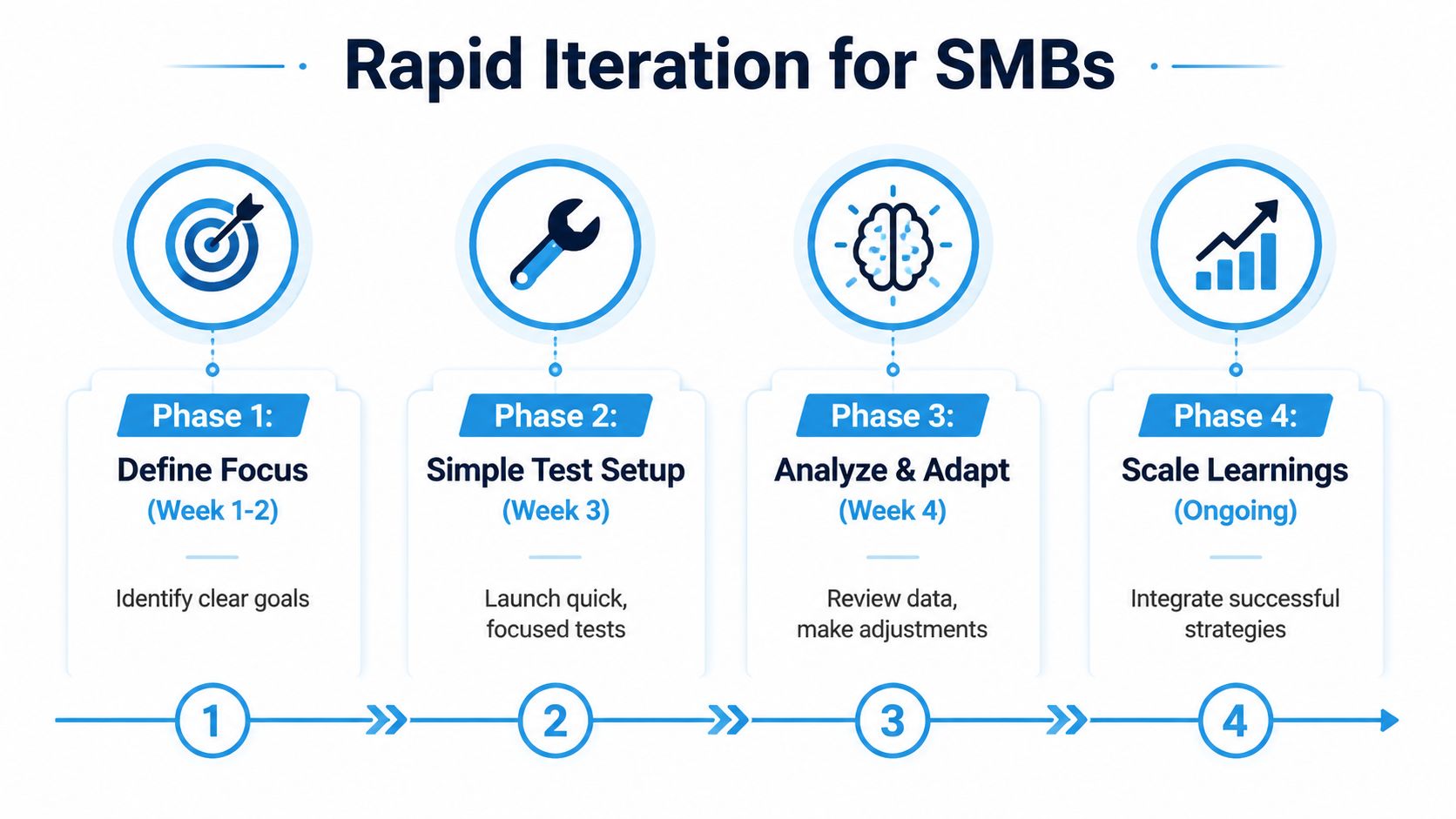
A useful structure is sprint-based testing. According to 25Madison's framework for sprint-based digital ad tests, these programs typically run as 6 to 8-week campaigns and isolate advertising variables through multivariate tests in two-week intervals to identify stronger combinations of audience, value proposition, and creative.
That structure works well for SMBs because it forces prioritization. Instead of carrying a bloated list of ideas, the team focuses on a small set of high-impact questions for a fixed period.
A sprint can be built around a sequence like this:
- Week range one: Validate the audience or segment.
- Next interval: Test message and offer fit within that audience.
- Final interval: Refine creative or landing page execution once the strategic signal is clearer.
This is also where AI-enabled workflows become practical. Use them to speed up variant production, summarize results, and organize patterns. Don't use them to flood channels with endless unstructured tests.
Build a lean operating rhythm
A lean optimization rhythm for an SMB usually needs five habits:
- One owner for prioritization so the backlog doesn't turn into a wish list.
- A fixed review cadence for results, decisions, and next tests.
- Tight KPI selection so each test has a primary success measure.
- Fast production support for ad variants, landing page edits, and reporting.
- Documented learning so the team doesn't repeat the same failed ideas.
For many small businesses, the missing piece isn't software. It's coordinated execution. That includes strategy, creative, analytics, and implementation moving on the same timeline.
If you're trying to increase that execution speed without adding full-time headcount, a practical starting point is this AI guidebook for small businesses, which helps frame where automation can support process discipline rather than replace it.
A working optimization system should feel manageable. It should tell the team what to test, when to test it, how to read the result, and what to do next. If it feels chaotic, the process needs simplification.
If your team needs help turning testing and optimization into a repeatable operating system, SharedTEAMS offers a practical next step. Their fractional model gives SMBs access to strategy, execution, and AI-enabled production support without building a full in-house department. A good place to start is a review of your current campaigns, funnel bottlenecks, and testing cadence so you can identify where better structure would improve ROI.