You're probably dealing with a familiar problem. The website is live, your business shows up somewhere on Google, and you know SEO matters. But between running the business, answering leads, managing staff, and handling day-to-day issues, SEO keeps getting pushed into the “important but not urgent” pile.
That's why most small business SEO plans fail. Not because the owner picked the wrong keyword. Because execution breaks down. A workable SEO strategy for small business has to fit limited time, limited staff, and uneven attention. It has to focus on the few actions that improve visibility, trust, and lead quality without turning into a part-time job you didn't ask for.
The good news is that you don't need to do everything at once. You need a baseline, a practical keyword plan, a clean website structure, a local search process, and a realistic way to keep the work moving for the next 90 days.
Table of Contents
- Your Starting Point A 5-Minute SEO Health Check
- Finding Your Keywords and Planning Content
- Mastering On-Page and Technical SEO Basics
- Winning Locally A Focused Local SEO Playbook
- Your First 90 Days An Actionable SEO Roadmap
- Bridging the Execution Gap Resourcing Your SEO
Your Starting Point A 5-Minute SEO Health Check
A small business owner usually notices SEO problems the same way customers do. The phone is quieter than it should be. A search for the business shows an old page, incomplete profile details, or a competitor taking the click.
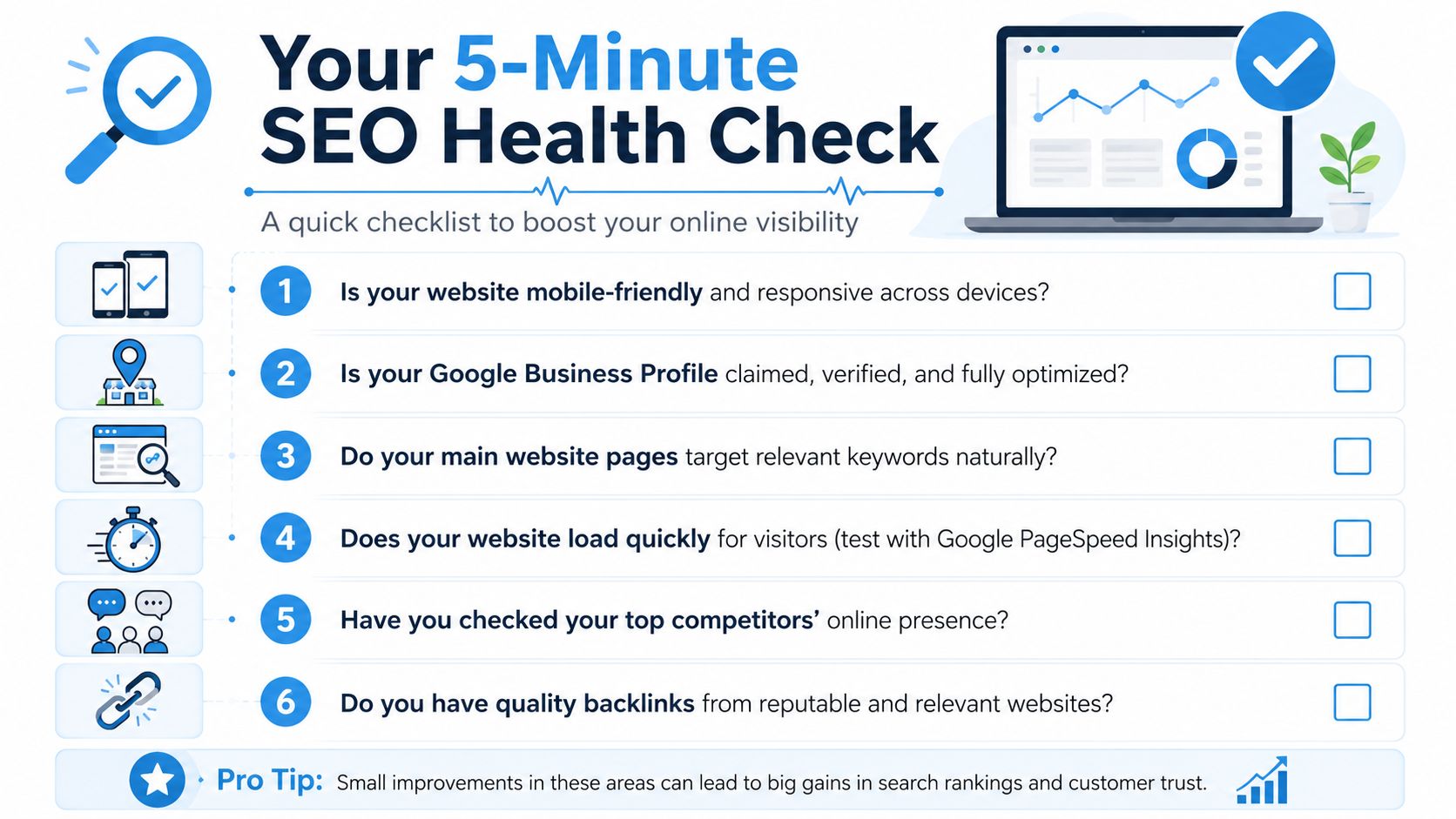
That is why the first step is not a full audit. It is a fast reality check. In five minutes, you can see whether your site and local presence are clear enough to support sales, or whether basic issues are blocking results before strategy even has a chance to work.
Check whether Google can find you
Start with Google, not your CMS.
Search for your business name. Then search for your main service and city. Open the results the way a customer would, on your phone if possible. You are checking for basic visibility and message match. If Google surfaces the wrong page, an outdated title, or thin information, that problem will drag down every later SEO effort.
Also test a few core pages directly. Look at the homepage, top service page, and contact page. The question is simple: does Google have a clear version of this business to show someone who is ready to call?
Use this checklist:
- Search your brand name: Your website and Google Business Profile should appear quickly.
- Search your main service plus location: This shows whether you are even in the local consideration set.
- Check page titles in results: Titles should describe the service and location clearly, not repeat generic wording.
- Visit the contact page: Confirm the phone number, address, hours, and form all work.
- Open the site on your phone: If the page is hard to read or tap, you have a conversion problem as much as an SEO problem.
Practical rule: If a customer cannot tell who you help, what you offer, and how to contact you within a few seconds, fix clarity before you spend time on advanced SEO tasks.
Review what a customer sees first
Your homepage has one job at this stage. It needs to confirm that the visitor is in the right place.
Many small business sites miss that test. They open with vague taglines, stock imagery, or a general statement that could fit ten competitors. A stronger homepage names the service, mentions the area served, and gives a clear next step such as call, request a quote, or book a consultation.
A quick review table keeps this simple:
| Checkpoint | What good looks like |
|---|---|
| Homepage headline | States the core service clearly |
| Navigation | Makes service pages easy to find |
| Contact options | Phone, form, and location details are visible |
| Mobile experience | Text, menus, and buttons work cleanly |
| Trust signals | Reviews, photos, certifications, or FAQs are present |
If you are short on time, start there. Small businesses do not usually lose SEO because of one complex technical issue. They lose it because the basics are unclear, outdated, or never consistently maintained. That execution gap matters, especially when nobody on the team owns SEO week to week.
Look at your Google Business Profile
For many local businesses, this profile drives more real leads than the website homepage. Google's own Business Profile guidance explains that owners should keep key business details accurate and complete so customers can find and contact them.
Open your profile and check the basics. Is it claimed and verified? Are your primary category, hours, phone number, services, and photos current? Do the business name, address, and phone number match your website exactly?
One more check helps here. Look at the questions customers ask most often, then compare that language to your profile and site copy. If you need a faster way to spot the terms people use, this guide to finding hidden search opportunities with smarter AI keyword research is a useful shortcut.
This health check gives you a baseline you can act on. It also shows whether you can handle the cleanup internally or whether you need on-demand support to keep the work moving. For a lot of small businesses, that is the bottleneck. The issue is not knowing what SEO is. It is making sure the right fixes get done.
Finding Your Keywords and Planning Content
A strong SEO strategy for small business starts with search intent, not brainstorming in a vacuum. You need to know what potential customers type when they're ready to buy, what they search when comparing providers, and what they ask when they're still learning.
Separate buying intent from research intent
Start with your services. Write down the direct phrases a customer would use if they were looking for help today. Those are your commercial terms. Then list the questions customers ask before they contact you. Those are your informational terms.
The distinction matters because these terms belong on different page types. Commercial terms usually fit service pages, location pages, and high-intent landing pages. Informational terms fit blog posts, FAQs, and resource pages.
Small businesses should identify and validate 20–50 keywords related to their products or services, then assign one primary keyphrase per page to avoid keyword cannibalization and ensure each page targets a distinct search intent, as outlined in Semrush's small business SEO guidance.
That means one page should target one primary idea. Don't ask a single page to rank for three unrelated services. Don't create multiple pages competing for the same term either. That confuses both search engines and your own content plan.
A practical split looks like this:
- Commercial pages: “family lawyer Austin,” “roof repair company near me,” “managed IT services for small business”
- Informational pages: “how long does roof repair take,” “when to hire a family lawyer,” “what's included in managed IT support”
Build a simple content map
Once you have your keyword list, map it to the site you already have. This doesn't need special software. A spreadsheet works.
Use three columns:
| Page type | Primary keyphrase | Purpose |
|---|---|---|
| Homepage | Brand + broad service | Brand clarity and navigation |
| Service page | One core service phrase | Lead generation |
| Location page | Service + city | Local relevance |
| Blog post | Informational question | Trust and supporting relevance |
The biggest mistake here is overproduction without structure. Owners publish random blog posts that never support a service page. Or they keep rewriting the homepage instead of building clear service depth.
The best content plan is usually smaller than people expect. Fewer pages, better mapped to intent, almost always beats a pile of unfocused articles.
If you want a sharper process for uncovering overlooked search terms, this guide to smarter keyword research with AI and hidden search opportunities is worth reviewing.
At this stage, you're not chasing every possible term. You're building a page map that matches how customers search and how your business makes money.
Mastering On-Page and Technical SEO Basics
A small business site can have the right services, the right keywords, and still underperform because the pages are inconsistent. I see this often. The homepage promises one thing, the service page targets another term, the title tag is generic, and the contact path is harder than it should be. Google gets mixed signals. So do buyers.
On-page SEO and technical SEO work best as a quality-control system. Each page needs one clear job. The title tag introduces the topic. The H1 confirms it. The copy answers the searcher's question. Internal links connect that page to supporting pages. The layout makes the next step obvious.
That sounds simple because it is. The hard part is doing it consistently across a real site when you are also running the business.
A lot of owners get stuck here. They know the basics, but they do not have time to audit 20 pages, rewrite metadata, fix duplicate headings, check canonicals, and test mobile layouts. That execution gap matters more than theory. A smaller site with disciplined page setup usually outperforms a larger site full of half-finished SEO work.
Set a page standard before you publish more
Before adding new content, tighten the pages that already matter. Start with the homepage, core service pages, and top location pages. Those are usually the pages closest to revenue.
Check each page against five questions:
| Area | What to check |
|---|---|
| Relevance | One primary topic and search intent per page |
| Clarity | Service, audience, and next step are obvious within seconds |
| Structure | Title tag, H1, H2s, and copy support the same topic |
| Crawlability | Canonical tags, indexation settings, and sitemap are set correctly |
| Usability | Mobile layout, speed, and navigation make action easy |
Trade-offs are important. Perfect technical cleanup across the whole site is rarely the best first use of time. Fix the pages that influence leads first, then work outward.
Get the basics right on every important page
Focus on the elements that shape relevance, click-through, and crawlability:
- Title tags: Write a distinct title for each important page. Lead with the service or topic, then add location or brand if it helps.
- Meta descriptions: Use them to pre-qualify clicks. Good descriptions improve click quality even when they do not directly change rankings.
- Headers: Use one H1 per page and H2s that reflect the subtopics a visitor expects.
- Internal links: Link from service pages to FAQs, case studies, blog posts, and location pages that support the same intent.
- Canonical tags and sitemap: Set preferred URLs correctly so search engines do not waste effort on duplicates or thin variations.
Avoid outdated rules like writing to a fixed keyword density. That usually creates stiff copy. Write naturally, keep the page tightly focused, and cover the questions a buyer has.
User experience also affects whether a page does its job after the click. Slow load times, cluttered layouts, and weak mobile formatting hurt conversion and can weaken engagement signals. For a closer look at how site experience ties into rankings, read algorithmic UX and the user experience signals that influence rankings.
Technical SEO does not rescue a weak page. It helps a strong page get crawled, understood, and used.
That is the standard to use. Clean up what blocks performance. Keep the system repeatable. If no one on your team has time to maintain that standard, on-demand SEO support can be the practical fix. It closes the gap between knowing what good looks like and shipping it every month.
Winning Locally A Focused Local SEO Playbook
A local prospect searches on their phone, sees three nearby businesses, and decides in under a minute who looks credible enough to call. That is the core local SEO contest for a small business. You are not trying to win every search. You are trying to show clear signs that your business is active, trusted, and easy to choose.
Why local SEO deserves priority
Local SEO pays off faster than broad content campaigns for many service businesses because it targets buyers with immediate intent. Someone looking for a roofer, dentist, accountant, or plumber in a specific area is often close to taking action. That makes your Google Business Profile, reviews, and location relevance part of the sales process, not just an SEO task.
Reviews shape that decision quickly. BrightLocal's Local Consumer Review Survey found that consumers regularly use reviews when evaluating local businesses. The practical takeaway is simple. Review management needs a system. If you only ask occasionally or respond when someone remembers, your visibility and conversion rate both suffer.
Google also reports that businesses with photos on their Business Profile tend to receive more requests for directions and more clicks through to their websites, as noted in Google Business Profile photo guidance. Photos help people confirm that the business is real, current, and worth contacting.
Citations still matter, but they are rarely the most impactful local task once your main listings are accurate. For small teams, the better sequence is to fix the major profiles first, then spend ongoing time on reviews, profile updates, and city-specific pages that support conversion.
The local signals that move the needle
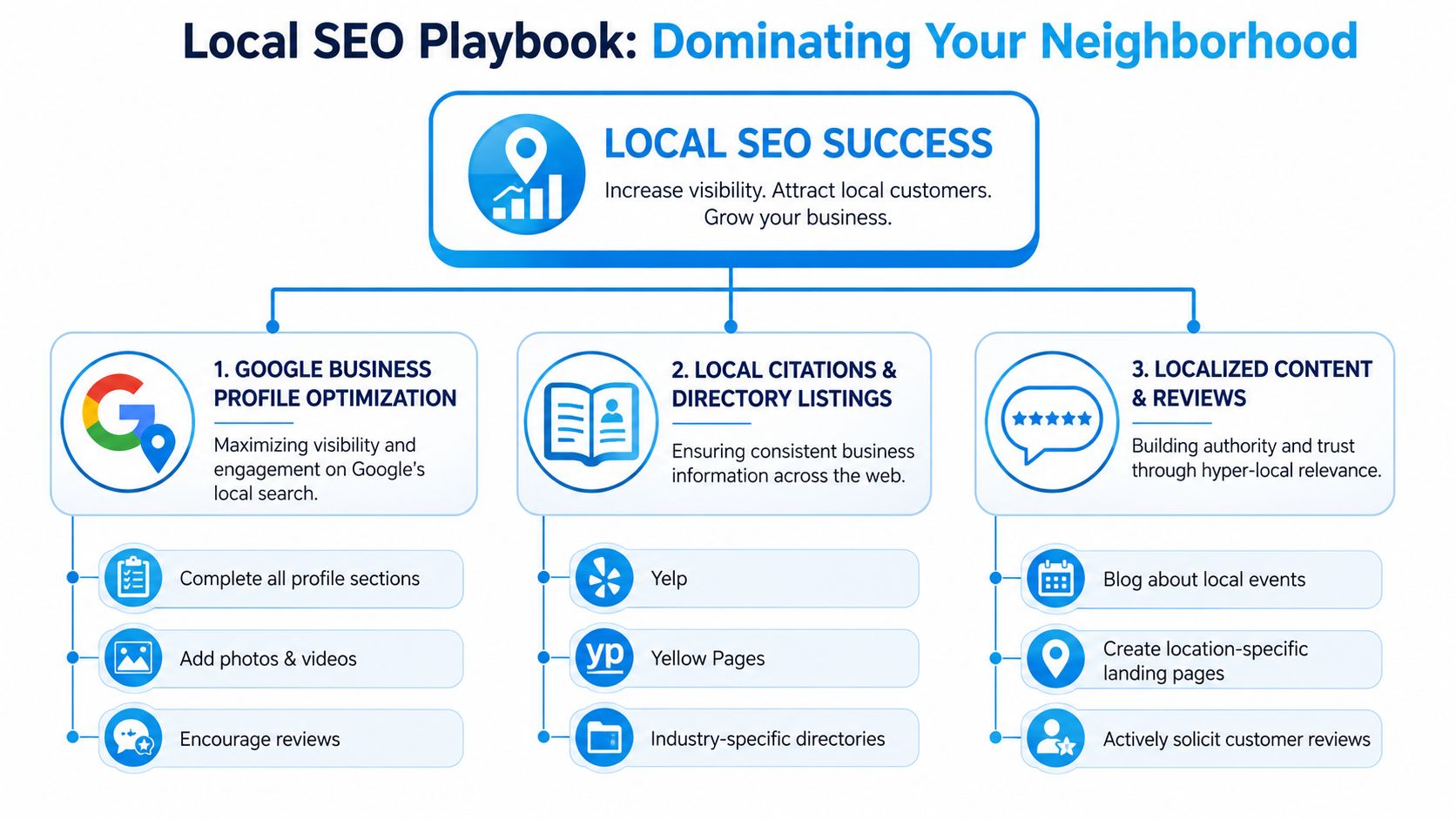
Start with your Google Business Profile. Fill in services, categories, hours, service areas, business description, and appointment options. Use current photos from real jobs, your team, and your location. Then keep it maintained. A profile that has not been touched in months often looks abandoned, even when the business is doing great work.
This video gives a useful walkthrough of the core profile and local ranking factors:
The next step is to tighten the signals around that profile so Google and potential customers see the same business everywhere.
- Primary listings: Make your business name, address, phone number, hours, and website match across Google, Apple Maps, Bing Places, Yelp, Facebook, and any industry directories that send real leads.
- Location relevance: Create separate pages for each city or service area only when you can make them distinct. Reused copy with a city name swapped in usually performs poorly and creates maintenance work.
- Review operations: Ask for reviews at a consistent point in the customer journey, usually right after a successful job or handoff. Respond to every review, especially negative ones, with specifics and a next step.
- Proof on the page: Add local project examples, neighborhood references, service area details, and FAQs based on questions buyers ask before calling.
This work is operational. That is why many owners struggle to keep it going.
The execution gap shows up here more than anywhere else in small business SEO. You know the profile needs photos, reviews need replies, listings need cleanup, and location pages need updates. The hard part is doing it every month while also running the business. That is why local SEO often benefits from a simple operating cadence or adaptive marketing planning frameworks that replace static annual plans. A small, repeatable rhythm usually beats a one-time cleanup.
If you need a broader framework to build a comprehensive SEO strategy, local SEO should sit near the top of the priority list for any business that depends on nearby customers. It is one of the clearest cases where focused execution beats bigger plans that never get implemented.
Your First 90 Days An Actionable SEO Roadmap
A common small business pattern looks like this. Week one starts with good intentions. By week three, SEO is competing with payroll, customer issues, and the work that keeps the business running. That is why a 90 day plan works better than a long wishlist. It gives you a short operating window, clear priorities, and a way to keep progress going even without a full marketing team.
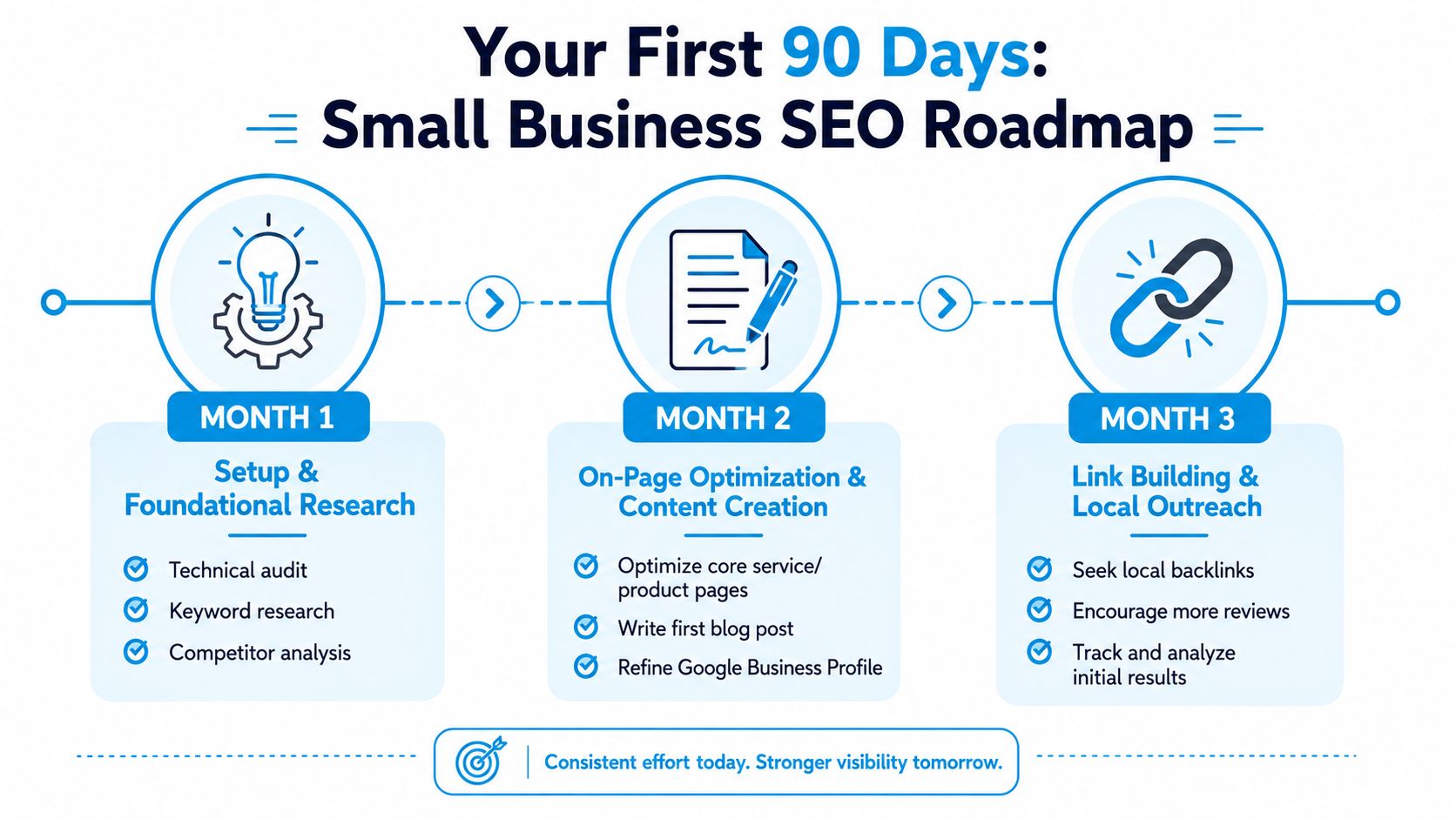
The goal in the first 90 days is not to do everything. The goal is to remove obvious blockers, publish a small number of useful assets, and set up a cadence you can repeat. Small businesses get better results from steady execution than from ambitious plans that stall after the first burst of effort.
Month 1 clean up the foundation
Start with the pages and profiles that already matter to revenue. Fixing weak basics usually produces faster gains than publishing new content too early.
- Run the basic health check and write down the issues that affect visibility or conversions first.
- Map core keywords to core pages so each main service page has a clear primary target.
- Tighten title tags, meta descriptions, headers, and internal links on your homepage and top service pages.
- Check your Google Business Profile and top directory listings for accuracy, missing categories, and inconsistent contact details.
- Set up tracking in Google Search Console and GA4 so you can see what changes are helping.
This is also the right point to build a comprehensive SEO strategy if your current approach is reactive and scattered.
Month 2 publish and strengthen authority
Month two is where execution usually slips. The initial cleanup is done, but nobody has time to turn that work into pages, posts, updates, and review requests.
Keep the plan tight. One improved service page, one useful supporting article, one review request process, and one citation cleanup pass is enough to create momentum.
| Focus area | What to do |
|---|---|
| Service pages | Improve the pages tied closest to leads or sales |
| Supporting content | Publish one article or FAQ that answers a real buyer question |
| Local proof | Add recent photos, fresh reviews, and specific business details |
| Citations | Fix the listings that are wrong, incomplete, or duplicated |
Semper Digital Solutions notes in its small business SEO guide that businesses tend to lose momentum when they stop after setup and never build the supporting content and authority signals that help rankings stick.
Month 3 measure and adjust
By month three, you should have enough data to make decisions without guessing. At this stage, many owners either overreact to small changes or stop checking results altogether. A simple monthly review is usually enough.
Look at a short list of signals:
- Search Console queries: Are the right terms starting to generate impressions and clicks?
- Top landing pages: Are your service pages attracting qualified visits?
- Google Business Profile activity: Are calls, direction requests, or profile views improving?
- Conversions: Which pages lead to calls, forms, or booked appointments?
Then make a few practical decisions. Update pages that are close to page one. Improve pages that get traffic but do not convert. Drop content ideas that sound interesting but are not tied to services or local demand.
If you need a system that is easier to maintain than a rigid annual plan, use adaptive marketing planning frameworks that replace static annual plans. That approach fits small businesses because it supports shorter planning cycles, clearer ownership, and course correction when time gets tight.
A good 90 day roadmap creates traction and a repeatable rhythm. If the business cannot execute that rhythm internally, this is often the point where fractional support starts making sense.
Bridging the Execution Gap Resourcing Your SEO
Monday starts with good intentions. You plan to update a service page, answer a few Google Business Profile questions, and publish the blog post that has been sitting in draft for three weeks. Then payroll, customer issues, and urgent sales follow-up take over. By Friday, the SEO plan still makes sense on paper, but nothing shipped.
That gap between knowing and doing is what stalls SEO for many small businesses.
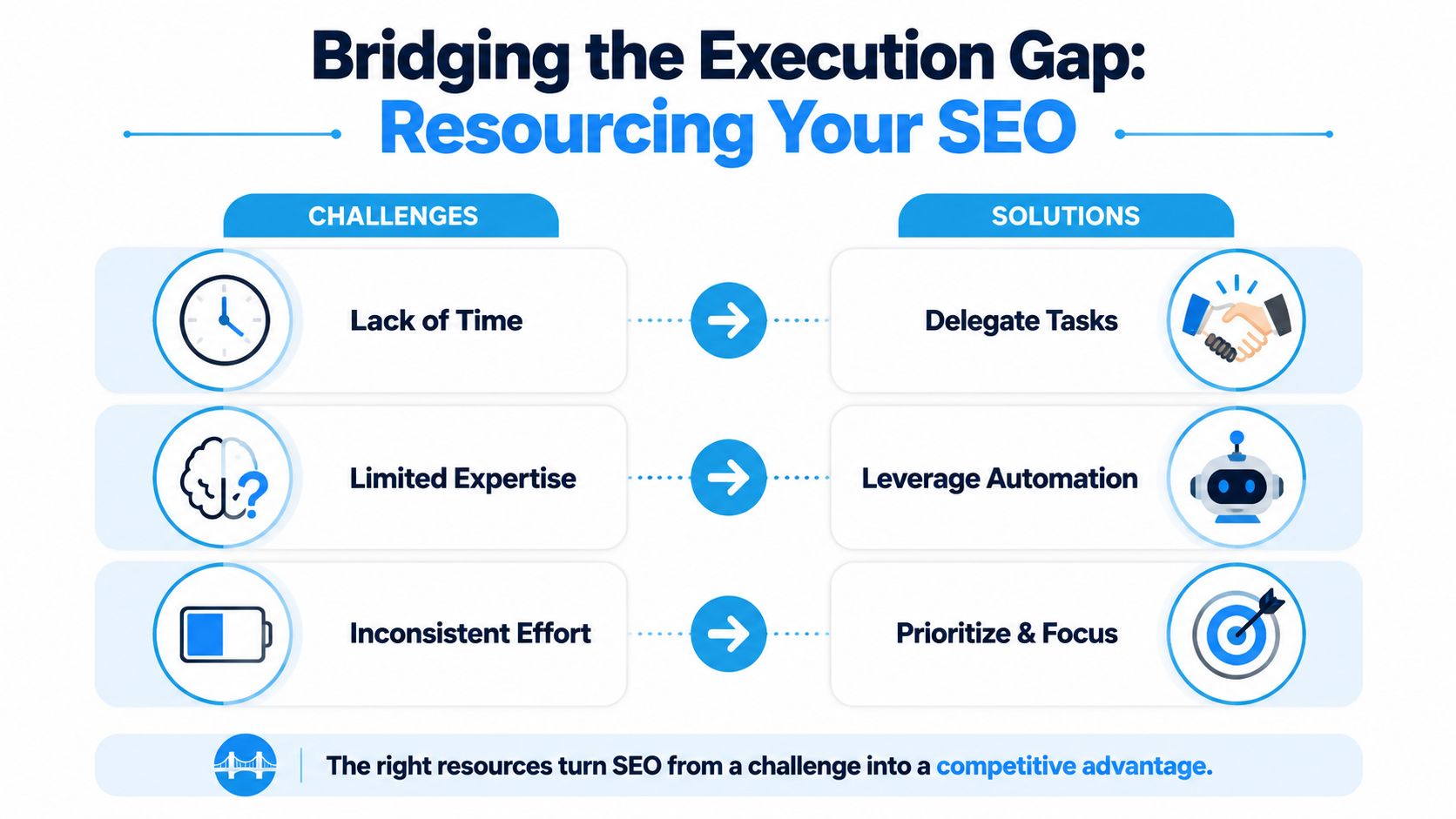
SEO does not fail because owners lack ideas. It fails because no one owns the recurring work. Pages need updates. Reviews need responses. Listings drift. Technical issues sit in a queue. Search Console data gets checked once, then ignored for a month. Without a team or a clear owner, the plan becomes a collection of half-finished tasks.
The three resourcing models
DIY fits a business with a simple site, a defined local market, and an owner who can block time every week. The benefit is control and low cash cost. The trade-off is predictable. SEO is one more responsibility competing with delivery, staffing, and sales, so consistency usually breaks first.
Full-time hire makes sense when the business has enough ongoing marketing work to support one role beyond SEO alone. The benefit is focus and faster internal coordination. The trade-off is specialization. One person rarely brings equal strength in content, local SEO, technical cleanup, reporting, and conversion improvement.
Fractional or on-demand support works well when the business needs steady output without adding full-time headcount. It gives you access to strategy, implementation, and specialist help in the areas that tend to get stuck. For many owners, that is the practical middle ground between doing everything themselves and overbuying agency services they will not fully use.
When fractional support makes the most sense
Fractional support solves a specific problem. The problem is throughput.
It tends to fit when:
- You already know the priorities: The keyword targets, page updates, and local SEO tasks are clear, but they do not happen on schedule.
- The work spans multiple skill sets: Writing, editing, on-page updates, technical fixes, review generation, and reporting often sit with different people or with no one.
- You need flexibility: A few focused hours each week can move SEO forward without the cost of a full-time salary.
- You use AI tools but still need judgment: AI can speed up research, outlines, and first drafts, but someone still needs to review accuracy, align content with services, and decide what deserves attention first.
If you are testing automation as part of local search work, this guide to AI tools for local SEO in 2026 gives a useful view of where software saves time and where human review still matters.
SEO for small business is often less about knowing what to do and more about making sure someone does it, every week, at a solid standard.
That is why resourcing matters as much as strategy. If delays are already costing rankings, leads, or follow-up on local opportunities, another planning document will not fix the issue. Clear ownership will. For some businesses that means protecting owner time. For others, it means hiring in-house. For many, fractional support is the fastest way to turn an SEO plan into repeatable execution without taking on the cost and risk of a full internal team.
If you need help turning an SEO plan into consistent execution, SharedTEAMS offers a practical middle ground between doing everything yourself and hiring a full in-house team. Their fractional, on-demand model is built for businesses that need strategic guidance, production support, and steady follow-through without a long-term agency retainer. A good next step is to review your current website, local presence, and internal capacity, then decide where outside execution support would remove the most friction.