You're probably in one of two situations right now. Either your launch date is getting closer and the work still feels scattered, or you've already seen a launch underperform because the team treated launch day like the finish line instead of the midpoint.
That pressure is real for small and mid-sized businesses. You don't have extra headcount to hide weak planning. You also can't afford to spend months producing assets for a product that isn't positioned clearly enough to earn traction.
A disciplined product launch strategy fixes that. It replaces guesswork with a phased process. It tells you what to validate before launch, what to build for launch, what to watch during launch, and what to improve after launch.
It also sets expectations correctly. Only around 15% of customers will buy a new product immediately after launch, while approximately 50% wait until the product has been proven through market validation and third-party adoption according to Ciradar's product launch statistics. That means most launches fail when teams expect instant broad adoption and then overreact when day-one demand doesn't match internal optimism.
A strong launch process matters because failure is common, but not random. Products usually miss because the team rushed research, aimed too broadly, priced with weak market input, or pushed campaign execution before the positioning was settled. The good news is that solving those problems doesn't require a huge in-house department. It requires structure, clear ownership, and enough specialized support to execute the plan well.
Table of Contents
- Introduction Your Guide to a Disciplined Product Launch
- Phase 1 Pre-Launch Research and Positioning
- Phase 2 Building Your Go-to-Market Plan
- Phase 3 Creating the Launch Timeline and Assets
- Phase 4 Executing and Monitoring the Launch
- Phase 5 Post-Launch Optimization and Measurement
- Conclusion Turning Strategy into Sustainable Growth
Introduction Your Guide to a Disciplined Product Launch
Most founders think they have a marketing problem when they really have a sequencing problem. They start building ads, emails, landing pages, and launch posts before they've made the harder decisions about who the product is for, what job it does better than alternatives, and how the market should understand it.
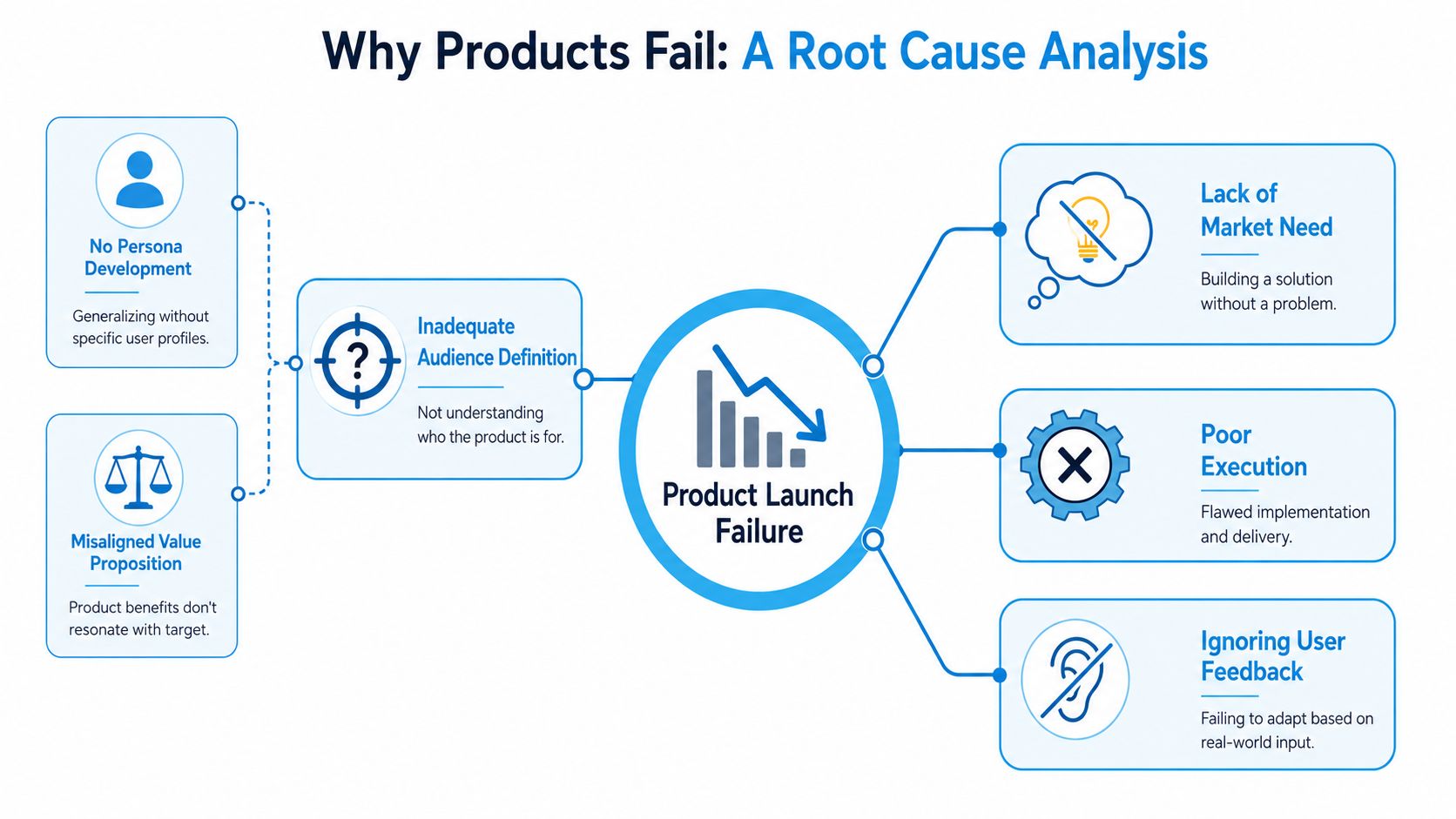
That shortcut is expensive. Approximately 95% of the roughly 30,000 new products launched annually fail, with inadequate definition of a target audience identified as the most common strategic root cause, according to Crayon's summary of Harvard Business School launch data. If you don't define the audience precisely, everything downstream gets weaker. The message gets vague. The offer gets generic. The channel plan gets bloated.
Practical rule: Don't spend on promotion until you can describe the buyer, the pain point, the buying trigger, and the reason they should choose your product instead of waiting.
For SMBs, this matters even more because resources are tight. Large teams can absorb some inefficiency. Smaller organizations can't. The advantage smaller teams do have is focus. They can make faster decisions, test faster, and launch in a more controlled way if they use a disciplined process.
That process starts before campaign production. It starts with three pieces of pre-launch homework:
- Audience clarity: Know who the product is really for, not who you hope might buy it.
- Competitive context: Understand where the market is crowded, weak, or underserved.
- Message discipline: Build one clear value proposition, then support it with proof and use cases.
When those pieces are in place, a launch stops feeling like a gamble and starts functioning like an operating plan.
Phase 1 Pre-Launch Research and Positioning
The fastest way to waste a launch budget is to move from product development straight into promotion. The market doesn't reward enthusiasm. It rewards relevance.
Start with audience definition, not channels
Audience definition has to go beyond age, industry, or company size. Those filters are useful, but they don't tell you why someone buys. A workable launch audience definition includes the buyer's current workaround, their urgency level, the consequence of doing nothing, and the internal objection you'll need to overcome.
That's why weak persona work creates weak launches. If your team says the product is “for small businesses” or “for busy professionals,” you're not ready. You need a narrower view of the first buyer you want to win.
A useful research pass should answer questions like these:
- Current behavior: What is the buyer using now, even if it's a spreadsheet, manual process, or competitor product?
- Buying trigger: What event pushes the problem from annoying to urgent?
- Decision criteria: What must be true before they'll switch, trial, or purchase?
- Risk concerns: What makes them hesitate, especially if the product is new?
If you need a practical primer on validating demand before heavy launch investment, this Proven SaaS guide to market validation is a useful reference because it keeps the focus on evidence instead of assumptions.
Find a position you can actually defend
Competitive analysis for SMB launches should be lean, not theatrical. You don't need a massive spreadsheet covering every company in the category. You need to know three things. What buyers already compare you against, where those alternatives are strongest, and where they leave dissatisfaction behind.
That's where many teams drift into copycat messaging. They study competitors, then repeat the same promises with slightly different wording. Good positioning doesn't come from sounding similar. It comes from choosing a lane.
A practical way to do this is to compare:
| Decision area | Weak approach | Better approach |
|---|---|---|
| Category framing | “We do everything” | “We solve one costly problem clearly” |
| Differentiation | Feature lists | Specific use case advantage |
| Competitive response | Match everyone | Focus where incumbents are slow or generic |
For teams that need sharper market context before finalizing positioning, an AI-powered competitive analysis workflow can help surface patterns, message gaps, and repeated claims in the category.
Products rarely lose because they lacked effort. They lose because buyers couldn't tell why this offer mattered for them, right now.
Turn research into a message hierarchy
Once the audience and position are clear, reduce the message. Most launches fail message discipline because everyone wants their favorite feature in the headline.
Don't do that. Build a hierarchy.
Start with one core promise. Then support it with proof points, use-case examples, and objection handling. Your homepage headline, paid ads, sales deck, email copy, and demo flow should all reflect the same argument, adapted for the format.
A simple message hierarchy usually includes:
- Primary value proposition that states the main business outcome.
- Supporting proof such as product capability, workflow improvement, or ease-of-use rationale.
- Audience-specific use cases that show fit for priority segments.
- Objection handling for concerns around switching effort, readiness, or trust.
This is also the point where a fractional team model becomes useful. SMBs often have the product insight internally but lack outside support to pressure-test the positioning, tighten the message, and turn the research into launch-ready decisions.
Phase 2 Building Your Go-to-Market Plan
Strategy answers who and why. A go-to-market plan answers how the product gets in front of the right buyer without creating internal chaos.
The teams that handle this well don't start with a channel wishlist. They start with the path to purchase, then choose channels that support it. That discipline matters because successful new product launches are directly correlated with perceived superior skills in six organizational capabilities: marketing research, sales force effectiveness, distribution network strength, promotional creativity, R&D innovation, and engineering precision, based on the ScienceDirect study on new product launch success factors.
Choose channels by buying behavior
If the product needs explanation, content and email often do more than broad paid reach alone. If the category is crowded and search intent is strong, paid search may deserve an early role. If visual demonstration matters, video becomes part of the launch system, not just a nice extra.
A practical channel mix usually includes a few core functions:
- Demand capture: Paid search, high-intent landing pages, comparison content.
- Demand creation: Social campaigns, thought leadership, short-form video, webinars.
- Nurture: Email sequences for waitlists, trials, demos, and follow-up education.
- Enablement: Sales one-pagers, demo scripts, FAQs, onboarding materials.
The key trade-off is depth versus spread. Most SMB launches underperform because they try to appear everywhere and end up thin everywhere.
Build the content path before launch week
Strong launch content works in sequence. It doesn't dump the same announcement into every channel.
Map content across the full launch arc:
| Launch stage | Content role | Example assets |
|---|---|---|
| Pre-launch | Build curiosity and educate the problem | teaser emails, waitlist page, early access explainer |
| Launch week | Drive clarity and action | announcement page, product demo, sales deck, ads |
| Post-launch | Reduce friction and strengthen adoption | tutorials, objection emails, comparison content, FAQs |
Video deserves special planning because teams often leave it too late. If video will carry part of your launch, this guide on how to scale video ads is useful for thinking through format, sequencing, and production demands before the deadline gets tight.
Cover capability gaps before they slow execution
SMBs rarely fail because they lack ideas. They fail because the work requires more specialties than the internal team can cover at once. One person can't reliably own strategy, copy, design, paid media, landing page production, analytics, and post-launch optimization without something slipping.
A fractional operating model is practical. SharedTEAMS functions as an on-demand marketing department for SMBs, combining strategy support, project execution, and AI-enabled production workflows when a launch needs more capacity than the internal team can supply.
If your launch plan depends on one overstretched marketer doing six jobs, the issue isn't effort. It's staffing design.
A solid GTM plan names owners clearly, keeps the channel mix focused, and limits launch scope to what the team can execute well.
Phase 3 Creating the Launch Timeline and Assets
This is the phase where strong plans often start to wobble. The strategy is approved. The team is aligned in principle. Then production begins, dependencies stack up, and the launch date starts moving.
That's not unusual. Market Logic reports that 45% of product launches are delayed by at least one month, primarily due to poor understanding of market requirements and misaligned pricing strategies during the pre-launch phase, according to Market Logic's review of product launch failure.
Build the timeline backward from launch day
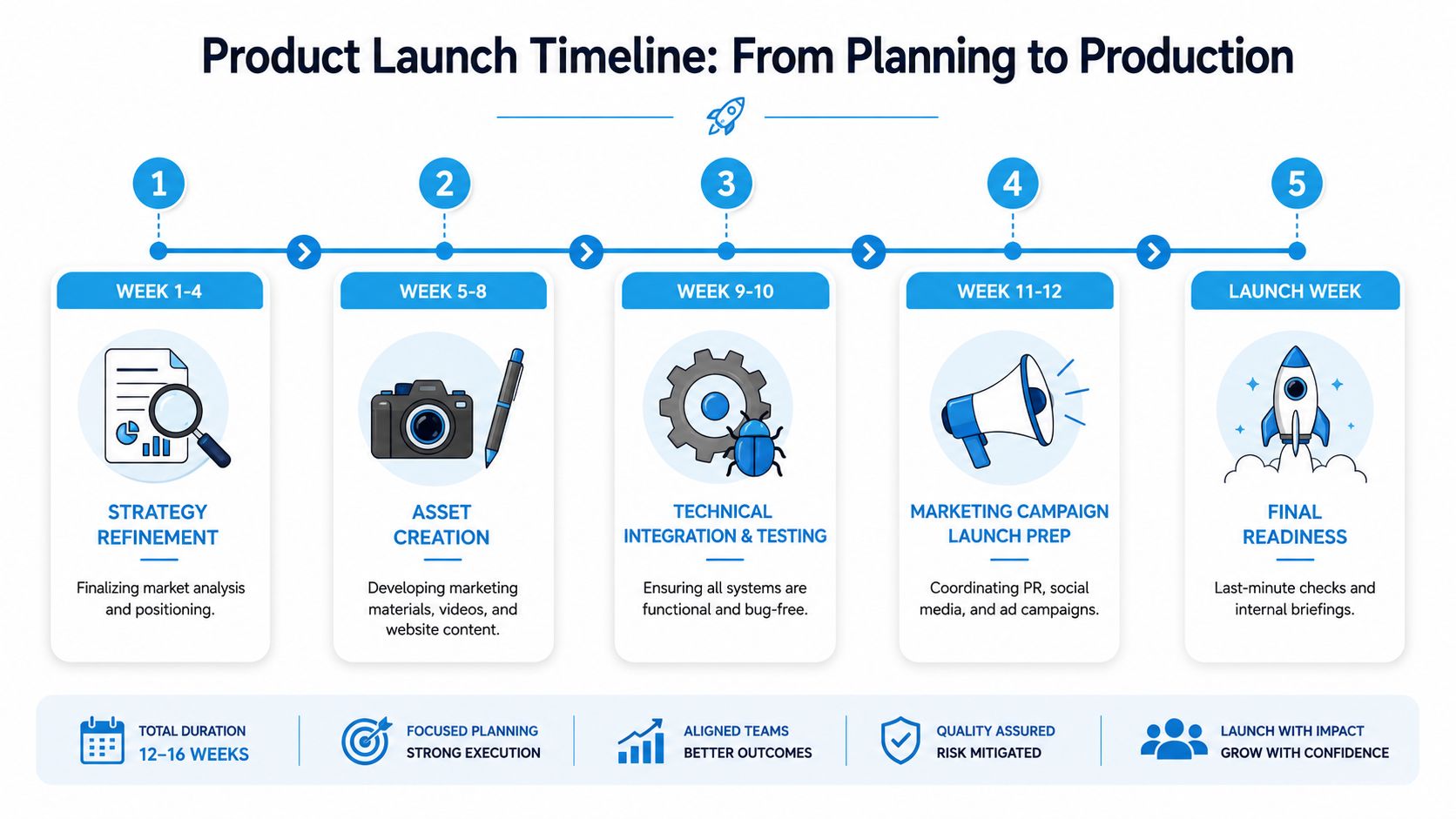
The simplest fix is reverse planning. Start with the date the market sees the product, then work backward through approvals, QA, asset production, training, and technical setup.
A clean reverse timeline usually includes milestone bands such as:
- Early planning window: finalize positioning, offer structure, pricing assumptions, and launch scope.
- Production window: build the landing page, email flows, paid creative, demo assets, sales materials, and tracking setup.
- Testing window: verify forms, analytics, automation, checkout or sign-up flows, and internal handoffs.
- Readiness window: brief sales and support, confirm schedules, lock copy, and stage campaigns.
The timeline only works if every deliverable has an owner and an approval path. Without that, teams stall in feedback loops.
Treat asset production like coordinated manufacturing
Launch assets aren't separate creative tasks. They're a connected system. The headline on the landing page should match the paid ad promise. The demo should reinforce the same business outcome. The sales deck should use the same positioning logic the email campaign introduces.
That sounds obvious, but inconsistency is one of the most common causes of launch friction. Buyers notice when the ad says one thing, the site says another, and the salesperson improvises a third message.
Use a production checklist that covers:
- Conversion assets: landing page, form flow, checkout or booking path.
- Nurture assets: launch emails, follow-up sequences, onboarding messages.
- Sales enablement: one-pagers, objection handling notes, demos, call scripts.
- Creative assets: ad variations, social graphics, product visuals, short videos.
- Operational assets: support macros, FAQ docs, internal briefing notes.
If the launch includes a new page build or a rapid refresh to an existing page, it helps to scope the work early against a realistic landing page production estimate.
What launch week actually feels like
On paper, launch week looks simple. In practice, it's coordinated tension. Someone notices a mismatch in the CTA copy between email and landing page. A paid ad gets approved later than expected. Sales asks for a one-sheet revision after the first calls. Support spots the same customer question coming in three times before noon.
The teams that handle this well don't treat those issues as surprises. They plan for them.
Field note: Launch week is rarely about one dramatic failure. It's usually about ten small frictions showing up at once.
A disciplined launch manager keeps one source of truth for approved messaging, current assets, owner assignments, and escalation paths. That prevents a small issue from turning into a scramble.
The other key move is protecting consistency. When teams are under time pressure, they tend to improvise. Sometimes that helps. More often, it creates version control problems and diluted messaging just as the market is seeing the product for the first time.
Phase 4 Executing and Monitoring the Launch
Launch day isn't the moment to discover whether your systems talk to each other. It's the moment to confirm that the preparation was real.
Run launch day from a single command center
The best launches operate from one command center, whether that's a meeting room or a shared digital workspace. One person owns status. One person monitors paid activity. One person watches site behavior, forms, and tracking. Sales and support have a direct line back to marketing.
A simple launch-day checklist should cover:
- Channel readiness: Ads are active, emails are scheduled or sent, social posts are confirmed, sales outreach is timed correctly.
- Technical readiness: Forms submit correctly, automations fire, analytics are recording, links resolve to the right pages.
- Response readiness: Team members know who handles copy edits, budget shifts, technical bugs, and customer issues.
- Observation discipline: Capture what buyers are saying, where they hesitate, and which messages trigger response.
If email is part of the launch sequence, the workflow should already be staged with a clear sequenced email campaign estimate so the team isn't improvising timing and copy under pressure.
Use a phased beachhead rollout when risk is high
Not every product should launch broadly on day one. That approach is often driven more by internal excitement than market logic.
Advanced launch strategies often use a phased beachhead rollout to validate the playbook in a single, specific market segment before expanding, as described in Simon-Kucher's guidance on mastering product launch strategies. For SMBs, this is one of the smartest ways to reduce wasted spend and tighten the offer before a wider push.
A beachhead rollout works well when:
| Situation | Why a phased rollout helps |
|---|---|
| The category is crowded | You can refine differentiation in one segment first |
| The product needs education | You can learn which message actually moves buyers |
| Sales capacity is limited | The team can respond well without spreading too thin |
| Pricing confidence is still forming | Early market reactions can guide adjustments |
This approach also improves monitoring quality. A narrower initial audience gives cleaner signal. You can see where the pitch lands, where friction shows up, and what needs to change before broadening the campaign.
Phase 5 Post-Launch Optimization and Measurement
The market doesn't care that the launch calendar is complete. It only cares whether the product earns adoption after first exposure.
That's why post-launch work deserves as much discipline as pre-launch planning. A launch that gets attention but fails to convert, activate, or retain users isn't a strong launch. It's a noisy announcement.
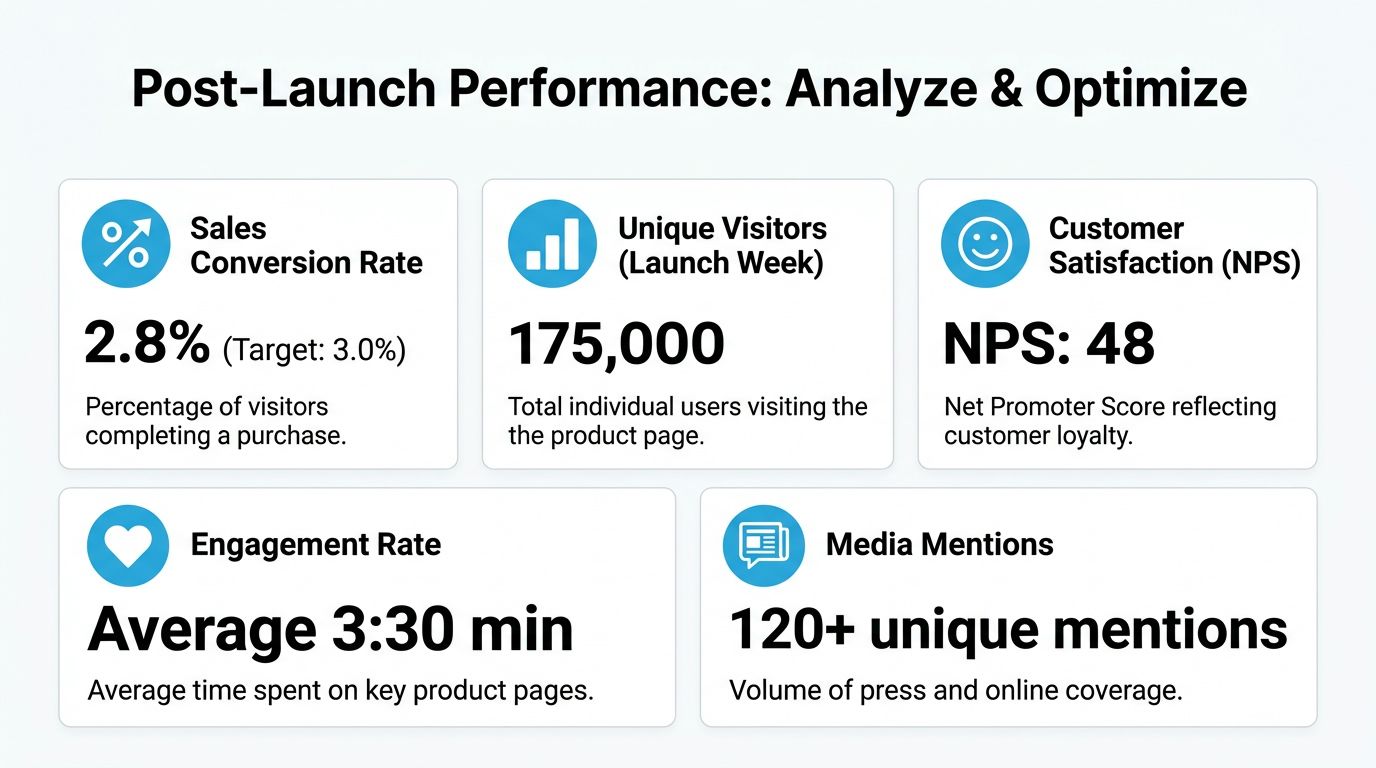
Start with a visual scorecard so the team stays focused on operational truths instead of opinions.
Use a one-page scorecard
A functional launch scorecard should stay short enough for leadership to review quickly and often. CommerceCentric recommends including the North Star metric, activation rate, time to value, cost per activated user, 30-day retention, early revenue, Net Promoter Score, and share of voice, reviewed weekly for the first 4–8 weeks in its guide to product launch metrics.
That matters because teams often review too many metrics and still miss the actual story. A launch scorecard should answer four practical questions:
- Are the right people arriving?
- Are they reaching value fast enough?
- Are they staying engaged long enough to matter?
- Are we acquiring customers at a cost the business can support?
Here's the discipline I recommend. Review the scorecard weekly, but don't react to every small fluctuation. Look for patterns that repeat across channels, messages, and user behavior.
Watch for leading indicators early. If activation is weak, more traffic won't fix the launch.
A short explainer can also help align the team around what to monitor during the first few weeks:
Build a post-launch pricing feedback loop
Pricing shouldn't freeze the moment the product goes live. One of the most overlooked parts of a product launch strategy is the post-launch pricing feedback loop.
That loop should capture:
- Sales objections: What price concerns show up repeatedly in calls, demos, or follow-up emails?
- Behavior by offer version: Which plans, packages, or terms produce the cleanest progression to purchase?
- Retention signals: Are early buyers staying engaged, or did price attract the wrong customer profile?
- Competitive pressure: Are prospects comparing your offer against lower-friction alternatives?
This isn't about changing prices impulsively. It's about pairing buyer feedback with launch KPIs so pricing becomes a managed variable rather than an assumption locked in too early.
Keep the launch alive after the announcement
The strongest post-launch teams continue the campaign after the initial burst. They publish clarifying content. They tighten onboarding. They rewrite weak sections of the landing page. They produce sales follow-up assets based on real objections. They keep learning.
That's also where the fractional model helps smaller organizations. Instead of staffing up permanently for a temporary surge, they can extend strategy, production, and optimization capacity long enough to interpret the data and improve the system.
A practical post-launch review cycle should include a weekly scorecard, a live issue log, direct customer feedback review, and a short decision list. What will you keep, cut, revise, or test next? That cadence turns a launch into a managed growth process instead of a one-time event.
Conclusion Turning Strategy into Sustainable Growth
A successful product launch doesn't depend on having a massive internal department. It depends on discipline. The teams that launch well do the same core things consistently. They research before they promote. They choose a clear position. They build a focused go-to-market plan. They manage production carefully. They monitor the launch closely. Then they keep optimizing after the announcement.
That five-phase structure reduces avoidable mistakes and gives SMBs a practical way to compete without pretending they have enterprise-level staffing. It also creates better decision points. You can see what's working, what's unclear, and where the next adjustment belongs.
If you're preparing for a launch, start with a readiness review. Check your audience definition, positioning, timeline, assets, ownership, and scorecard. If any of those pieces are weak, fix them before you add more promotion.
If you need extra capacity to plan or execute a launch without building a full in-house department, SharedTEAMS is one option to evaluate. It offers fractional marketing support for strategy, campaign production, web assets, and ongoing optimization, which can be useful when your internal team has product knowledge but not enough bandwidth to carry the entire launch process alone.