Your Google Analytics account probably isn't empty. It's cluttered. You've got traffic reports, event counts, attribution views, and maybe a dashboard someone built months ago. But when you need to decide where to cut spend, what to test next, or why leads dropped, the data doesn't give you a clear answer.
That's the reason many SMBs look into Google Analytics consulting services. They don't need more charts. They need someone to turn messy tracking into decisions the marketing team can act on this week, not someday after another reporting cycle.
Table of Contents
- From Data Overload to Actionable Insight
- What Are Google Analytics Consulting Services
- Common Deliverables and Pricing Models
- How to Evaluate a GA Consulting Provider
- The Consulting Engagement Process and Timeline
- Real-World Outcomes for SMBs
- FAQs for SMBs Considering Fractional Support
From Data Overload to Actionable Insight
Most SMBs don't have a tracking problem in the narrow technical sense. They have a translation problem. The reports exist, but nobody has converted them into budget decisions, campaign changes, landing page priorities, or a testing plan.
That gap is common. Data from 2025 shows 68% of SMBs struggle to connect analytics to strategy, and many consulting offers still focus on data accuracy without addressing decision velocity, according to Vidi Corp's review of Google Analytics consulting services. That's why business owners often feel stuck between “we have data” and “we know what to do next.”
The real problem is decision lag
If your team can't trust the numbers, you hesitate. If you hesitate, campaigns stay live too long, weak offers don't get fixed, and paid spend drifts into waste.
A useful analytics setup should answer practical questions like these:
- Channel quality: Which traffic sources produce leads or sales, not just visits
- Conversion friction: Where users abandon forms, checkout flows, or demo requests
- Campaign prioritization: Which messages deserve more budget and which should be cut
- Audience behavior: How mobile users, returning visitors, and branded traffic differ
Practical rule: If analytics doesn't change what your team does next, it's reporting, not strategy.
This is especially important for lean teams. When you're trying to move fast, clean measurement supports faster testing.
Why consulting matters for execution
Good Google Analytics consulting services bridge technical setup and marketing action. They don't stop at fixing events or confirming that GA4 is installed. They help you decide what to measure, how to interpret it, and what changes should follow.
That's the difference between a consultant who audits your property and one who improves your marketing system. The first gives you cleaner data. The second helps your team use it to make better decisions on ads, landing pages, email flows, and content priorities.
For teams trying to tie analytics to media performance, this guide on using AI analytics to maximize ad ROI is worth reading because it shows how measurement becomes a lever for campaign execution, not just a reporting exercise.
What Are Google Analytics Consulting Services
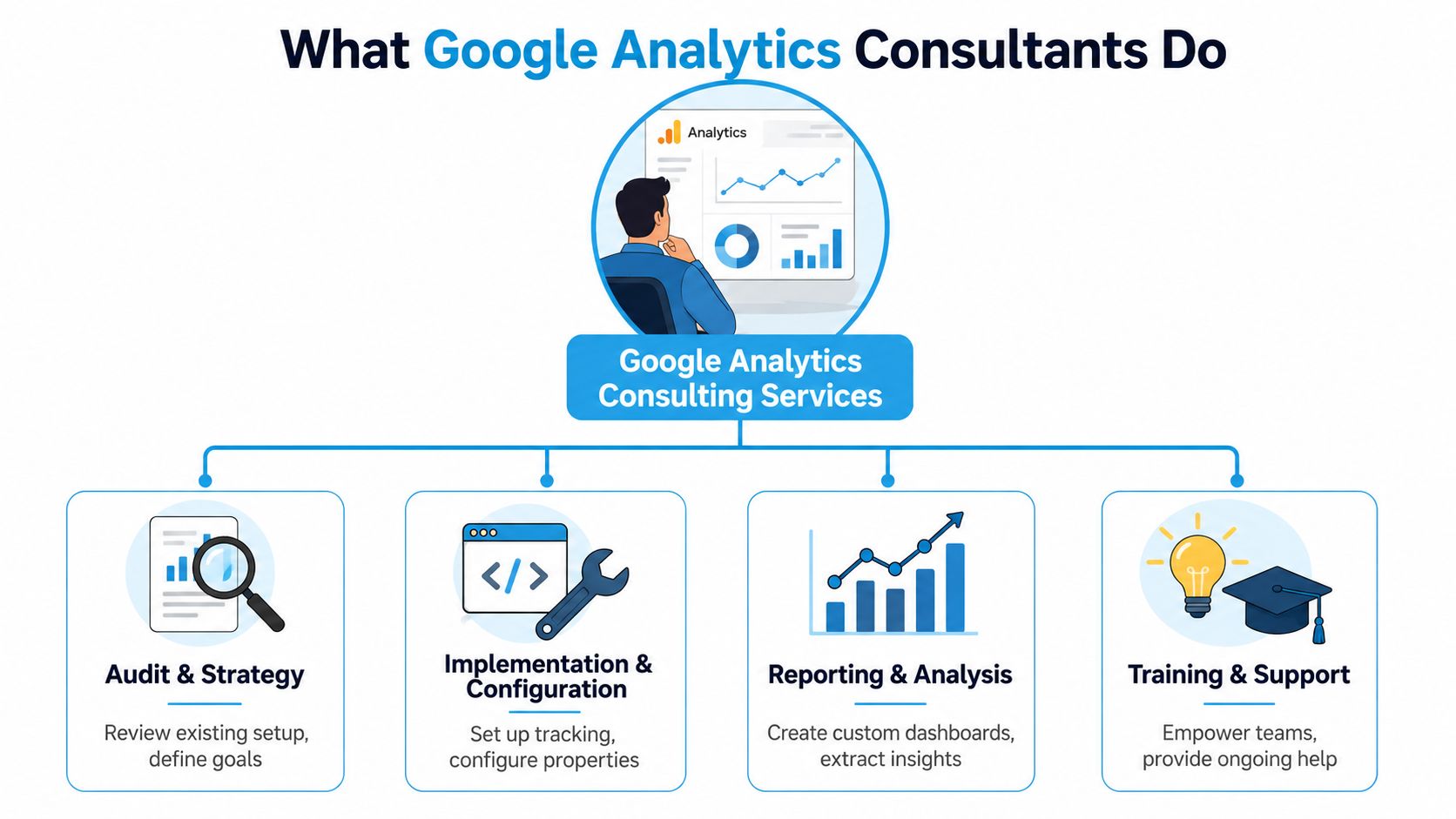
Google Analytics consulting services are specialized engagements that help businesses set up, fix, interpret, and operationalize GA4. That sounds technical because part of it is. But the business purpose is straightforward. You need a measurement system your team can rely on.
The category matters because the market is large and established. The global analytics consulting market is valued at approximately $43 billion, and Google Analytics holds a 24.46% share of the web analytics market, according to Consulting.us market coverage. For most SMBs, that means Google Analytics remains the default platform, and expertise in it isn't optional if digital marketing is a serious growth channel.
The core work behind reliable analytics
A solid consultant usually handles several layers of work.
First comes migration and implementation. If your setup is outdated or incomplete, the consultant configures GA4 correctly, aligns properties and data streams, and makes sure key business actions are being captured.
Then comes event and conversion tracking, often through Google Tag Manager. At this stage, form submissions, purchases, calls, bookings, file downloads, or other critical actions get defined properly.
You'll also need a measurement plan. Many businesses often struggle with this. A consultant should map your goals to trackable actions so your reporting reflects how the business grows.
Why this matters beyond reporting
Analytics architecture works like a foundation. If it's weak, every dashboard built on top of it is suspect.
Here's what competent Google Analytics consulting services typically include:
| Service area | What it does | Why it matters |
|---|---|---|
| Audit | Reviews tracking gaps and configuration issues | Prevents bad decisions based on broken data |
| Implementation | Sets up GA4, GTM, events, and conversions | Creates usable measurement |
| Reporting | Builds dashboards in tools like Looker Studio | Helps leaders monitor KPIs efficiently |
| Governance | Defines naming, access, and data rules | Keeps reporting consistent over time |
A dashboard isn't insight. It's only useful if the underlying tracking reflects the real customer journey.
Common Deliverables and Pricing Models
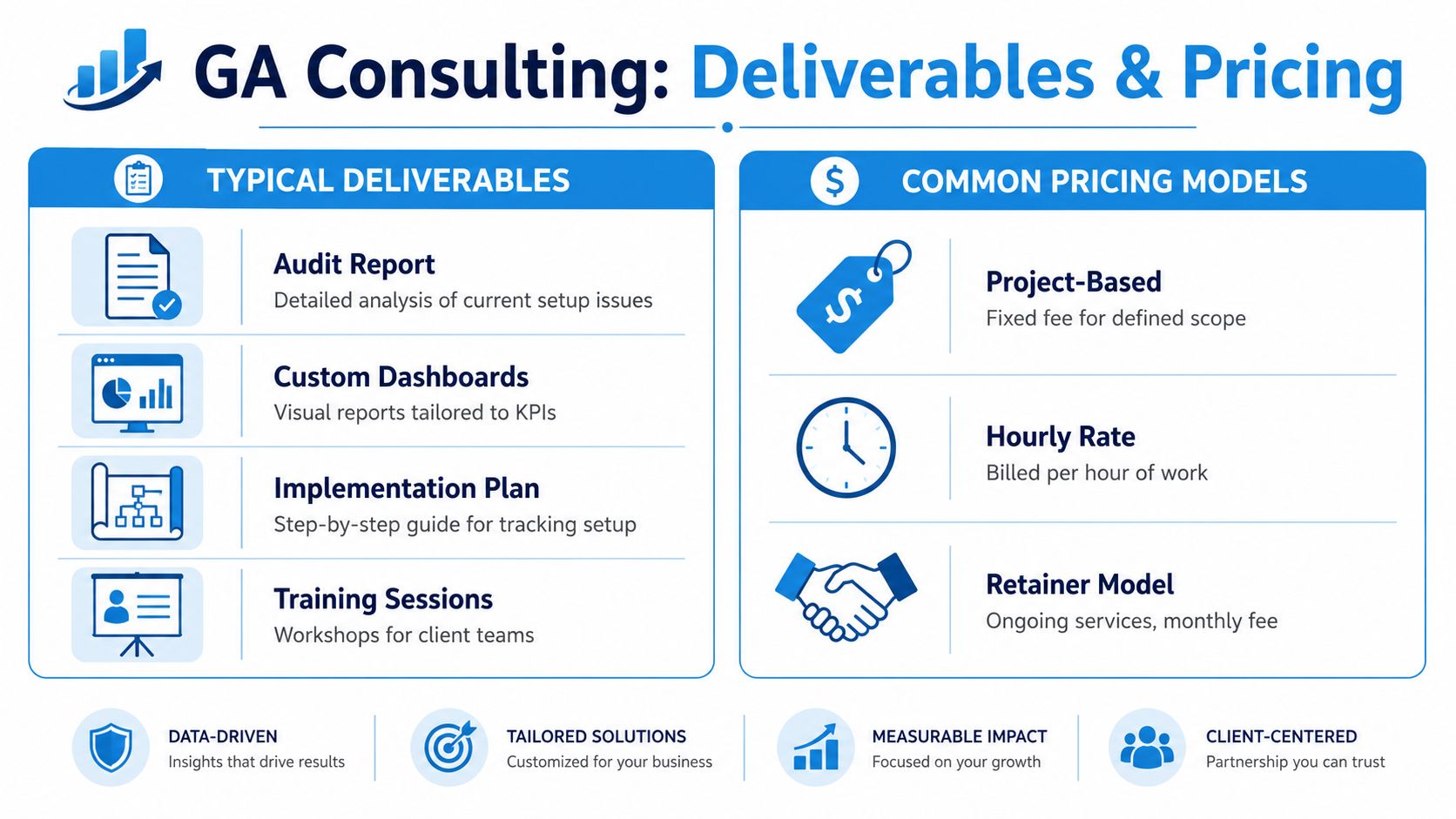
If you're paying for Google Analytics consulting services, you should expect tangible outputs. Not vague “strategic support.” Not a couple of calls and a slide deck. You need assets your team can use.
Expert engagements commonly start with in-depth GA4 and Google Tag Manager audits to identify data ingestion gaps, followed by custom implementation roadmaps that integrate CRM and attribution systems, directly enabling dashboards designed for operational optimization, as described by Marcel Digital's Google Analytics service overview.
What you should expect to receive
A useful engagement usually produces a mix of technical fixes and decision tools.
- Audit findings: A clear review of what's broken, missing, duplicated, or misattributed in your current setup
- Implementation roadmap: A prioritized plan covering what should be fixed first, what can wait, and how each item ties to business goals
- Dashboard build: Looker Studio or equivalent reporting views for leadership, marketing, or channel-specific management
- Documentation and training: Instructions so your team can maintain naming conventions, events, and reporting logic after launch
A good consultant should also tell you what not to track. Too many SMBs end up with bloated event libraries that create noise instead of clarity.
How pricing usually works
There are three standard models, and each fits a different business need.
| Pricing model | Typical use case | Cost range |
|---|---|---|
| Hourly consulting | Troubleshooting, audits, short advisory work | $150 to $300 per hour per SR Analytics |
| Project-based work | GA4 setup, migrations, event tracking, dashboard projects | $2,500 to $15,000 per SR Analytics |
| Monthly retainer | Ongoing optimization, reporting support, strategic guidance | $1,500 to $5,000 per month per SR Analytics |
If your need is narrow, hourly work is fine. If you need a full rebuild, choose a project. If analytics should actively guide paid media, CRO, and ongoing marketing decisions, a retainer is usually the smarter structure.
For budgeting a setup project, this breakdown of web analytics setup project estimates gives a practical reference point for what scoped implementation work can include.
How to Evaluate a GA Consulting Provider
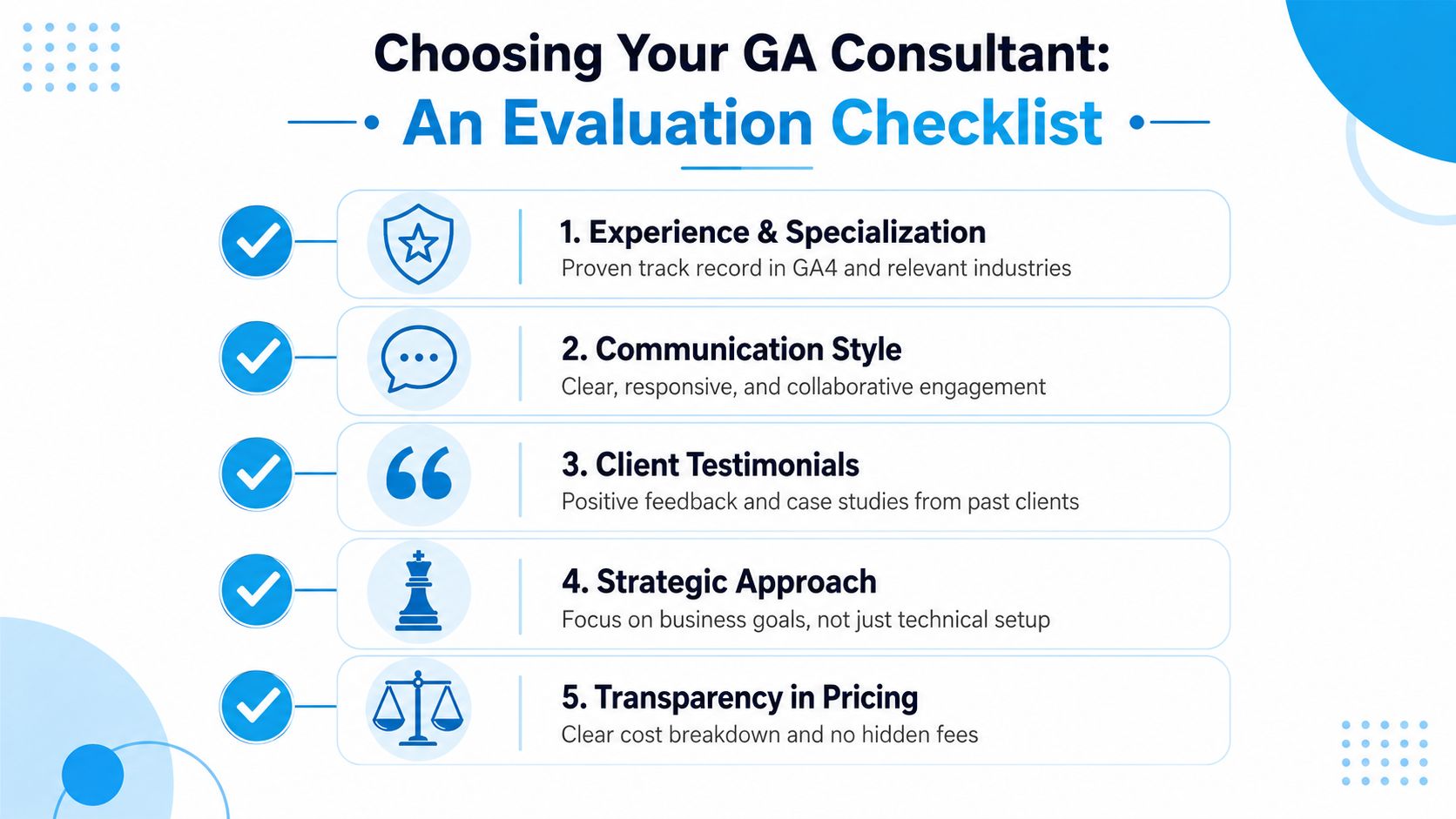
Don't choose a Google Analytics consultant because they speak fluent jargon. Choose them because they can connect tracking quality to business decisions.
The technical bar still matters. Certified Google Analytics consultants who configure cross-device tracking and machine learning-based insights can deliver full-stack GA4 setups associated with 30–40% higher data accuracy in conversion attribution, according to Adaptive's Google Analytics consulting page. But technical capability alone isn't enough for an SMB. You need someone who can explain what that accuracy changes in actual campaign management.
What separates a technician from an advisor
A technician can install tags. An advisor can tell you which conversions deserve weighting, what attribution blind spots are hurting budget allocation, and how reporting should differ for leadership versus channel managers.
Look for providers who can discuss these areas comfortably:
- Cross-device tracking: If customers research on mobile and convert later on desktop, your reporting needs to reflect that
- Consent management: Privacy compliance affects data quality and implementation choices
- BigQuery integration: This matters when GA4's standard interface isn't enough for deeper analysis
- Governance: Naming conventions, access rules, and documentation keep the account usable after the consultant leaves
If a provider only talks about tags and never asks how you make marketing decisions, keep looking.
Questions worth asking before you sign
Use the sales conversation to test how they think.
Ask them how they'd approach a drop in lead volume when paid traffic looks stable. Ask what they'd audit first if form submissions appear lower in GA4 than in your CRM. Ask how they decide which events become conversions.
Their answers should sound commercial, not just technical.
Here's a simple evaluation lens:
- Strong fit: They ask about revenue goals, sales process, CRM handoff, and campaign priorities
- Weak fit: They stay at the level of events, triggers, and tags without connecting those items to business outcomes
- Strong fit: They explain tradeoffs clearly and define success before implementation begins
- Weak fit: They promise a quick cleanup without discussing reporting use cases
If you want strategic support beyond analytics alone, a fractional model for marketing guidance and execution planning can make more sense than hiring a niche technician in isolation.
The Consulting Engagement Process and Timeline
Most SMBs hesitate because they assume a consulting engagement will be disruptive, slow, or overly technical. It doesn't have to be. A well-run project is structured and readable from the client side.
How the work usually unfolds
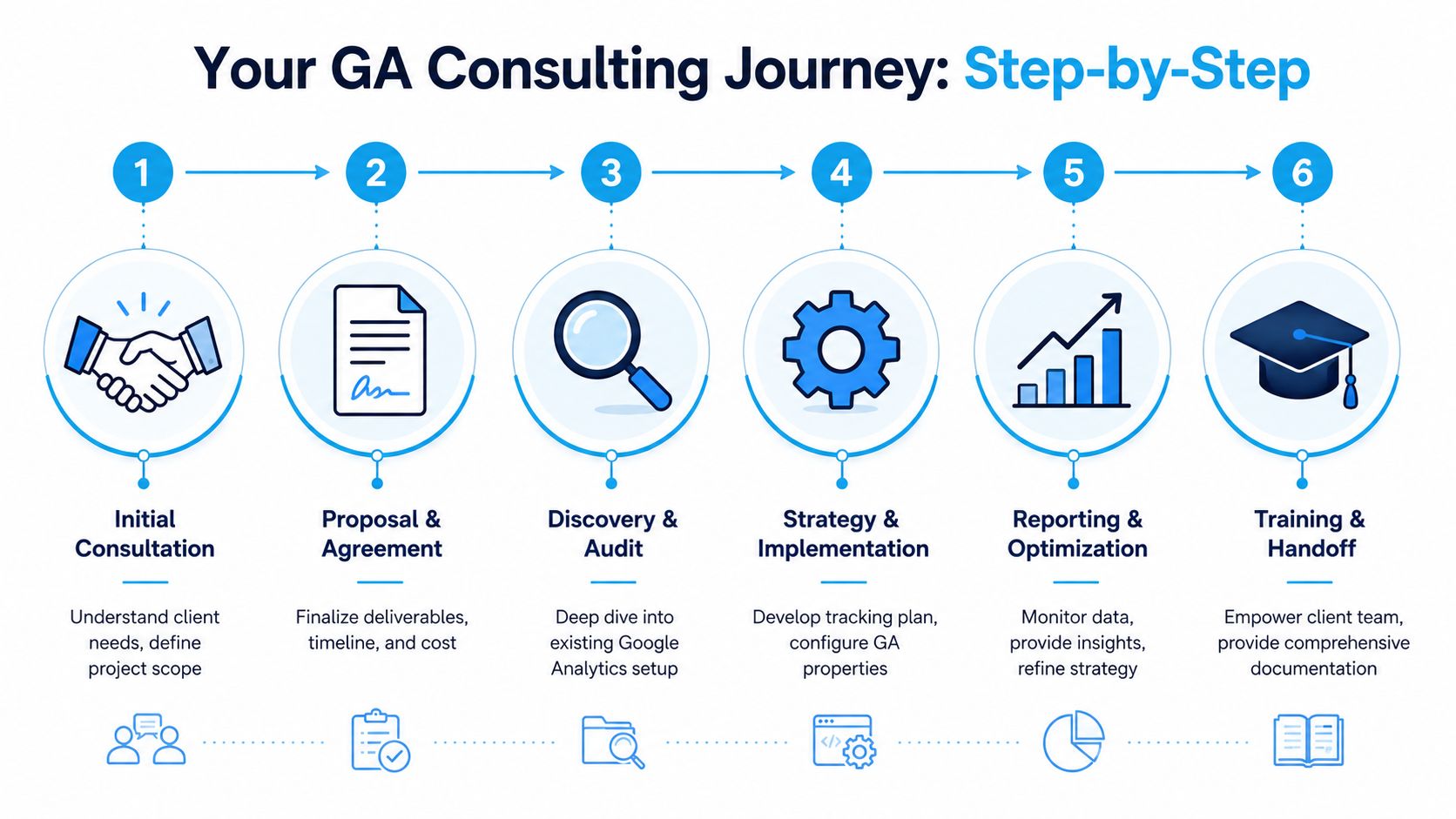
First, the consultant should ask about your business goals. Not just your website. They need to know what counts as success, which channels matter most, where leads or sales are supposed to come from, and what systems already hold customer data.
Then they audit the current environment. That usually includes your GA4 property, Google Tag Manager, conversion settings, channel definitions, and any CRM or ad platform handoffs.
After that, you should receive a roadmap. It should be prioritized, plain English, and tied to action. For example, fix duplicate purchase events first, align lead conversions with CRM stages next, and rebuild dashboards after the tracking logic is stable.
Where SMBs get the most value
Implementation comes next. Events are corrected, conversions are redefined, filters are reviewed, and reporting views are rebuilt around the KPIs your team uses.
From there, the best engagements move into interpretation. Your consultant should review what the new data is showing and recommend actions. Maybe your paid search campaigns need different landing pages. Maybe your form funnel needs simpler steps. Maybe branded traffic is masking weak acquisition from non-brand channels.
A typical SMB project often moves through these phases:
- Discovery
Business goals, lead flow, reporting needs, and platform access - Audit
Technical review of GA4, GTM, event structure, and conversion logic - Roadmap
Prioritized fixes, ownership, and decision-focused reporting plan - Implementation
Tracking updates, dashboard creation, and system integration - Optimization
Ongoing review, interpretation, and campaign guidance
You shouldn't need to become a GA4 expert to get value from the engagement. The consultant's job is to make the system clearer, not more intimidating.
Real-World Outcomes for SMBs
A common SMB scenario looks like this. An ecommerce or lead generation business sees inconsistent performance. Paid campaigns are running. Traffic seems steady. But revenue or qualified leads don't match what the team expected, and nobody trusts the reporting enough to know where the issue starts.
A typical before and after scenario
A consultant begins with a proper audit and finds that the core problem isn't demand alone. The setup has data ingestion gaps, weak event definitions, and missing connections between analytics, attribution, and CRM records.
That's where expert consulting earns its keep. Expert-level Google Analytics consulting services mandate in-depth GA4 and Google Tag Manager audits to identify data ingestion gaps, followed by custom implementation roadmaps that integrate CRM and attribution systems, directly enabling dashboards customized for operational optimization, based on Marcel Digital's service framework.
Once the tracking is fixed, the consultant can isolate a specific point of friction. It may be a checkout step, a lead form field, a device-specific drop-off, or a mismatch between ad intent and landing page content. Before the audit, that issue was buried. After the audit, it becomes visible and actionable.
Why execution matters as much as insight
Many businesses still struggle at this stage. They get the insight but not the follow-through.
The right outcome isn't “we now have cleaner reports.” The right outcome is that the marketing team uses those reports to revise pages, reallocate media spend, tighten campaigns, and monitor whether those changes improve sales efficiency.
That's why SMBs often benefit from a fractional execution model after consulting work is complete. You need people who can implement the landing page changes, ad updates, content revisions, and reporting cadence the data points toward. Otherwise, analytics becomes another smart diagnosis that never changes the patient.
FAQs for SMBs Considering Fractional Support
Can I hire a consultant for one project
Yes, and in many cases you should.
If your issue is narrow, such as a GA4 migration, broken conversion tracking, or a dashboard rebuild, project-based consulting is usually the cleanest option. It gives you a defined scope, a defined output, and a clear handoff.
If you only need a technical repair, don't overbuy. But if your team also needs help turning insights into campaign changes, one-off consulting can leave a gap.
How is this different from hiring in house
A full-time analyst can make sense if you have enough ongoing complexity to justify the salary, management overhead, and tool coordination. Many SMBs aren't there yet.
Fractional support is usually better when you need senior thinking without a permanent hire. You can bring in expertise for strategy, setup, interpretation, and execution support without carrying a full internal department.
That's especially useful when your bottleneck isn't just reporting. It's getting from insight to action across ads, landing pages, content, and conversion paths.
What if my tracking is already a mess
That's normal. A messy account is not a reason to avoid help. It's the reason to get help.
Broken event naming, duplicate conversions, poor channel attribution, and weak dashboard logic are all fixable. The bigger risk is continuing to make budget decisions from unreliable information.
Start with an audit. Don't start with a redesign of your reporting dashboard. If the inputs are wrong, the presentation layer won't save you.
One more issue deserves attention. 40% of marketing managers fail to track click-through rate as a primary KPI, even though CTR directly indicates ad relevance and audience alignment, according to Unbounce's PPC metrics guidance. If your analytics setup can't connect ad engagement signals to downstream conversions, you'll struggle to judge whether poor results come from weak targeting, weak offers, or weak tracking.
Fractional support works best when you need flexibility. You can bring in specialized analytics help, connect it to broader marketing execution, and avoid the delay of building an internal team before you're ready.
If your analytics are technically “working” but your team still can't move faster or make better marketing decisions, it's time to review the system end to end. SharedTEAMS helps established small businesses combine strategy and execution under an accountable Marketing Director, so cleaner data leads to actual campaign improvements instead of another unused dashboard.