You're probably in a familiar spot. The founder wrote the first website copy, ran a few paid campaigns, posted on LinkedIn, briefed a freelancer on social, and maybe hired a junior marketer to keep things moving. It worked long enough to get early traction. Then growth slowed, lead quality got messy, and every marketing decision started routing back to the CEO.
That's the wall. Not because marketing stopped mattering, but because founder-led marketing stops scaling once the business needs positioning, channel prioritization, reporting, and actual operating discipline. Most startups don't need a full-time CMO at that moment. They need senior judgment, a clear go-to-market system, and someone who can make execution coherent.
That's where a fractional CMO for startups can make sense. But there's a catch most guides ignore. Strategy alone doesn't fix the problem. If your fractional CMO hands you a smart plan and nobody owns the work, you've just bought a better slide deck.
If you want to compare this decision against a startup-focused operating model, it also helps to understand how startup marketing support is often structured in practice.
For established firms rather than startups, Fractional CMO vs. Managed Marketing Team compares the two models side by side.
Table of Contents
- When Founder-Led Marketing Hits a Wall
- What a Fractional CMO Actually Does for a Startup
- Key Signs Your Startup is Ready for a Fractional CMO
- The Business Impact Why Startups Hire Fractional CMOs
- Engagement Structures and Pricing Models
- How to Evaluate and Choose the Right Partner
- Your Next Step in Strategic Marketing
When Founder-Led Marketing Hits a Wall
Founder-led marketing usually breaks in a predictable way. At first, the founder's proximity to the customer is an advantage. They know the pain point, they can pitch the product, and they can produce credible early messaging faster than anyone else.
Then the company adds channels, vendors, and goals.
Now someone needs to decide whether Google Ads deserves more budget than SEO, whether the website reflects the product roadmap, whether sales decks match the homepage, and whether customer feedback is changing the ideal customer profile. Those aren't junior marketing tasks. They're leadership tasks.
A lot of founders respond by patching the problem. They hire a content freelancer, then a paid media shop, then a designer, then maybe a marketing coordinator. This usually creates more output, but not more clarity. Work gets done, yet the business still lacks a real go-to-market owner.
The ceiling shows up in daily decisions
The warning signs are operational before they're financial:
- Messaging keeps drifting: The homepage says one thing, sales calls say another, and ads promise something else.
- Agencies need constant correction: You're paying for outside help, but you still have to supply direction every week.
- The founder is the bottleneck: Campaign approvals, product positioning, budget choices, and content priorities all come back to one person.
- Execution outpaces strategy: The team is busy, but nobody can explain what should happen next quarter or why.
Founders often think they need more marketing activity. Most of the time, they need a better decision-maker.
That's why a fractional CMO can be the right first strategic hire. Not because the title sounds senior, but because the startup needs someone to turn scattered effort into a system. The right person gives the company structure without forcing it into the cost and rigidity of a premature executive hire.
What a Fractional CMO Actually Does for a Startup
A fractional CMO isn't a part-time marketing manager. They also shouldn't be a strategy-only consultant who disappears after a kickoff workshop. In a startup, the role has to bridge leadership and execution.
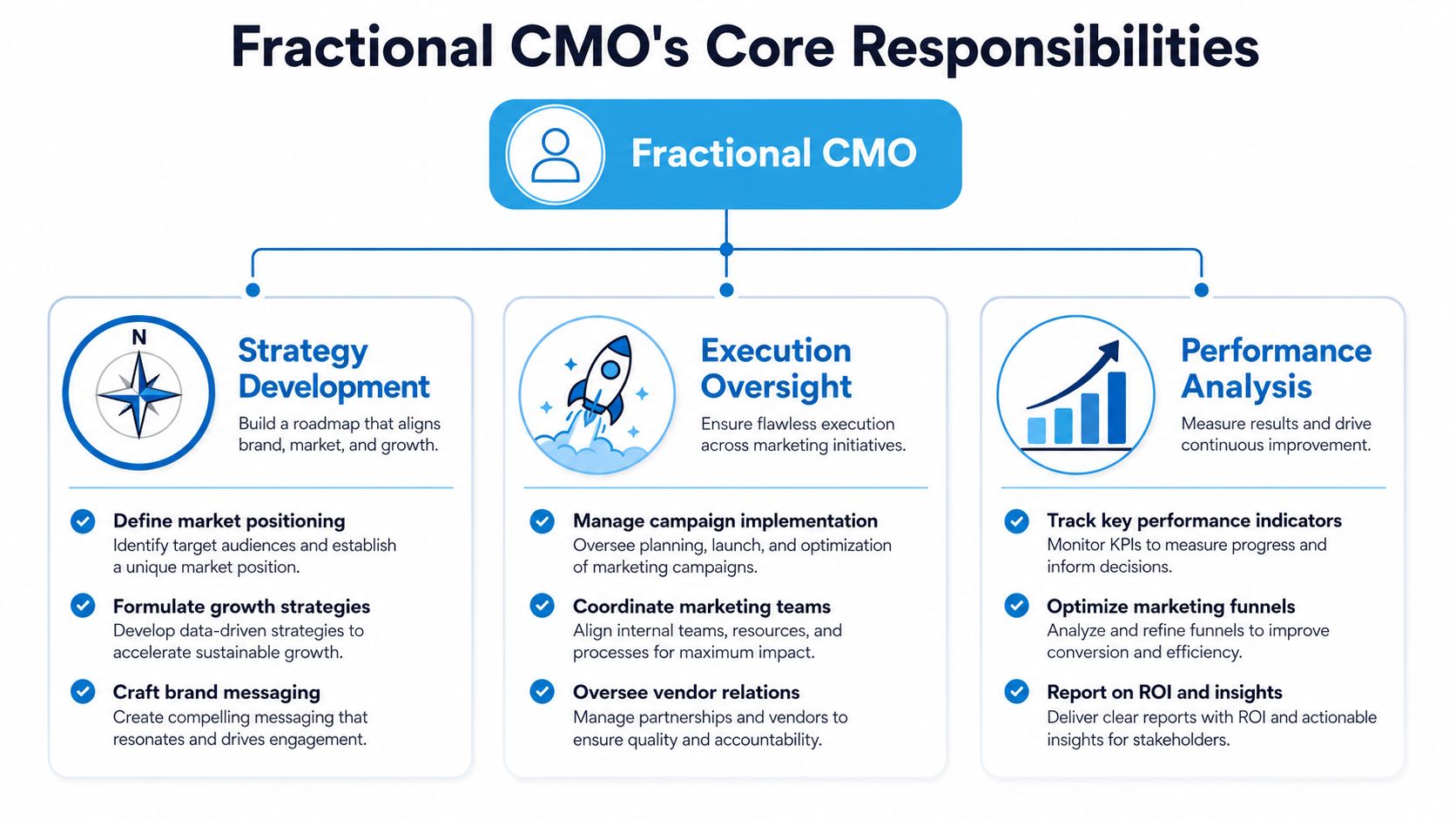
According to Lebowski's analysis of fractional marketing leadership, fractional CMOs provide senior-level go-to-market leadership and deliver 48% faster time-to-market than building a full-time marketing leadership structure. The same analysis defines the role across three core areas: strategy development, execution, and commercial alignment.
They set direction
A good fractional CMO clarifies where the company is going to win.
That means tightening positioning, defining the ideal customer profile, setting channel priorities, and deciding what not to do. If your startup is chasing every possible segment, your problem isn't content volume. It's strategic indecision.
This work should produce a few concrete outputs:
- A sharper market position: What the product does, who it's for, and why it's different.
- A realistic growth roadmap: Which channels deserve focus now, later, or not at all.
- A measurement framework: KPIs that connect marketing activity to pipeline, conversion, and revenue.
They own the execution system
This is the execution gap most founders underestimate. A startup doesn't benefit from strategy unless someone translates it into weekly work, manages the moving parts, and keeps standards high.
That can include briefing a copywriter, tightening a landing page in Webflow, reviewing HubSpot lifecycle stages, aligning paid search creative with sales objections, or pushing an agency to fix weak targeting. The best fractional CMOs don't do every task themselves. They make sure the right tasks happen in the right order.
Practical rule: If a candidate only talks about vision, brand, and board decks, you're interviewing an advisor, not an operator.
They align marketing with revenue
Startups get in trouble when marketing, product, and sales operate as separate conversations. The fractional CMO should connect them.
They make sure messaging reflects the actual product, demand generation supports the sales process, and budget decisions serve commercial outcomes instead of channel vanity. If sales says leads are weak, the answer isn't “marketing generated volume.” The answer is to fix the system.
That's the value of a fractional CMO for startups. They don't just create plans. They create accountability.
Key Signs Your Startup is Ready for a Fractional CMO
A common startup scene looks like this. The founder still approves homepage copy at 11 p.m., an agency sends reports nobody trusts, a junior marketer stays busy but cannot set priorities, and sales keeps saying lead quality is off. Marketing is happening. It is not being led.
That is the point where a fractional CMO starts to make sense.
The decision has little to do with title and everything to do with management load. You are ready when marketing choices carry real revenue consequences, but the company still should not spend full-time executive dollars on one senior hire.
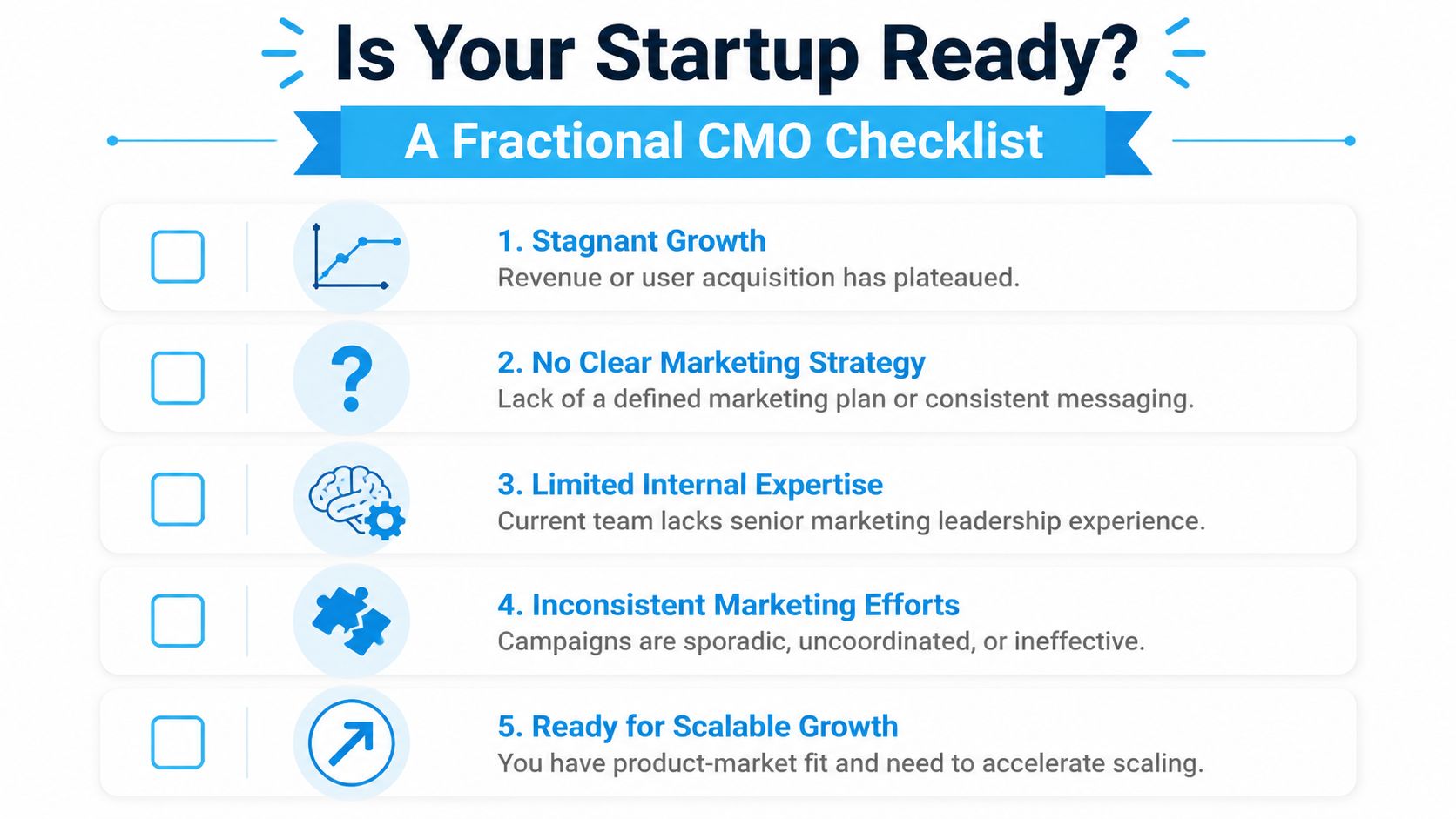
Your team is producing work, but nobody is directing the system
This is the clearest sign.
Campaigns go out. Content gets published. Paid spend continues. CRM workflows exist. Yet nobody is making hard calls on positioning, channel priority, funnel design, or budget trade-offs. Activity fills the week, but it does not build a repeatable growth engine.
You will usually see one of these patterns:
- A junior marketer is carrying too much weight: They can ship tasks and coordinate vendors, but they cannot decide what to stop, what to test, and what the company should bet on.
- An agency is doing work without owning outcomes: You are getting assets, reports, and meetings. You are not getting clear direction, strong internal alignment, or accountability for business results.
- The founder is still the approval bottleneck: Marketing cannot move without your input on messaging, spend, priorities, and trade-offs. That slows the team and keeps strategy trapped in your head.
- Channel debates are replacing diagnosis: The team keeps asking whether to invest in SEO, paid social, outbound, or content when the underlying issue is weak positioning, poor conversion paths, or unclear ICP definition.
If your weekly marketing meeting keeps returning to the same unresolved basics, you do not need more motion. You need leadership.
You need senior judgment, but you also need execution capacity
Many founders make the same mistake here. They hire a solo fractional strategist who writes a smart plan, presents it well, and disappears until the next monthly call. The strategy may be sound. It still fails because nobody owns implementation.
This execution gap is where many fractional CMO engagements break down.
A startup is ready for a fractional CMO when it needs both strategic direction and a practical way to get the work done. In some cases, that means one strong operator who can lead internal staff and agencies. In many cases, the better fit is an integrated model with strategy plus execution support, so the company is not left holding a roadmap with no driver.
Use that standard when you evaluate options. If the business lacks writers, designers, channel specialists, marketing ops support, or project management discipline, a solo advisor will not solve the actual problem.
Growth pressure has outgrown founder-led marketing
Founder-led marketing works early because speed matters more than structure. Then the company reaches a stage where instincts are no longer enough.
Watch for these signs:
- Growth has stalled: Demand is no longer improving from simple founder effort and ad hoc experiments.
- CAC pressure is rising: Acquisition costs are climbing, but nobody can say whether the problem sits in targeting, messaging, conversion, or sales follow-up.
- A fundraise or revenue target changed the standard: The business now needs a real plan, clear ownership, and predictable execution.
- Sales, product, and marketing are drifting apart: Each function is making reasonable decisions on its own, but the combined go-to-market motion is getting weaker.
- You are about to hire multiple marketing resources: Before adding agencies, freelancers, or junior staff, put someone in place who can set priorities and manage the whole system.
Hire a fractional CMO when better decisions need to happen every week.
The strongest candidates are not prestige hires. They bring focus, impose order, and close the gap between strategy and execution. If they cannot show how the work will get done after the plan is approved, keep looking.
The Business Impact Why Startups Hire Fractional CMOs
A founder usually reaches this decision after an expensive quarter. Pipeline is uneven. Paid spend is harder to justify. Sales wants better leads, product wants sharper positioning, and nobody owns the full revenue story. Hiring a full-time CMO can fix that. It can also lock a young company into a large executive cost before the business is ready.
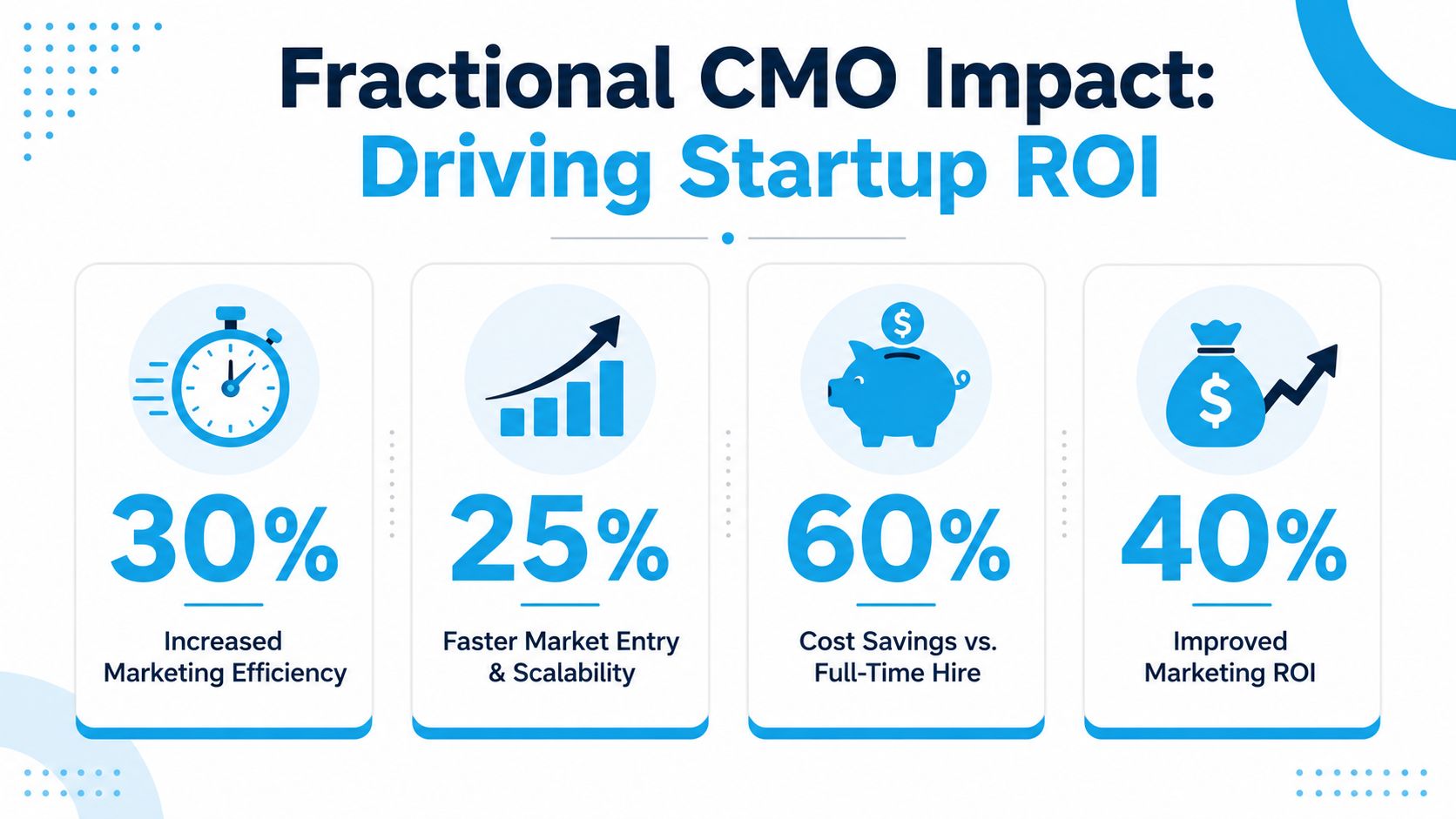
That is why startups hire fractional CMOs. They need senior judgment now, but they still need room in the budget to build campaigns, fix conversion paths, clean up CRM data, and ship the work.
The financial return comes from better allocation
The obvious benefit is lower executive overhead. A fractional CMO costs less than a full-time CMO because you are not paying for a full executive package, long recruiting cycle, and year-one ramp for a role you may not need at 40 hours a week.
That savings matters for one reason. It preserves capital for execution.
If your budget all goes to senior strategy, you still lose. Startups need copy, design, paid media management, lifecycle setup, analytics, landing pages, and reporting discipline. The right fractional model gives you leadership without starving the work that produces revenue. If you want to pressure-test the math, use a fractional marketing cost estimator before you compare options.
| Cost area | Full-time CMO | Fractional CMO |
|---|---|---|
| Executive cost burden | Higher | Lower |
| Hiring and onboarding risk | Higher | Lower |
| Budget left for execution | Lower | Higher |
| Flexibility if priorities change | Lower | Higher |
The real value is strategic control
Cost savings get attention. Better coordination creates the return.
Startups rarely fail because they had no ideas. They fail because marketing activity fragments across channels and teams. Paid media targets one problem. Sales pitches another. The website reflects an old story. Reporting is partial, so nobody can tell which issue is hurting growth.
A strong fractional CMO fixes that by setting one go-to-market direction, forcing trade-offs, and giving each function a shared operating plan. That changes how money gets spent and how fast the company can correct mistakes.
The execution gap decides whether the hire pays off
This is the part many guides miss.
A solo fractional CMO can produce a sharp strategy, a clean roadmap, and a confident board update. None of that matters if the company lacks the people and systems to implement the plan. Founders then end up managing freelancers, chasing agencies, and translating strategy into tasks themselves. They bought leadership and kept the execution burden.
That is why the model matters as much as the individual.
The strongest setup for many startups is not a standalone advisor. It is an integrated model that combines senior marketing leadership with the people who can build, launch, measure, and refine the work. That structure closes the gap between deciding what to do and getting it done. It also lowers founder overhead, which is often the hidden cost nobody prices in.
If a fractional CMO cannot show who will execute the roadmap, how work will be prioritized, and how results will be reviewed, the engagement is incomplete.
Founders should judge business impact with a simple question. Will this hire improve decisions and increase execution capacity at the same time? If the answer is no, you are buying advice, not momentum.
Engagement Structures and Pricing Models
Not every fractional CMO engagement is built the same way. That matters because the structure determines whether you're buying advice, management, or a functional growth system.
The traditional models still dominate. They can work. But founders should be honest about the trade-off. Many solo consultants are excellent at strategy and weak at implementation capacity. If your startup already has a capable team in HubSpot, Google Ads, Webflow, Figma, and analytics, that may be enough. If you don't, the solo model often exposes the execution gap fast.
The classic solo consultant model
The usual structures are hourly, project-based, or retainer.
| Model | Best For | Execution Support | Management Overhead |
|---|---|---|---|
| Hourly advisory | Founder coaching, audits, one-off guidance | Low | High |
| Project-based strategy | Positioning work, GTM plans, launch planning | Low to moderate | Medium to high |
| Monthly retainer | Ongoing leadership and prioritization | Moderate | Medium |
| Membership-based integrated team | Startups needing strategy plus production | High | Lower |
Hourly work is useful when the founder wants judgment on a narrow issue. It's rarely enough to run a startup's marketing function.
Project-based work can help with repositioning, category messaging, or launch planning. But once the deck is done, the startup still needs someone to implement, review, and adjust.
Retainers are the standard middle ground. Verified market data shows typical monthly retainers for fractional CMOs in the $5,000 to $15,000 range, with annualized costs of $60,000 to $180,000. That can be efficient, but only if the company already has execution horsepower.
The integrated team model
This is the model more founders should consider. Instead of hiring one strategist and then stitching together freelancers, developers, and channel specialists, you work with a structure that combines leadership with delivery.
The key question is not “What's the rate?” It's “Who is doing the work after the strategy is approved?”
An integrated setup is usually better when:
- The startup lacks a mature in-house team: There's nobody to absorb and execute the plan.
- Speed matters: You can't spend weeks sourcing separate specialists for copy, design, paid media, and web updates.
- Brand consistency is slipping: One operating system is easier to manage than five vendors.
- The founder wants fewer dependencies: One accountable group beats a strategy lead plus a cluster of contractors.
If you're comparing structures, use a practical budgeting tool like a marketing pricing estimator to pressure-test how much support you'll need. Don't just compare leadership cost. Compare total implementation cost, founder oversight time, and how quickly the work can start.
That's the important distinction. The best engagement model isn't the cheapest on paper. It's the one your startup can execute.
How to Evaluate and Choose the Right Partner
A common mistake is asking whether a fractional CMO has startup experience before asking how they will help your team ship work.
Experience matters. Delivery matters more. A polished operator can run a sharp strategy session, produce a clean roadmap, and still leave your startup with the same problem: nobody owns implementation on Monday.
That is the execution gap. It is the main reason fractional CMO engagements disappoint founders.

Ask how work gets done
Do not spend the first call on pedigree. Spend it on operating model.
Ask blunt questions:
- What happens in the first 30 days: Will they audit positioning, interview customers, clean up analytics, review funnel conversion, or reset channel priorities?
- Who does the work after priorities are set: Your team, outside freelancers, agency partners, or their own embedded specialists?
- What can be shipped in the first month: A new homepage, revised messaging, campaign launches, CRM cleanup, reporting fixes, or just a strategy deck?
- How is progress managed: Weekly priorities, pipeline reviews, dashboard reporting, channel scorecards, or ad hoc founder check-ins?
- What does handoff look like: Will your next in-house leader inherit documentation, playbooks, reporting, and meeting cadence, or have to rebuild the system from scratch?
Clear answers signal a real operating model. Vague answers signal a consultant who stops at advice.
That distinction matters because solo consultants and integrated team models create very different outcomes. A solo fractional CMO can be the right hire if you already have strong internal execution. If you do not, choose a partner that pairs strategy with delivery capacity. Otherwise you are buying direction without momentum.
Factor in the hidden cost of coordination
Fragmented support looks cheaper in a spreadsheet. It often costs more in founder time.
A strategist sets direction. A freelancer writes copy. A paid media contractor runs campaigns. A designer waits on inputs. Nobody owns the full system, so the founder becomes the translator, project manager, and tie-breaker. That work is expensive even when it never shows up on an invoice.
A frequently overlooked cost is coordination drag. The wrong setup creates more meetings, more re-explaining, and more delays between decision and launch.
Use this filter when comparing partners:
- Stage fit: Have they worked with companies at your stage, with your level of team maturity and reporting discipline?
- Execution coverage: Can they support implementation directly, or will you need to hire and manage extra specialists?
- Commercial judgment: Do they connect positioning, pipeline, conversion, and spend, or stay stuck in channel tactics?
- Operating discipline: Can they explain tools, meeting cadence, ownership, and reporting in plain language?
- Founder load: Will this partner remove decisions from your plate, or create another layer for you to manage?
You should also test how they think about channel execution. If they can discuss tactical standards with the same clarity they bring to strategy, that is a good sign.
If you want a benchmark, review what structured senior marketing guidance for growing startups includes, then compare each provider against that bar. Choose the partner that reduces founder oversight and increases shipping speed. That is the hire that changes the business.
Your Next Step in Strategic Marketing
If founder-led marketing is breaking down, don't rush into a full-time executive hire just because the company feels more complex. Complexity alone doesn't justify overhead. What matters is whether the business needs senior direction, execution discipline, and cross-functional alignment right now.
That's why a fractional CMO for startups can be the right move. But be strict about the model. Strategy without implementation support creates a new bottleneck. The startup ends up with a better plan and the same operational problem.
Start with a simple internal audit. Review your positioning, channel mix, reporting, ownership gaps, and how many marketing decisions still depend on the founder. Then ask a harder question. If a strong strategy arrived tomorrow, who would execute it?
The next step is practical. Identify where leadership is missing, where execution is breaking, and whether one integrated model would remove more friction than another patchwork hire.
If you want a low-pressure way to assess that fit, SharedTEAMS offers a practical starting point for founders who need strategic guidance and execution support without jumping straight into a full-time hire. A focused audit of your current marketing gaps can tell you quickly whether you need a solo fractional CMO, a stronger internal operator, or a more integrated team model.