You may be in this position right now. Your team has spent money on PR, collected a stack of media mentions, and still can't answer a simple leadership question: did any of this improve rankings, pipeline, or revenue?
That frustration is reasonable. Traditional PR reports often stop at visibility. A modern digital PR service should go further. It should help your company earn authoritative coverage that supports organic search, strengthens trust, and creates assets your sales and marketing teams can use.
That shift isn't a niche trend. The global digital PR services market is projected to reach USD 60.20 billion by 2031, growing from USD 39.64 billion in 2026, according to Mordor Intelligence's digital PR services market report. The reason is practical. Companies are moving toward measurable, SEO-integrated public relations strategies that connect reputation work to search visibility and business growth.
Table of Contents
- Moving Beyond Hope as a Marketing Strategy
- What a Digital PR Service Actually Delivers
- The Digital PR Workflow from Strategy to Placement
- Measuring the Business Impact of Digital PR
- Digital PR Service Pricing and Engagement Models
- How to Evaluate and Choose the Right Provider
- Conclusion Turn Visibility Into Tangible Value
Moving Beyond Hope as a Marketing Strategy
A lot of PR buying still runs on optimism. Leadership approves a budget, an agency promises exposure, and a few months later the reporting package highlights mentions, estimated reach, and logos from publications your buyers may or may not care about.
That isn't enough if your company is trying to grow through search, improve conversion on commercial pages, or build category authority in a competitive market. CEOs don't need another awareness update detached from performance. They need to know whether the work increased discoverability, strengthened trust signals, and supported revenue.
Digital PR changed the standard because it brought PR closer to SEO and demand generation. Good coverage still matters for credibility, but the job isn't finished when an article goes live. The work has to influence how search engines evaluate your site and how buyers evaluate your brand.
Why the business conversation changed
The old model rewarded volume and optics. The newer model rewards relevance, authority, and measurable impact.
That changes the buying criteria. A serious provider should be able to explain:
- Which pages matter most and why they need authority support
- Which story angles are likely to earn editorial links rather than low-value mentions
- How coverage will be distributed internally across SEO, content, and sales functions
- How success will be judged beyond media volume
Practical rule: If a PR partner can't explain how earned coverage supports rankings, branded demand, or conversion paths, you're not buying a growth function. You're buying publicity.
What leaders should expect now
A digital PR service should feel closer to a performance marketing program than a publicity tour. It should have a thesis, a target, a measurement model, and technical follow-through.
That doesn't mean every campaign becomes a spreadsheet exercise. Judgment still matters. Editorial instincts matter. Relationships matter. But the work should lead somewhere concrete, especially for companies that need every marketing dollar to support growth.
The difference is simple. Hope is not a strategy. A measurable authority-building system is.
What a Digital PR Service Actually Delivers
At its best, a digital PR service is not “press release distribution with better branding.” It's a structured effort to earn editorial coverage that strengthens your website's authority and supports organic growth.
The core definition that matters
Digital PR is technically defined as an SEO-subcategory strategy where the primary success metric is the acquisition of editorial backlinks from high-domain-authority publications, as explained in Rhino Rank's guide to digital PR services. That matters because the output is not just awareness. It is meant to drive measurable gains in organic rankings and topical authority.
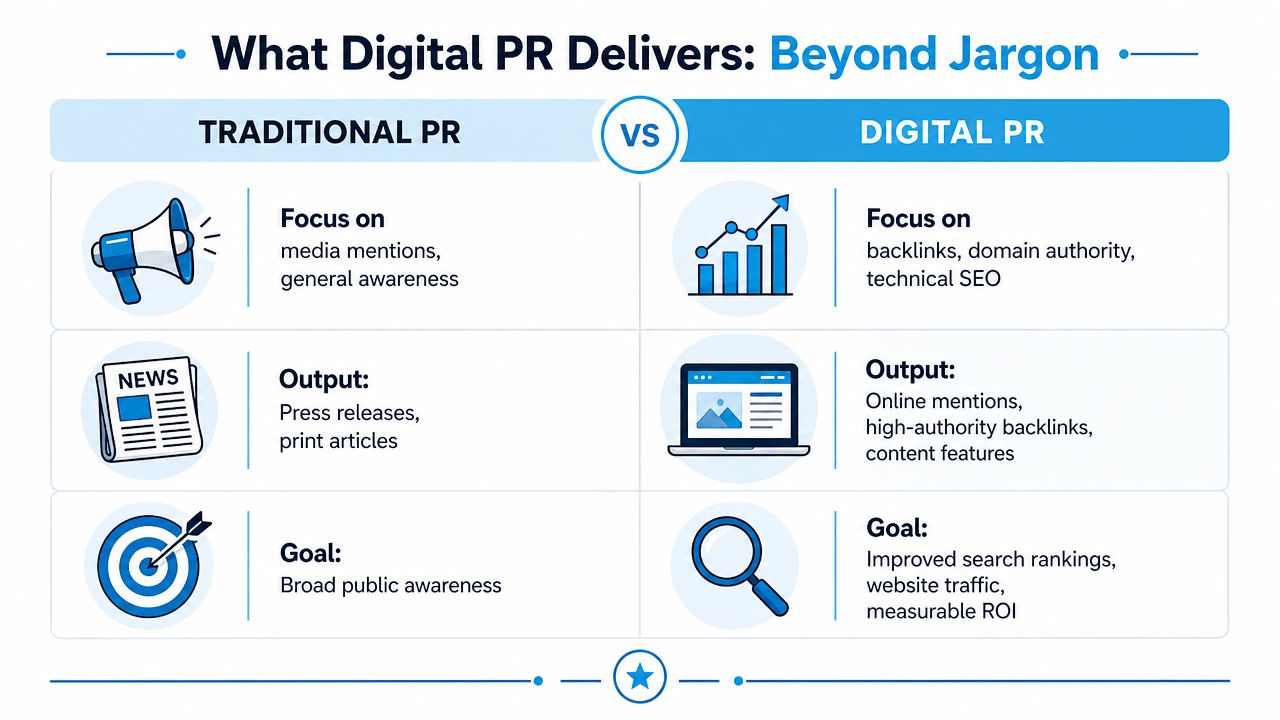
A simple way to think about it:
| Approach | Primary focus | Typical output | What leadership should care about |
|---|---|---|---|
| Traditional PR | Awareness and brand exposure | Press releases, interviews, print or broadcast mentions | Reputation and visibility |
| Content marketing | Publishing on owned channels | Blog posts, guides, landing pages, videos | Education, lead nurture, search coverage on your own site |
| Digital PR | Earning third-party editorial validation | Online features, citations, backlinks, expert commentary | Rankings, authority, qualified traffic, commercial support |
A lot of confusion comes from overlap. Digital PR often uses content marketing assets. It may also support broader communications. But the central test is different. Did the campaign earn third-party validation that improved your digital position?
For founders who want a sharper sense of what effective outreach and positioning can look like, strategies for founders to win at PR offers useful perspective on how to approach media attention with more precision.
What sits inside the service
The work usually includes several connected pieces. If a provider only offers one of these, you're not looking at a complete digital PR service.
Campaign angle development
The agency identifies a story journalists might cover. That could come from internal customer data, market behavior, expert commentary, or a fresh analysis of an industry claim.Linkable asset production
This is the thing people reference. It may be a data page, report, visual asset, quote bank, expert reaction piece, or interactive resource hosted on your site.Media targeting and outreach
Outreach should be selective. Good teams build journalist lists around relevance, beat fit, and editorial value. Bad teams blast a generic pitch to a giant list.On-site technical support
The asset has to live on a crawlable, indexable page with sensible internal links. If the source sits in a buried PDF or on a weak subdomain, you lose much of the SEO upside.Post-placement use of coverage
Coverage should not die in a monthly report. It should support website proof, executive credibility, sales follow-up, and brand search demand.
The best digital PR teams think like SEOs when they build assets, like editors when they shape stories, and like operators when they report outcomes.
That combination is what separates real authority building from glorified outreach.
The Digital PR Workflow from Strategy to Placement
Digital PR feels opaque from the outside because clients usually see only the beginning and the end. They approve an idea, then later they see a list of placements. The middle is where quality is decided.
How strong campaigns take shape
A reliable workflow starts with strategic filtering, not content production. Teams should first decide which themes are commercially important, which pages need authority support, and what kind of evidence the business can credibly bring to market.
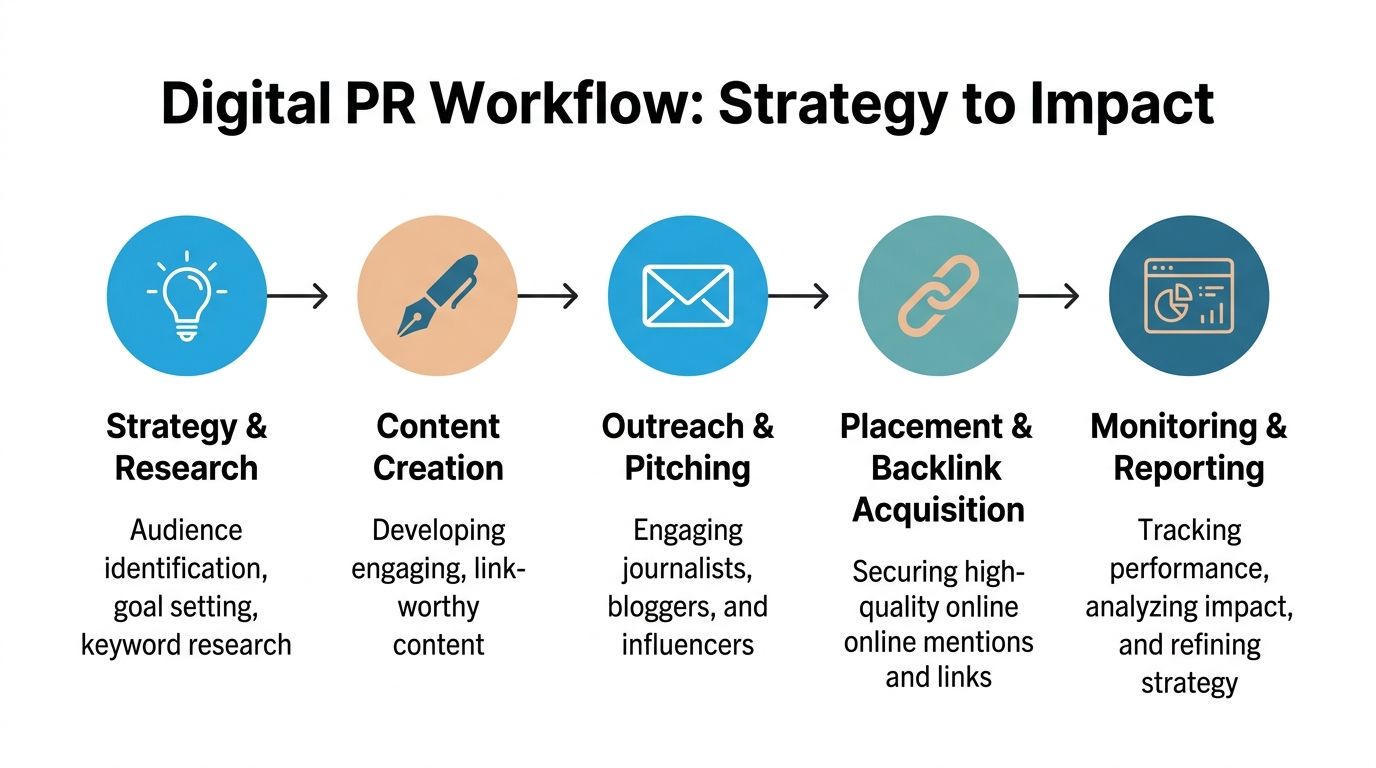
From there, the process usually moves through these stages:
Research and angle selection
The team reviews audience interests, competitor narratives, search opportunities, and internal business insight. The strongest angles sit where editorial relevance and business value overlap.Asset creation
The story becomes something usable. This could be a data hub, a concise research page, a visual summary, an expert response package, or a news-reactive content piece.Pitch development
Many campaigns often underperform in this phase. According to Relevance's overview of digital PR, high-performing pitches follow a tight structure: a one-sentence headline, a short story angle, a few bullet-proof data points, and a clear reason the story matters now. The email body should stay very short.
Before outreach starts, it helps to map the scope of publications, targets, and timelines in a concrete way. A structured media outreach project estimate is often the difference between disciplined execution and vague activity.
After the core plan is in place, this video offers a useful visual walkthrough of how digital PR fits into broader marketing execution:
What happens after coverage lands
Placements are not the finish line. Many agencies often leave value on the table.
A good team should review whether the placement linked to the intended page, whether the linked page supports a target topic cluster, and whether internal links route earned authority toward commercial pages that matter. If none of that happens, you may get a nice logo and very little lasting search benefit.
The post-placement phase should include:
Link and page quality review
Not every mention carries the same value. Relevance, placement context, and destination page all matter.Distribution across owned channels
Coverage can support newsletters, sales collateral, executive bios, investor materials, and proof sections on the website.Performance review cycles
Monthly analysis should look at referring domains, rankings, branded impressions, and traffic quality. Quarterly adjustments help refine themes and target publications.
Short outreach cycles create activity. Strong workflows create compounding authority.
That's the difference between a vendor who sends emails and a partner who runs a system.
Measuring the Business Impact of Digital PR
The biggest reporting mistake in digital PR is stopping at coverage. Coverage is an output. The question is whether that output changed anything meaningful.
The metrics that deserve executive attention
A useful scorecard starts with search performance, but it shouldn't end there.
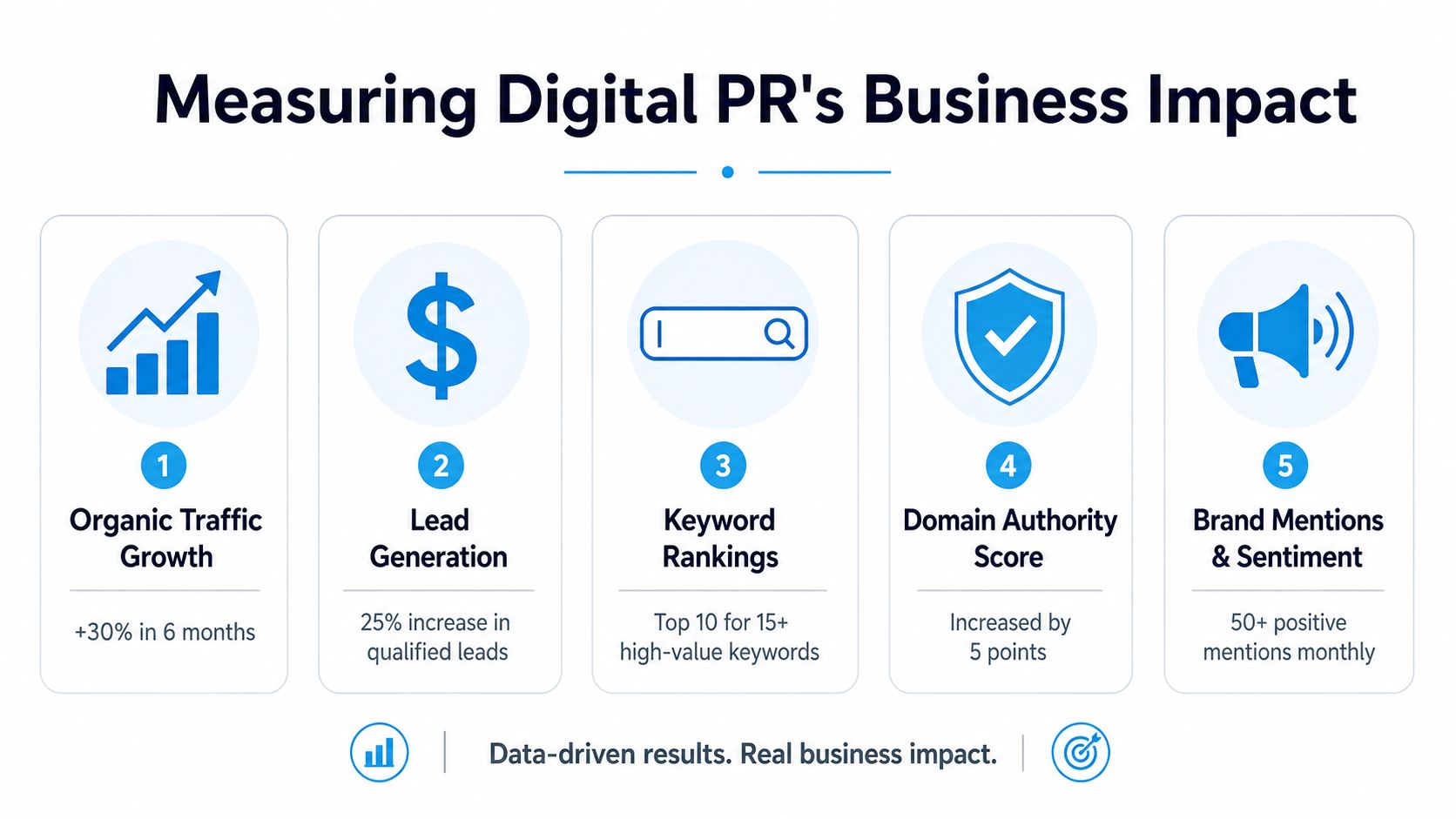
The first layer is operational:
| Metric | Why it matters |
|---|---|
| Referring domains to campaign assets | Shows whether the campaign earned actual editorial traction |
| Rankings for target keyword clusters | Indicates whether earned authority is helping important topics move |
| Google Search Console branded impressions | Helps reveal shifts in branded search demand |
| Referral traffic quality | Shows whether visitors from placements engage and assist conversions |
| Placement and interest rates | Helps benchmark outreach quality over time |
For outreach benchmarking, Moz's guidance on optimizing digital press coverage notes that teams should track Placement Rate and Interest Rate, and that a valid baseline requires at least 30 pitches. That matters because raw placement counts tell you very little without context.
At the business layer, reporting should get stricter. Digitaloft's measurement framework for digital PR recommends isolating lead or revenue growth on pages supported by campaigns in GA4 and comparing that growth over a rolling period against the sitewide average. That's a far more honest test than attributing every sale to the article that earned the link.
How to connect coverage to commercial value
The part most guides miss is what happens after the mention. PR Newswire's article on digital PR definition, examples, and benefits makes an important point: the value isn't just backlinks. It's also tracking branded search movement and using coverage for sales enablement and website conversion support.
That means your team should ask:
- Did branded search trend upward after sustained coverage?
- Did PR-supported pages improve lead quality or assisted conversions?
- Were strong logos and quotes added to pages where buyers make decisions?
- Did sales reps get a usable sentence or proof point from the placement?
Annual benchmarking also matters. Hallam's digital PR measurement guide notes that Share of Voice and Share of Search are annual metrics used to compare your brand's online presence against organic competitors.
If your reporting includes social amplification, use a measurement method that keeps the analysis grounded in outcomes rather than vanity engagement. For teams that need a more technical view of that side, tracking social media for developers is a useful reference. And if you need an SEO-centered execution model for earned authority, a dedicated link building service often sits next to digital PR in the broader mix.
Coverage matters most when it changes what prospects search, what pages rank, and what sales conversations sound like.
Digital PR Service Pricing and Engagement Models
Cost questions are fair. Digital PR can be a strong growth lever, but only if the commercial logic holds up.
How agencies usually price the work
The most common model is the monthly retainer. According to Shno's roundup of digital PR statistics, digital PR agency retainers typically range from $5,000 to $10,000 per month, which is often lower than traditional PR agency pricing.

That range can make sense when the provider is doing real strategic work, producing campaign assets, running thoughtful outreach, and reporting against business outcomes. It makes less sense when the agency is mostly reskinning press releases and sending them to a broad contact list.
Pricing usually moves based on a few realities:
Research complexity
Campaigns built on original analysis or proprietary data take more planning and QA than simple expert commentary.Asset production demands
A polished report page, custom graphics, or interactive content requires more coordination than a quote-led reactive campaign.Outreach depth
Niche lists, journalist matching, follow-up discipline, and vertical tailoring increase labor, but they usually improve relevance.Technical involvement
If the provider also coordinates page structure, internal links, indexation checks, and measurement setup, the work is more valuable and more demanding.
Why flexible models deserve a serious look
The retainer model isn't wrong. It's just not always the best fit.
Some businesses need sustained PR support each month. Others need senior oversight, selective campaign execution, and the flexibility to shift budget between digital PR, content, web updates, SEO support, and sales enablement as priorities change. That's where newer agency structures are more practical.
A fractional or membership-based model can be a better operational fit when:
| Business situation | Why flexibility helps |
|---|---|
| You don't need a full-time PR program every month | You can activate specialist support when the angle, asset, or launch is ready |
| Internal teams are thin | You get access to strategists, writers, designers, and outreach support without adding headcount |
| Priorities move quickly | Budget can shift between supporting assets, technical fixes, distribution, and campaign follow-up |
| Leadership wants tighter oversight | Scoping is clearer, and work can be approved in smaller, more accountable units |
This model tends to work well for SMBs, lean marketing teams, and companies in transition. It also creates a healthier buying decision. Instead of asking, “How many links are we getting this month?” the better question becomes, “What combination of strategy and execution is most likely to improve authority and revenue over the next quarter?”
That's a smarter way to buy marketing.
How to Evaluate and Choose the Right Provider
A provider can sound impressive and still be a poor fit. The easiest way to avoid that mistake is to ask questions that expose process quality, technical depth, and commercial thinking.
Questions that reveal real capability
Start with the story engine. A lot of agencies talk confidently about “data-led campaigns” but struggle when the client doesn't have a research department.
That matters because, as Use Shiny's digital PR strategies guide points out, many SMBs face a real gap between limited proprietary data and journalists' preference for original research. A good provider should be able to explain how they'll create newsworthy angles from operational data, customer feedback, anonymized usage patterns, or disciplined manual analysis without forcing you into expensive external studies.
Ask questions like these:
- How do you find stories when a client doesn't have a large original dataset?
- What kind of page or asset do you build on the client site before outreach begins?
- How do you decide which pages should benefit from the authority you're trying to earn?
- What does your reporting include beyond placement counts?
- How do you turn coverage into website proof or sales enablement?
- Who handles technical SEO decisions if a link points to the wrong page or a weak asset?
If the answers stay vague, the delivery will probably be vague too.
For companies that need stronger planning before they buy execution, a structured marketing strategy service often helps clarify whether digital PR is the right lever now, or whether technical SEO, content infrastructure, or conversion work should come first.
Red flags that usually lead to wasted budget
Some warning signs are consistent.
If a provider guarantees specific top-tier placements, treat that as a credibility problem, not a selling point.
Other red flags include:
Vanity-metric reporting
If the agency leads with impressions, “potential reach,” or generic sentiment summaries, expect weak business accountability.No technical SEO discussion
Digital PR without crawlability, page targeting, and internal linking is incomplete.One-size-fits-all campaigns
The same survey format and same media list won't work across sectors, maturity levels, and buyer types.No post-coverage plan
If the agency can't explain how placements support conversion or brand demand after publication, they're treating PR as an isolated tactic.Weak explanation of fit
A strong partner should tell you when a full retainer is too much, when a lighter engagement is enough, and when the business simply isn't ready.
The right choice is not always the biggest agency or the flashiest deck. It's the team whose process fits your market, your internal capacity, and your growth priorities.
Conclusion Turn Visibility Into Tangible Value
A strong digital PR service doesn't sell attention for attention's sake. It builds authority your site can use, trust your buyers can recognize, and proof your team can turn into better sales and marketing performance.
That's the standard worth holding. Look for a partner who understands search, editorial judgment, technical execution, and commercial measurement. Then evaluate the engagement model with the same discipline. The best setup is the one that gives you the right level of expertise, flexibility, and accountability for where your business is now.
If you want a practical next step, SharedTEAMS offers a flexible way to assess where digital PR fits inside your wider marketing system. Their fractional, on-demand model is useful for organizations that need expert guidance and execution without locking into a rigid long-term retainer.