Your marketing manager is stretched thin. Your founder is still approving copy. Paid campaigns are running, but nobody is sure which ones deserve more budget. The website is outdated, sales wants better leads, and every new initiative seems to require hiring another specialist you can't justify full-time.
That's where many SMBs are when they start asking what is fractional marketing.
They don't need another vague strategy deck. They need senior judgment, real execution, and a model that fits the budget and pace of a growing company. The problem is that most explanations stop at “hire a fractional CMO” and ignore the harder reality. Strategy without production usually stalls. Execution without ownership usually drifts.
Fractional marketing works best when it closes that gap. You get part-time senior leadership, but you also need a practical way to turn strategy into campaigns, content, landing pages, reporting, and iteration. For many small and mid-sized businesses, that modular team model is the difference between a smart plan and actual progress.
Table of Contents
- Introduction
- Understanding Key Concepts of Fractional Marketing
- Exploring Engagement Models and Membership Approaches
- Benefits and Outcomes for SMBs
- Comparing Costs with Full-Time Hires and Agencies
- Real-World Use Cases and Quick ROI Examples
- Decision Checklist for Choosing a Fractional Provider
- Conclusion and Next Steps
Introduction
A lot of SMB leaders reach the same point at roughly the same time. Marketing exists, but it doesn't feel managed. One person is posting on social. A freelancer is updating the website when asked. An agency is running ads. Sales is asking for better messaging. Nobody owns the whole system.
That setup can limp along for a while. Then lead costs rise, campaigns go out late, brand consistency slips, and the business starts spending money without a clear operating plan.
Fractional marketing is the fix when you need more than production but aren't ready for a full internal department. It gives you access to senior marketing leadership on a part-time basis, then layers in execution where it's needed. Done well, it creates direction, accountability, and enough production capacity to keep momentum.
Most SMBs don't have a marketing talent problem first. They have a coordination problem.
The important distinction is this. The best fractional model isn't just one senior adviser giving recommendations from the sidelines. It's a modular structure that combines strategic oversight with hands-on delivery. That's what helps businesses move from scattered activity to a functioning marketing engine.
Understanding Key Concepts of Fractional Marketing
What fractional marketing actually means
Fractional marketing is a resourcing model where a business brings in senior marketing leadership on a part-time, project, or retainer basis instead of hiring that person full-time. A fractional CMO or head of growth typically works 10 to 20 hours per week while serving two or three clients simultaneously, and a well-structured engagement that includes a fractional leader plus execution support typically costs $8,000 to $25,000 per month according to Geisheker's overview of fractional marketing.
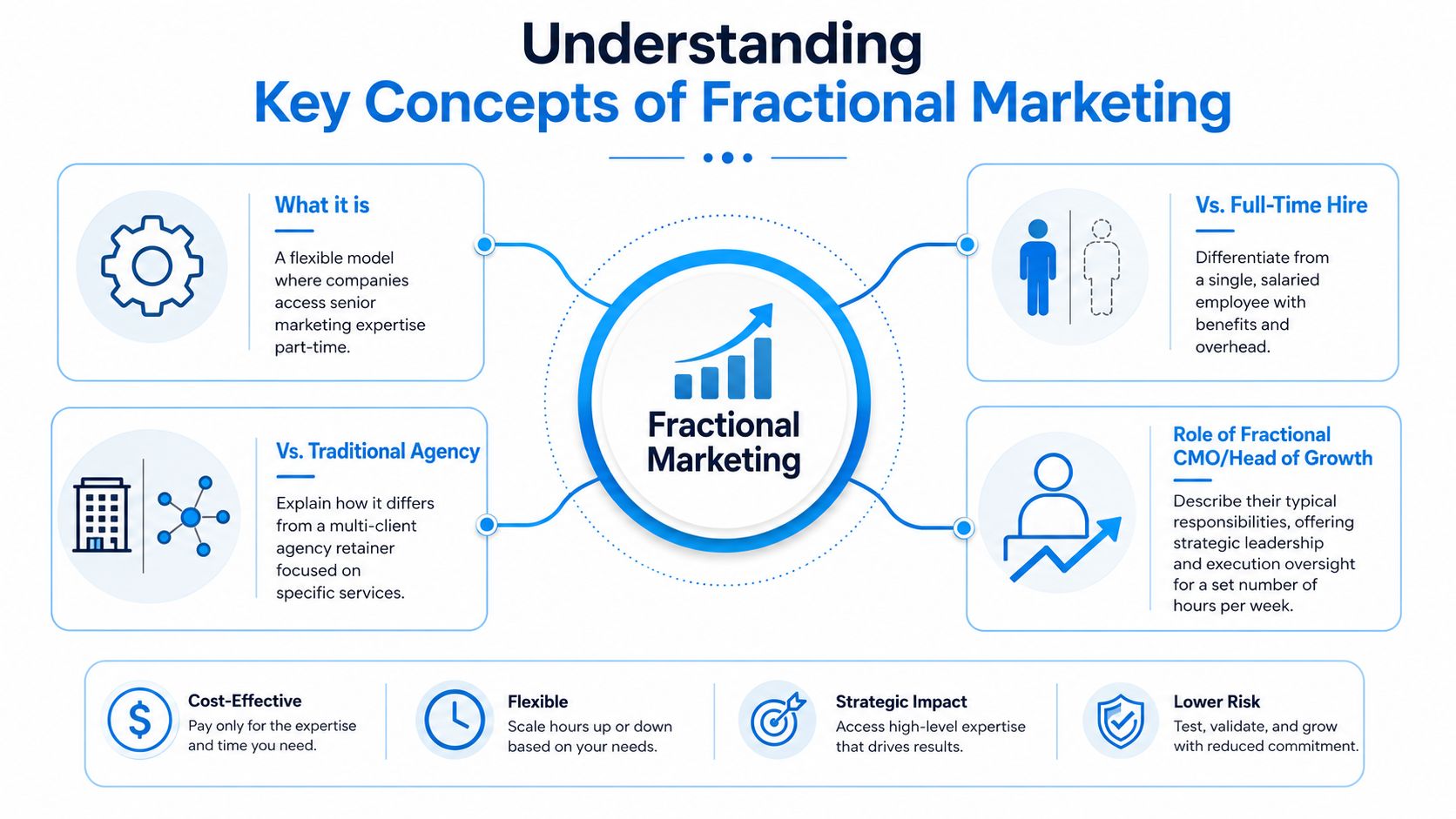
That definition matters because a lot of businesses confuse three different things:
- A consultant gives advice.
- An agency delivers scoped services.
- A fractional leader owns priorities, makes decisions, and stays accountable for outcomes.
Another useful operating range appears in Her Business Alliance's explanation of fractional marketing, which notes that fractional marketing professionals typically work 10 to 30 hours per week with a single client. That range helps distinguish this model from a casual part-time contractor. The point isn't reduced commitment. The point is concentrated senior attention.
Here's a useful visual summary before going deeper.
Why the team model matters
Most guides get too narrow. They explain the role of a fractional CMO, then leave SMBs wondering who will build landing pages, write campaign assets, manage paid search, update tracking, or keep content moving.
That's the strategy-execution gap, and it's the main reason some engagements disappoint. A senior leader without production support often creates a backlog of smart ideas. A delivery team without strategic ownership often produces disconnected work.
A stronger model uses a modular fractional team. The senior marketer sets direction, defines channel priorities, sharpens positioning, and chooses how success will be measured. Then specialists handle the work that supports that plan, whether that's PPC, SEO, content, design, web development, email, or reporting.
Practical rule: If a provider can only talk about leadership or only talk about deliverables, you probably still have a gap.
This is also why fractional marketing differs from a traditional agency relationship. In the verified data, agencies are described as more limited to discrete deliverables, while fractional marketers work as embedded internal components with access to systems like CRM, email engines, and analytics. That internal access changes the quality of decisions because the team can adjust based on what's happening inside the business, not just what was written in the original scope.
For SMBs, that embedded model is usually the primary value. It gives you judgment, not just activity.
Exploring Engagement Models and Membership Approaches
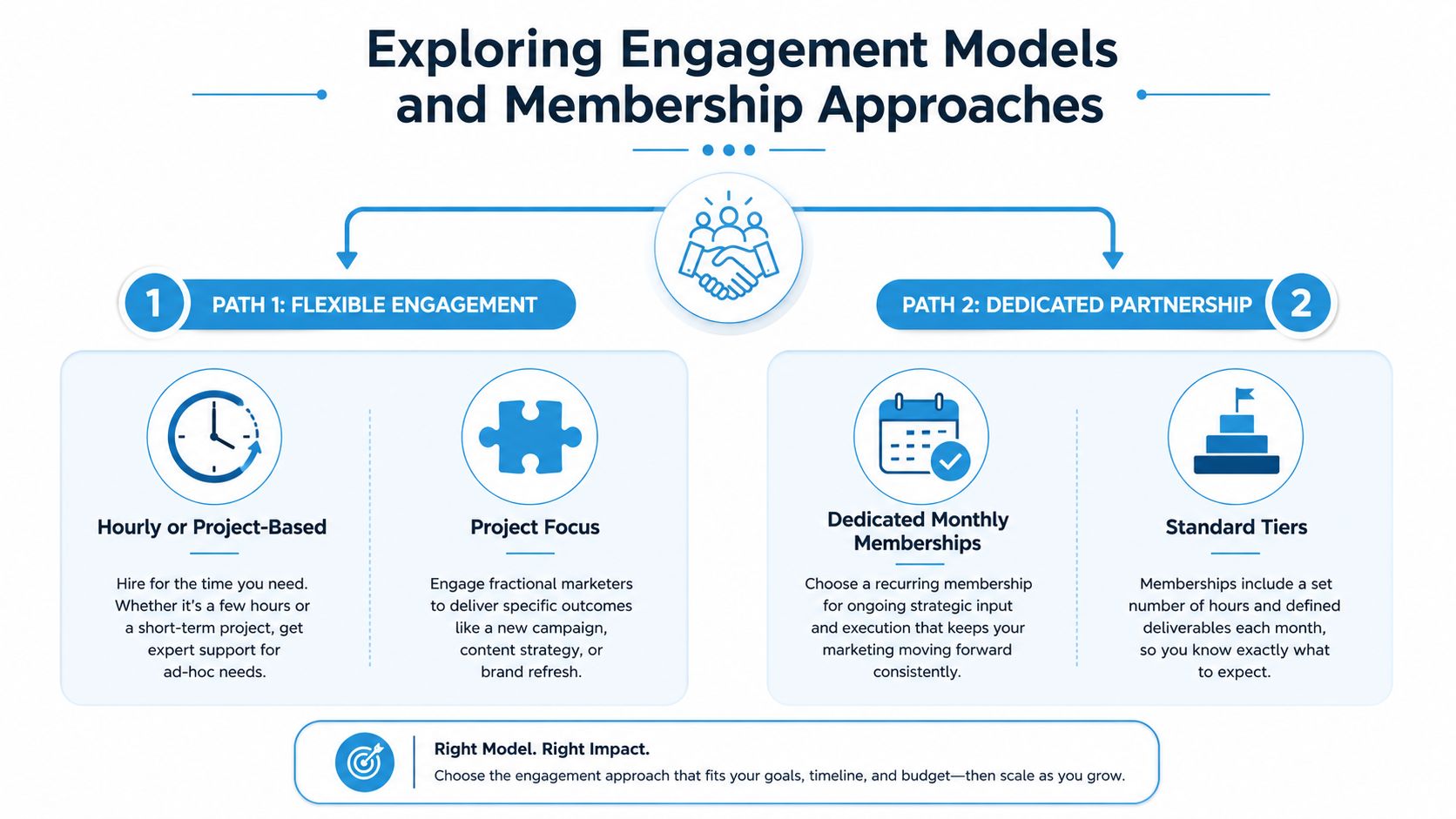
Some businesses need a marketing partner for a specific push. Others need an ongoing operating layer. Those are different buying decisions, and you should treat them that way.
When flexible engagement makes sense
A flexible engagement works best when your needs are clear but not constant. You may need a campaign launch, a website refresh, ad account cleanup, a brand messaging reset, or support for a seasonal initiative. In that model, you're not trying to build a standing department. You're buying focused access to strategic guidance plus defined execution.
This structure is useful when:
- The scope is contained and you can name the project or problem.
- Your budget needs control through hourly or project-based work.
- Your internal team exists but lacks a specialist in one area.
- You need quick movement without committing to a heavier monthly setup.
According to Altitude Marketing's explanation of fractional marketing for complex B2B companies, benchmark data shows average project start times of 1 to 3 days for dedicated and standard tiers, with AI-enabled workflows increasing speed and consistency while reducing acquisition costs through expert-led optimization cycles. That speed matters for SMBs because marketing problems are rarely isolated. A delayed landing page slows ad launches. A delayed ad launch affects lead flow. A delayed lead flow pressures sales.
If you want a concrete example of this kind of structure, a service like marketing guidance memberships can fit companies that want strategic input and on-demand project support without building a full internal team first.
When a dedicated membership is the better fit
A dedicated monthly membership is a stronger option when marketing has become continuous operational work. You've moved beyond one-off fixes. You need prioritization, production cadence, and tighter communication.
That model usually works better when the business needs:
| Engagement type | Best fit | Main advantage | Main trade-off |
|---|---|---|---|
| Flexible hourly or project-based | Defined campaigns or isolated needs | Lower commitment and clean scope | Less continuity |
| Dedicated monthly membership | Ongoing channel management and recurring priorities | Faster routing and better context retention | Requires stronger internal alignment |
A dedicated setup tends to produce better work over time because the team keeps a living record of brand standards, channel history, active priorities, and approved workflows. The team doesn't restart from zero every month. That reduces rework and keeps messaging more consistent.
The operational difference is simple. In a flexible model, you brief each project. In a dedicated model, the team already knows the account, the brand, and the next priorities.
Good fractional marketing should feel easier to manage over time, not harder.
If your company is regularly balancing ad work, web updates, content requests, campaign reporting, and sales support, a dedicated structure is usually the smarter choice. It creates momentum because strategy and execution happen in the same system instead of across scattered vendors.
Benefits and Outcomes for SMBs
The biggest benefit of fractional marketing isn't cost. It's clarity with output.
SMBs usually don't struggle because nobody is doing marketing. They struggle because the work happening each week doesn't connect well enough to business priorities. Fractional marketing can fix that by giving one senior person or one coordinated team authority to decide what matters now, what can wait, and what should stop.
What improves when strategy and execution stay connected
The verified data points to a strong pattern here. Companies utilizing fractional marketing report 80% higher marketing impact compared to their previous arrangements, and the most effective engagements combine tactical implementation with strategic guidance according to GTM 80/20's fractional CMO statistics.
That tracks with what many SMBs need. Not another slide deck. Not another siloed specialist. They need someone who can connect positioning, channel choice, messaging, reporting, and production.
When that happens, several things usually improve:
- Priority setting gets sharper. Teams stop chasing every idea and focus on the few channels and offers most likely to matter.
- Execution quality rises. Creative, copy, landing pages, and reporting are built against a strategy instead of as isolated tasks.
- Internal coordination gets easier. Sales, leadership, and marketing work from the same plan more often.
- Iteration speeds up. Campaigns can be reviewed and adjusted quickly because the people making decisions are close to the work.
Where SMBs usually feel the difference first
The first gains are often operational. Work starts moving with fewer delays. Brand voice becomes more consistent. Leadership has a better read on what marketing is doing and why.
Then the strategic value becomes clearer. Fractional marketers function as embedded internal components with access to systems and active data, which allows them to adjust based on actual performance instead of waiting for a quarterly reset. That's a better fit for growing companies than static planning cycles.
A modular team also helps businesses expand capacity without adding headcount role by role. If you need ad support this month and web support next month, you can shift resources without reopening a hiring process. That flexibility is often more useful than a single generalist employee trying to cover every function.
The SMB win is simple. You get senior decision-making and enough execution power to act on it.
This model also suits companies that are in-between stages. Maybe you've outgrown founder-led marketing, but you're not ready to hire a full-time CMO plus specialists. Fractional marketing fills that middle ground well, especially when the provider can supply both oversight and production instead of forcing you to assemble the rest yourself.
Comparing Costs with Full-Time Hires and Agencies
The cost conversation around fractional marketing often gets oversimplified. It's not just “cheaper than hiring.” The better question is what kind of cost you're taking on, what level of ownership you get back, and how much waste the model removes.
What you are really paying for in each model
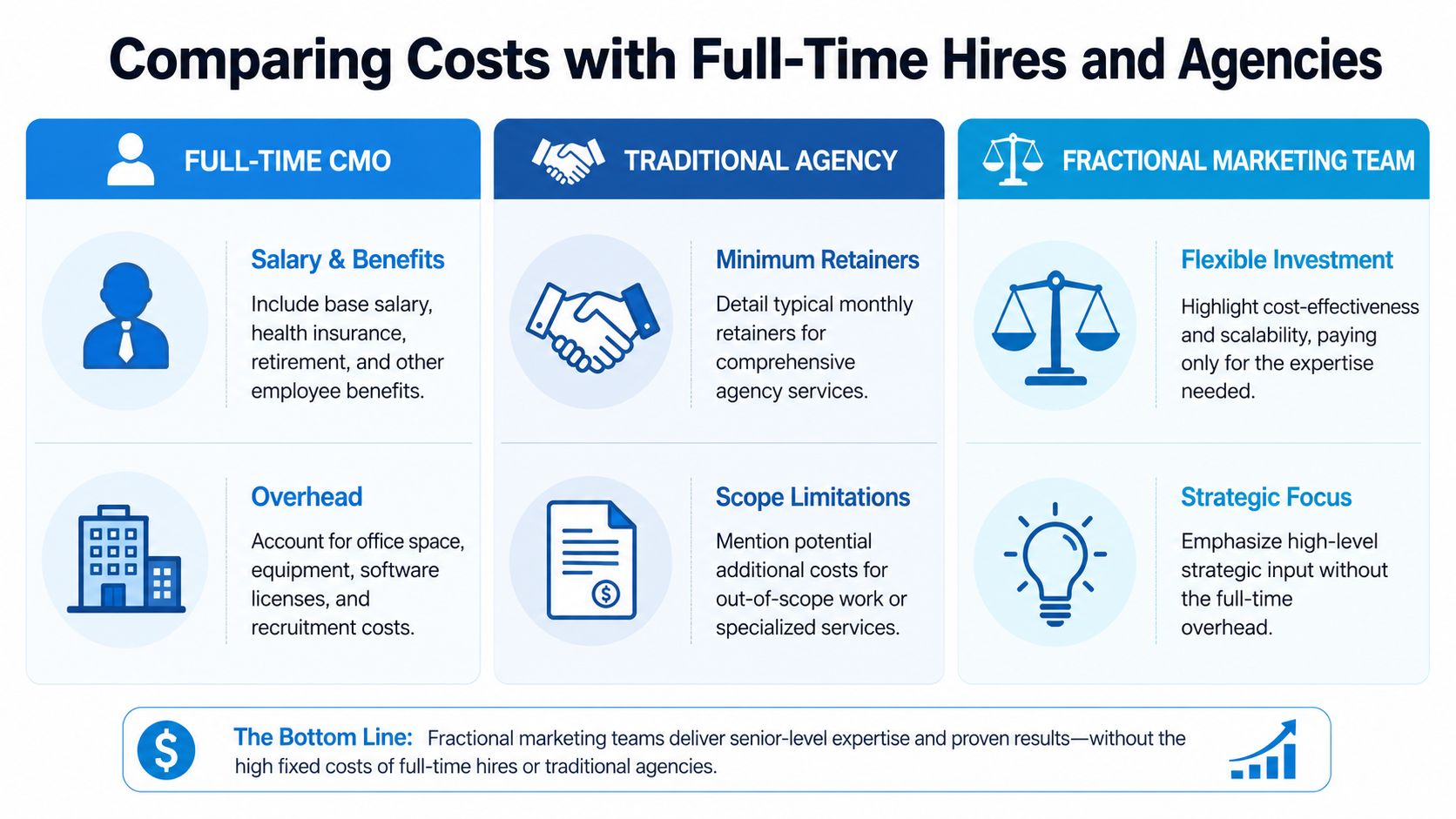
A full-time executive can make sense, but only if the business requires daily executive presence and can absorb the full employment cost. The verified data makes the basic economics clear. The primary cost advantage of fractional marketing comes from replacing a full-time executive salary of $200,000 or more, plus benefits and overhead, with a proportional engagement fee according to Cocan Media's guide to fractional marketing.
A traditional agency is different. You usually get production capacity tied to a scope of work. That can be useful, but it doesn't automatically give you someone who owns positioning, channel allocation, reporting logic, or the internal coordination needed to keep marketing aligned with sales and leadership.
A fractional team sits between those options. You're paying for strategic ownership plus selected execution, without committing to a full internal department.
Cost comparison of marketing engagement models
| Option | Cost (Annual) | Advantages | Considerations |
|---|---|---|---|
| Full-Time CMO | $200,000 or more plus benefits and overhead | Deep internal presence, executive authority, daily availability | Highest fixed cost, slower to adjust if needs change |
| Traditional agency | Varies by scope and retainer structure | Useful for campaign production and specialized services | May focus on deliverables more than strategic ownership |
| Fractional marketing team | $96,000 to $300,000 annually for a well-structured engagement with a fractional leader plus execution support, based on the monthly range cited earlier in the article | Flexible scope, senior oversight, modular specialist access | Requires clear scope and strong communication to work well |
The annual cost range for a well-structured fractional engagement comes from the monthly figure already cited in the article from the Geisheker source. What matters more than the math, though, is fit.
If you need someone in the office every day, a fractional model may feel too light. If you need both strategy and execution but can't justify a senior full-time hire plus multiple specialists, it's usually a strong fit. If you only need task production, an agency or specialist freelancer may be enough.
For businesses comparing actual service structures, it helps to review a provider's marketing pricing options and see whether the model includes strategic ownership, execution support, or just task fulfillment.
Don't compare invoices only. Compare who owns decisions, who manages execution, and who is accountable when priorities change.
Real-World Use Cases and Quick ROI Examples
Most businesses don't buy fractional marketing because they like the org chart. They buy it because something is stuck.
What follows aren't numeric case studies. They're common SMB scenarios that show where the model works, where it struggles, and why the modular team approach usually outperforms strategy-only arrangements.
A service business that needs traction fast
A professional services firm often starts with a familiar problem. Referrals still matter, but they're no longer enough. The website hasn't kept up with the business. Paid search was tested before, but nobody built proper landing pages. Email outreach exists in fragments. Sales collateral is inconsistent.
A single strategist can diagnose that quickly. The hard part is getting all the parts moving at once.
A modular fractional team solves this by putting one person in charge of the roadmap while specialists handle messaging updates, campaign setup, landing page revisions, and creative assets. The senior lead decides which offers deserve promotion first and which channels should wait. The execution team turns that into usable marketing.
The result isn't instant magic. It's a cleaner operating rhythm. Fewer random projects. Better handoff between marketing and sales. Faster launches because the strategy and production sit in one working model.
A startup that has activity but no operating system
Startups often have the opposite problem. There's plenty of activity, but little coherence. Founders are testing paid channels, publishing content, updating product pages, and reacting to investor pressure all at once.
Fractional marketing can bring discipline. A fractional leader can define positioning, channel focus, reporting cadence, and ownership without forcing the company into a premature full-time executive hire. Then a cross-functional team can support the actual work, whether that means building nurture emails, cleaning up conversion paths, or restructuring ad campaigns.
A startup rarely needs more marketing motion first. It needs better sequencing.
Without that sequencing, the company burns time. Ads point to weak pages. Content targets the wrong buyer. Product launches happen without coordinated follow-up. The modular model helps because the startup doesn't need to hire a head of growth, a designer, a writer, and a paid media specialist all at once. It gets access to the right functions as needed.
A regional company dealing with inconsistent execution
Regional businesses often have a different challenge. They've been in market for years, but brand execution is inconsistent across locations, teams, or campaigns. One vendor built the website. Another handles social. Internal staff produce sales materials. Nobody maintains standards.
Fractional marketing helps when the goal is consistency with better oversight. The senior lead creates shared rules for messaging, brand presentation, campaign planning, and measurement. The team then applies those standards across assets and channels.
That embedded structure matters because the work isn't just creative. It's operational. Somebody needs access to the systems, timelines, and decision-makers to keep all the pieces aligned.
If you're evaluating how providers handle this kind of work, reviewing actual marketing case studies and delivery examples is more useful than reading generic service descriptions. You want to see whether the provider can support ongoing coordination, not just isolated projects.
What quick ROI usually looks like in practice
For SMBs, early return on investment often shows up in a few practical ways:
- Faster time to launch because strategy, approvals, and production are better coordinated.
- Less wasted spend because campaigns and assets are reviewed by senior operators before more budget gets committed.
- More consistent conversion paths because pages, ads, email, and messaging are built with one objective in mind.
- Reduced management burden on founders or internal leaders who were previously coordinating multiple vendors themselves.
That's the right way to think about quick ROI. Not as one dramatic spike, but as a reduction in friction and a better use of existing budget.
Decision Checklist for Choosing a Fractional Provider
A fractional provider can help a business move faster, or create a new layer of confusion. The difference usually comes down to scope, team structure, and operating discipline.
Questions to ask before you sign anything
Start with reputation, but don't stop there. Testimonials are nice. You need to know how the provider works when projects get messy, priorities shift, and channels underperform.
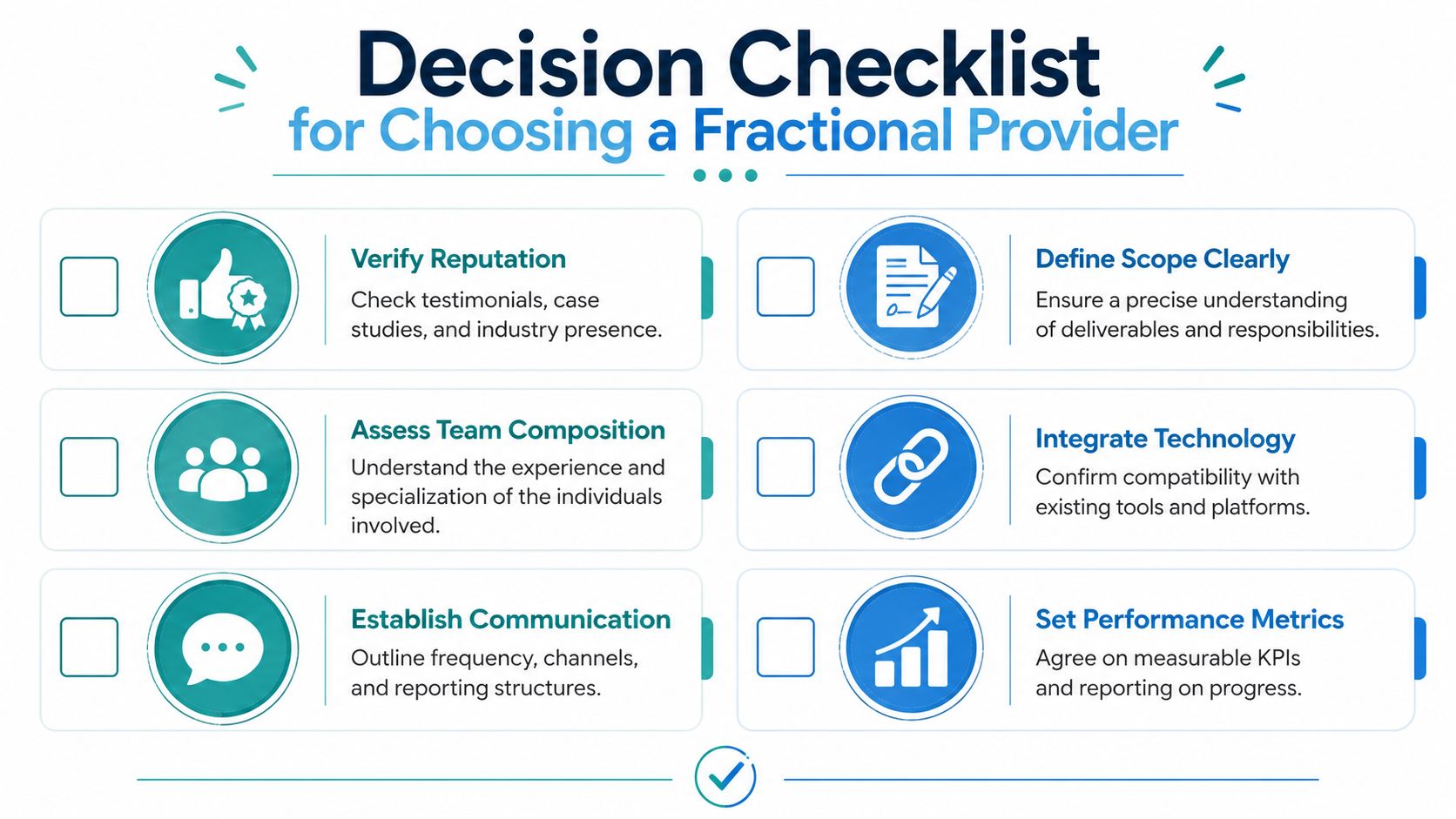
Use this checklist:
- Verify reputation. Review testimonials, published work, and real examples from companies that look like yours. Ask who will perform the work, not just who will sell the engagement.
- Define scope clearly. Get precise about what is included. Strategy only is not the same as strategy plus execution.
- Assess team composition. Find out whether you're hiring one senior adviser or a true cross-functional team with access to channel specialists.
- Confirm technology integration. Ask whether the team can work inside your CRM, analytics, email platform, ad accounts, and content systems.
- Establish communication. You need a clear cadence for check-ins, approvals, project updates, and reporting.
- Set performance metrics. Decide how progress will be evaluated before work starts.
One overlooked area is channel-specific expertise. If email is a meaningful growth lever for your business, ask whether the provider understands deliverability and list health, not just campaign writing.
Warning signs that should slow you down
Some red flags are obvious. Others aren't.
A provider may sound strategic but avoid operational details. That usually means they'll give recommendations and leave your team to figure out the hard part. At the other extreme, a provider may promise endless production but show no clear method for deciding what deserves attention first.
Watch for these issues:
| Warning sign | Why it matters |
|---|---|
| Vague deliverables | You can't manage expectations or accountability |
| No clear team structure | You may be buying one person when you need multiple functions |
| Limited system access | Strategy quality drops when the provider can't see live data |
| No reporting cadence | Problems surface late and trust erodes |
| No discussion of brand readiness | Existing reputation or messaging issues can undermine early progress |
One particularly important point gets ignored in most buying guides. Fractional marketing isn't a rescue plan for a broken reputation by itself. If your brand already has trust issues, unclear positioning, or poor customer experience signals, the first phase should include readiness work. Otherwise the team may launch campaigns into preventable friction.
Choose the provider that can tell you when not to spend yet.
That's usually the better partner.
Conclusion and Next Steps
If you've been asking what is fractional marketing, the practical answer is straightforward. It's a way to access senior marketing leadership without committing to a full-time executive hire, and it works best when that leadership is paired with the execution capacity to move campaigns, content, web updates, and optimization forward.
For SMBs, that combination is a key advantage. You get strategy, accountability, and flexible production in one operating model. You also avoid a common mistake: paying for advice when the actual bottleneck is delivery, or paying for delivery when nobody owns the plan.
Use the checklist above to assess your current setup. Look at where work stalls, where decisions are unclear, and where execution depends too much on founders or scattered vendors. If those issues sound familiar, a fractional model is worth serious consideration.
If you want a low-pressure next step, review your current marketing priorities and consider starting with a strategic audit or brand profile setup through SharedTEAMS. That's a practical way to see whether a managed marketing team fits your business before making a bigger commitment.