You're probably in one of two situations right now. Either you've watched competitors keep showing up above you in search while your team keeps saying, “We need to do SEO,” or you've already talked to a few providers and now you're more confused than when you started.
That confusion is normal. “Monthly SEO service” gets sold as everything from blog writing to technical fixes to vague “authority building,” and too many proposals bury the only question that matters: Will this create measurable business value, or just create recurring activity?
A smart monthly SEO investment isn't a bundle of random tasks. It's an operating system for improving visibility, fixing technical drag, publishing the right content, and tying organic search back to leads, sales, and revenue. The hard part isn't deciding whether SEO matters. The hard part is choosing the right model, the right scope, and the right partner.
Table of Contents
- What Is a Monthly SEO Service (And Why You Need One)
- Core Deliverables and Workflows in a Monthly SEO Plan
- How Monthly SEO Services Are Priced in 2026
- Choosing Your SEO Partner Model
- Key Metrics That Show Your SEO Is Working
- Your First 90 Days with a Monthly SEO Service
- How to Choose the Right SEO Partner and Avoid Red Flags
What Is a Monthly SEO Service (And Why You Need One)
A monthly SEO service is an ongoing strategy and execution program designed to improve how your business shows up in search over time. It's not a one-time audit. It's not a stack of blog posts. And it's definitely not a “set it and forget it” project.
Search changes constantly. Competitors publish new pages, earn new links, adjust site structure, and improve their offers. Search engines also keep reevaluating your site's speed, usability, content quality, and relevance. If your SEO provider only shows up once, you're left with a report instead of a growth system.
That's why I tell business owners to think of monthly SEO as a compounding asset-building function. Each month should improve one or more of these areas:
- Technical performance so search engines can crawl, index, and trust the site
- Content relevance so your pages match real buyer intent
- Authority signals so your site can compete in tougher results
- Conversion paths so traffic turns into leads or revenue
Practical rule: If a provider can't explain how monthly work connects to business goals, you're not buying strategy. You're buying task completion.
A one-time SEO project can help if your site has serious technical problems or no foundation at all. But most businesses that care about pipeline, lead flow, and long-term visibility need continuity. Rankings don't improve because someone checked boxes in a setup phase. They improve when audits, fixes, content updates, internal linking, reporting, and strategic adjustments happen in a disciplined cycle.
That's also why the right question isn't “Do I need SEO every month?” It's “What should be improving every month, and who should own it?”
Core Deliverables and Workflows in a Monthly SEO Plan
You hire an SEO partner, pay the retainer, and 60 days later you get a polished report with rankings, traffic charts, and a few vague wins. That is not a monthly SEO plan. A real plan runs on an operating cadence. It assigns priorities, ships work, measures outcomes, and adjusts fast enough to affect pipeline.
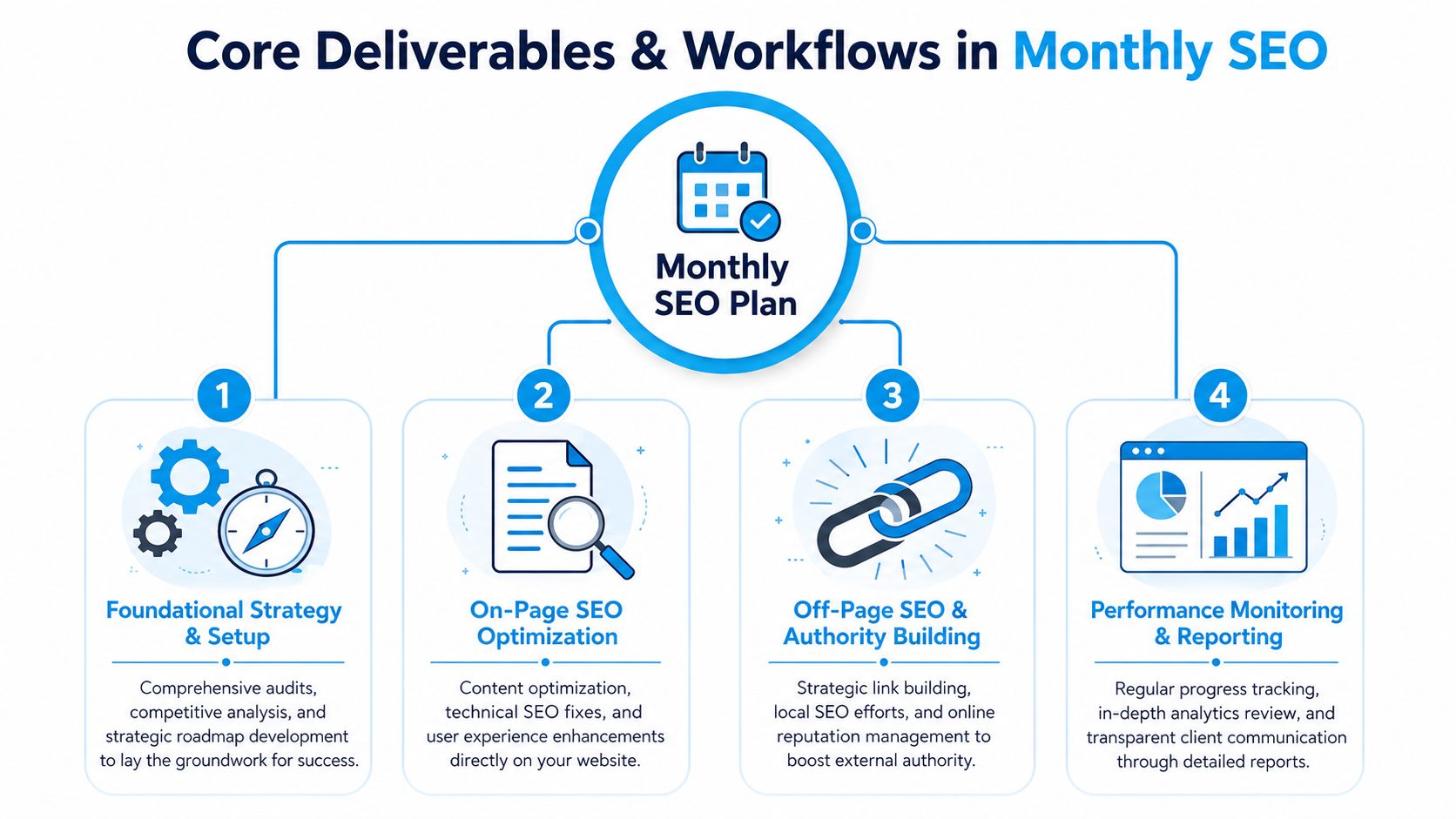
The deliverables matter, but the workflow matters more. Agencies usually handle volume well because they have specialists for technical fixes, content, and reporting. Freelancers often move faster and write better strategy, but execution can bottleneck if one person owns everything. A fractional SEO lead is often strongest when you already have developers, writers, or an in-house marketer and need senior direction instead of task production.
Technical health comes first
Technical SEO sets the floor for everything else. If search engines cannot crawl key pages, render them properly, or trust the site structure, content work gets delayed and authority work gets wasted.
A monthly technical workflow should include checks on Core Web Vitals and page experience. Google defines good performance targets as Largest Contentful Paint at 2.5 seconds or less, Interaction to Next Paint at 200 milliseconds or less, and Cumulative Layout Shift at 0.1 or less, according to Google's Core Web Vitals documentation.
That review usually covers:
- Crawl diagnostics: broken URLs, redirect chains, orphan pages, duplicate versions, wasted crawl paths
- Indexation control: sitemap quality, canonical tags, noindex mistakes, parameter issues, internal link support
- Performance fixes: image compression, script reduction, template cleanup, mobile rendering issues
- Search presentation: title tags, meta descriptions, structured data, page directives
Do not accept a provider that runs a technical audit once and calls it done. A good agency has a recurring QA process. A good freelancer has a prioritized fix list tied to business pages. A good fractional SEO lead makes sure your developer ships the fixes.
On-page optimization turns research into page-level execution
On-page SEO is where keyword research either becomes revenue or dies in a spreadsheet. The job is simple. Match the right search intent to the right page, improve the page so it deserves to rank, and remove friction that hurts conversion.
That work usually includes keyword-to-page mapping, heading rewrites, internal linking, content pruning, stronger calls to action, and clearer service page positioning. It also includes deciding what not to create. If an existing page can be improved to capture demand, publish less and optimize more.
User engagement helps you judge whether a page is doing its job. Google Analytics defines average engagement time as the time your website was in focus in a user's browser or app foreground, which makes it more useful than older vanity metrics for judging content quality, as explained in Google Analytics support documentation. For update cycles, HubSpot recommends auditing content on a regular schedule so high-value pages stay accurate and competitive, as outlined in HubSpot's guide to content audits.
Good monthly SEO work answers three questions every month. Which pages matter most, what changed on them, and did those changes improve leads or sales.
This is also where business economics need to show up. If a service page drives calls worth thousands of dollars, it deserves tighter optimization and faster testing than a top-of-funnel blog post. The same logic shows up in call handling costs. Compare lead value to handling cost and staffing reality, as shown in Recepta.ai's cost breakdown.
Off-page authority and content should share one roadmap
Content and authority work should not run as separate subscriptions with separate goals. They should support the same pages, the same offers, and the same growth targets.
Three workflows usually drive the best monthly gains:
Content planning and production
Service page expansion, topic clusters, supporting articles, FAQ additions, and content refreshes based on ranking opportunity or sales feedback.Authority building
Link outreach, local citations, digital PR, unlinked brand mention recovery, and asset promotion tied to pages you want to rank.Competitive monitoring
Reviews of competitor page launches, content gaps, linking patterns, SERP feature changes, and offer positioning.
The partner model becomes a real decision, not a branding choice. Agencies are usually best if you need all three workflows executed at once. Freelancers are often best if you need focused expertise on content and on-page work. Fractional SEO support is usually best if you need someone to set priorities, coordinate your internal team, and keep the roadmap tied to revenue.
Ask to see the monthly operating rhythm before you sign. You want to know what gets reviewed every month, what gets shipped every month, who owns implementation, and how priorities change when results come in. If the proposal is just a list of activities, keep looking.
How Monthly SEO Services Are Priced in 2026
SEO pricing is messy because the label stays the same while the scope changes wildly. One provider means technical auditing and content strategy. Another means two blog posts and a dashboard. Another means local listing management with minimal site work. You can't compare price until you compare operating model.
The published ranges that small businesses often see are broad. Some content lists $499 to $3,500 per month, while Thryv data cited in the verified brief notes that small businesses often pay $399 to $999 per month depending on page count. The bigger problem is that most providers still don't explain the cost-to-value ratio in a way that helps an owner judge ROI.
What the market usually includes
A useful reference point comes from a 2024 Reddit discussion among SEO professionals. It showed that a $2,500 per month plan typically includes weekly blogs, daily Google Business updates, backlinks, and quarterly KPI analysis, yet clients still struggle to see whether those activities lead to measurable revenue growth, according to this Reddit SEO retainer discussion.
That's the issue. Activity is easy to package. Business impact is harder to prove.
If you're budgeting for your first SEO investment, look at pricing through three lenses:
- Scope intensity: technical cleanup, page optimization, content, local SEO, and authority work all require different amounts of labor
- Strategic depth: are you paying for execution only, or also for planning, prioritization, and analysis
- Market difficulty: a local service area business and a national B2B company don't need the same mix
If you want a practical example of how businesses should think about service pricing more broadly, this Recepta.ai's cost breakdown is worth reviewing. It's not about SEO, but it models the right buying mindset: compare price to scope, responsiveness, and operating value, not just the sticker number.
How to judge value instead of price
The cheapest monthly SEO package is usually cheap for a reason. It may rely on thin deliverables, generic reporting, or outsourced production with little strategic supervision. That doesn't make every low-cost package bad, but it does mean you should expect tradeoffs.
Use this short filter before you buy:
- Ask what gets touched monthly: pages, templates, content assets, Google Business Profile, link outreach, reporting
- Ask what gets measured: rankings alone aren't enough
- Ask what changes when results flatten: if there's no adjustment process, the plan is static
- Ask who's doing the work: senior strategist, junior coordinator, freelancer network, or AI-assisted team
A monthly SEO service should feel like a managed growth function. If it feels like a subscription to vague effort, keep looking.
Choosing Your SEO Partner Model
Most buyers focus on the wrong comparison. They compare agency A against agency B. The better question is whether you need an agency at all.
The choice is between in-house, freelance, agency, and fractional or membership-based support. Each model solves a different problem, and each breaks down in predictable ways.
One reason businesses make poor choices is that the market rarely segments strategy clearly enough. Many providers say monthly SEO drives long-term results, but they don't distinguish between local SEO needs such as Google Business optimization and citations versus national SEO needs such as authority backlinks and content scaling, which leaves SMBs choosing the wrong model for their market scope, as noted in this discussion of monthly SEO packages.
Comparison of SEO Partner Models
| Criterion | In-House | Freelancer | Agency | Fractional/Membership |
|---|---|---|---|---|
| Best fit | Businesses with enough ongoing volume to justify a dedicated role | Companies needing targeted execution without a large contract | Businesses needing breadth across strategy and execution | Businesses needing flexible access to multiple skills without full agency overhead |
| Strategic depth | Can be strong if you hire senior talent | Varies heavily by individual | Usually broader because multiple specialists can contribute | Often strong when senior oversight is paired with shared delivery capacity |
| Execution capacity | Limited to one person or a small team | Limited by the freelancer's bandwidth | High, especially for content, technical, and reporting workflows | Moderate to high, depending on membership structure and specialist access |
| Scalability | Slower unless you add headcount | Can become a bottleneck quickly | Easier to scale across channels and site needs | Scales well for SMBs that need intermittent bursts of work |
| Communication | Direct and embedded in the business | Usually direct and simple | Can be excellent or bureaucratic, depending on account structure | Often more collaborative when workflows are platform-based |
| Risk | Hiring mistake is expensive and slow to fix | Key-person risk is high | Process can become rigid or generic | Depends on how clearly the team scopes and prioritizes work |
| Local vs national fit | Good if the hire has the right specialization | Good for niche local or content-led work | Strong for broader programs if the agency truly segments strategy | Strong when the business needs adaptable support across both local and broader initiatives |
How to match the model to your business
If you need one specialist skill, a freelancer can work well. If you need technical SEO, content planning, reporting, and website coordination, a single freelancer may struggle to cover the stack consistently.
If SEO needs to connect tightly to sales, product, and internal operations every day, in-house can make sense. But many SMBs hire too early, then discover they needed multiple specialties, not one generalist.
Agency support works when you need breadth and established process. The downside is that some agencies over-standardize delivery. You end up buying their template instead of your strategy.
Fractional or membership-based support often makes the most sense for growing companies that want strategic oversight without the commitment of a large traditional retainer. It's also a useful fit when SEO touches adjacent needs like web updates, content production, analytics, and campaign alignment.
If your business needs one person, hire one person. If it needs a system, buy a system.
For a useful perspective on how modern search service models are evolving around AI and answer-focused execution, this playbook for AEO agency growth is worth reading. It's especially relevant if you're evaluating whether your future partner understands where search is heading, not just where it has been.
And if you're weighing how much automation should influence provider selection, this piece on balancing AI automation with authentic SEO strategy gives a practical lens. The takeaway is simple: automation helps delivery, but strategy still needs human judgment.
Key Metrics That Show Your SEO Is Working
A monthly SEO service should not drown you in charts. If the report is full of motion but empty on decisions, it's not doing its job.
The KPI set should stay focused. The optimal number of SEO KPIs is typically 7 to 9, and those metrics should include business impact measures like Total revenue in GA4 and Conversion rate from organic search, according to this SEO KPI reporting guidance.
The KPI set should stay tight
Most businesses should track a mix of leading indicators and business outcomes.
Leading indicators tell you whether visibility is moving:
- Keyword trend quality: especially high-intent and long-tail terms
- Organic traffic quality: not just visits, but visits to commercial pages
- Click-through rate: whether search snippets are winning attention
- Engagement signals: whether visitors stay and take meaningful actions
Lagging indicators tell you whether SEO is creating value:
- Conversion rate from organic search
- Total revenue from organic traffic in GA4
- Form submissions, purchases, or downloads from organic sessions
- Pipeline contribution when the business has enough lead volume
For SaaS companies, pipeline attribution from organic search is premature when the organization generates fewer than 50 monthly organic leads, so early-stage teams should focus more on traffic volume and email signups first, based on this Animalz guide to SEO KPIs.
Modern reporting also needs to reflect how search behavior is changing. SEO teams now need to track AI share of voice, Mentions, and Citations in generative search environments, not just rankings and clicks, as outlined in this guide to new SEO KPIs.
What a real monthly report should answer
A useful report answers five business questions:
- What improved
- What declined
- Why it changed
- What should happen next
- How this connects to revenue or lead quality
If your provider only sends keyword screenshots and traffic graphs, you're missing the strategic layer. That's also where forecasting and expectation-setting become important. This article on AI forecasting for SEO performance is a helpful companion if you want to understand how stronger teams move from rear-view reporting to forward-looking planning.
The standard should be simple. You should be able to read the monthly report and know what your SEO partner did, what changed, and what they're doing next.
Your First 90 Days with a Monthly SEO Service
The first three months tell you a lot about whether the engagement is real. Not because rankings should explode immediately, but because the workflow should be disciplined, visible, and tied to priorities.
This timeline gives you a reasonable picture of what a well-run monthly SEO service often looks like.
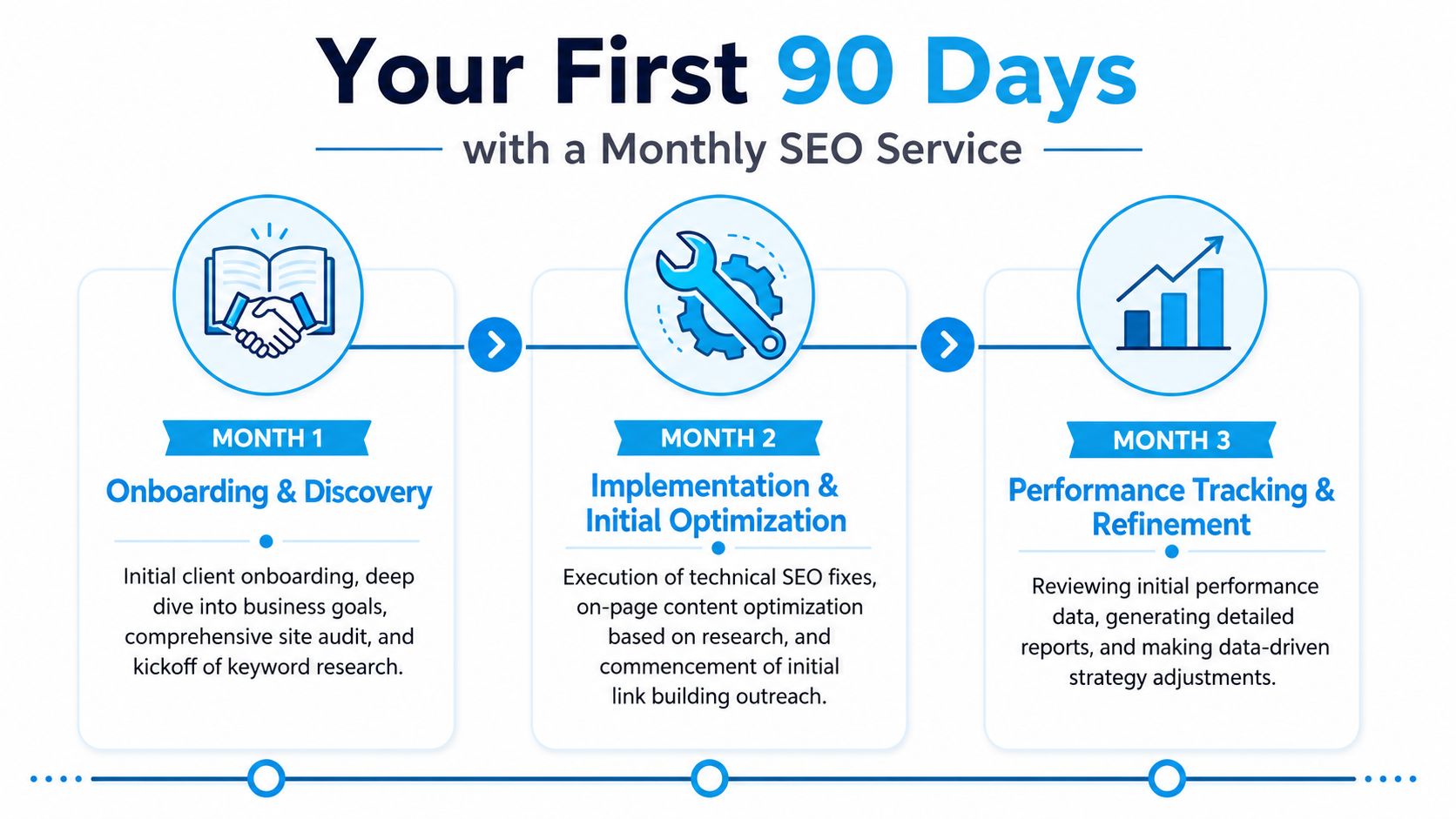
Month 1 onboarding and discovery
The first month should be heavy on diagnosis and alignment. A provider who starts publishing content before auditing the site, understanding your offers, and mapping your conversion goals is moving too fast in the wrong direction.
Core work usually includes:
- Business and audience discovery: services, margins, sales cycle, target geography, and decision-maker intent
- Baseline auditing: technical review, indexation review, core page assessment, analytics setup check
- Keyword and competitor research: especially around commercial intent and local versus broader search scope
- Measurement setup: defining the KPI set and report format
The first month should produce clarity. If all you got was a kickoff call and a list of “opportunities,” push for a real roadmap.
A visual overview can help set expectations before execution starts.
Month 2 implementation and initial optimization
Month two is where the serious work begins. Technical fixes should start moving into implementation, priority pages should be optimized, and the content roadmap should turn into published or revised assets.
This is also the month where weak providers often slip. They're good at audits but slow at execution.
Expect activity such as:
- Technical fixes: crawl issues, indexing barriers, speed improvements, mobile usability adjustments
- On-page work: title tags, page copy improvements, internal linking, service page strengthening
- Content production: publishing new pieces or upgrading older pages with better intent matching
- Local or off-page setup: citations, Google Business work, outreach prep, asset identification
Month 3 performance tracking and refinement
By the third month, you may not have final ROI clarity yet, but you should have real signals. You should know what has been implemented, what early movement exists, where friction remains, and which next steps are highest priority.
A strong month-three review includes:
| Focus area | What you should see |
|---|---|
| Execution proof | A clear record of fixes, updates, and published work |
| Early performance data | Movement in impressions, clicks, keyword visibility, or engagement quality |
| Strategic adjustment | Changes to priorities based on what the first two months revealed |
| Next-quarter priorities | A tighter roadmap, not a recycled task list |
If month three still feels vague, the engagement probably lacks operational discipline.
How to Choose the Right SEO Partner and Avoid Red Flags
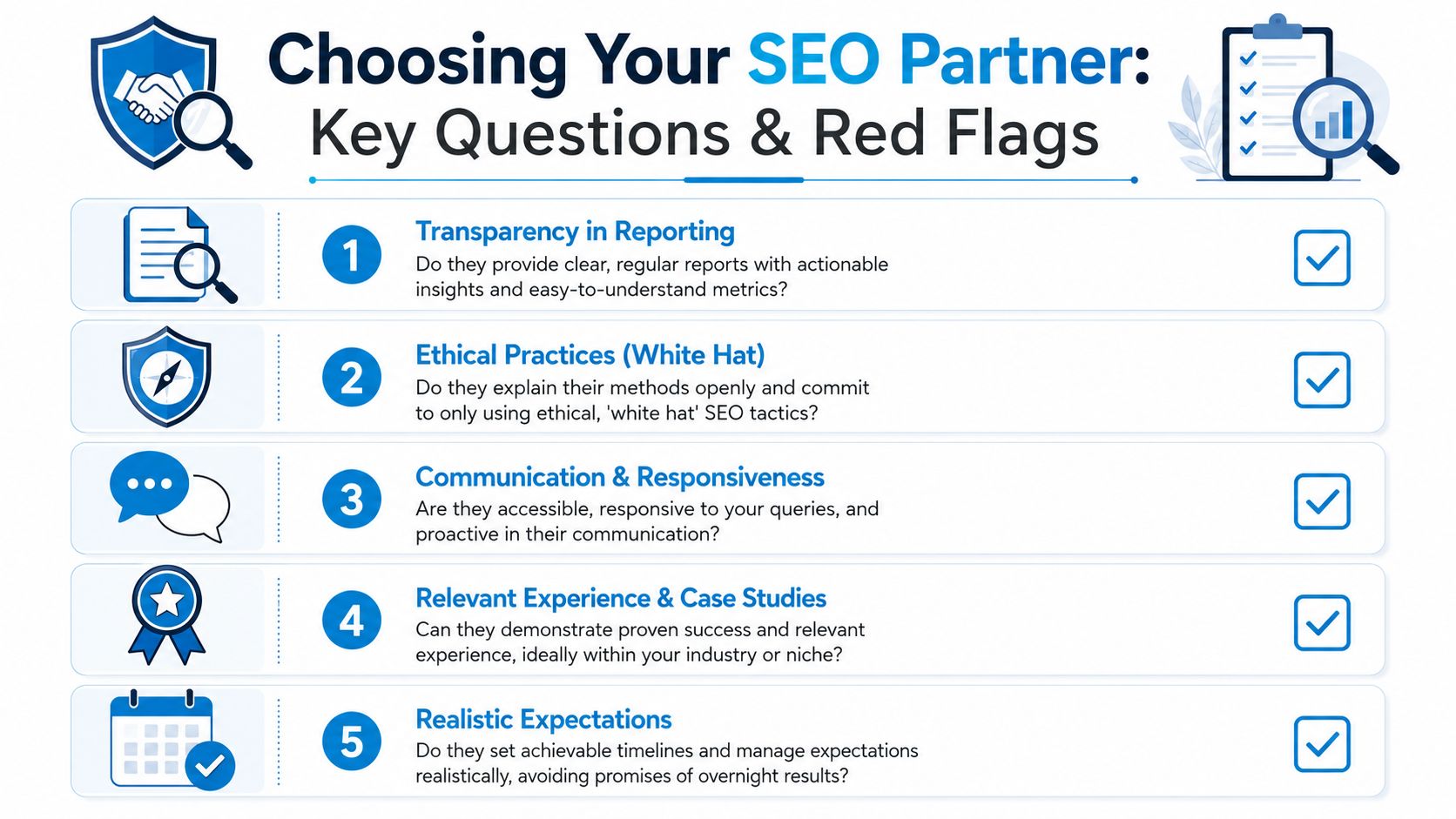
Most SEO disappointments are buying mistakes, not channel failures. The business chose a provider with vague methods, weak accountability, or the wrong delivery model.
That's fixable if you vet carefully.
Questions worth asking before you sign
Use direct questions. Don't let the conversation drift into jargon.
- How do you decide monthly priorities? Look for a clear planning process, not “we do a bit of everything.”
- What metrics will you report on? You want focused KPIs tied to visibility and business outcomes.
- Who will do the work? Strategy and execution roles should be clear.
- How do you separate local SEO needs from national SEO needs? This is one of the easiest ways to spot whether the strategy is real.
- What happens if performance stalls? Good partners adjust. Weak ones repeat deliverables.
A related concern now is content quality and AI usage. If you want a grounded look at how search teams should think about that issue, this article on AI content detection and SEO rankings is worth reading before you sign with anyone promising “AI-scaled SEO” without editorial standards.
Red flags that should stop the conversation
Some warning signs are immediate disqualifiers.
- Guaranteed rankings: no credible SEO partner can promise a specific rank outcome
- Vague proprietary methods: if they won't explain the work, don't fund the experiment
- Reporting that avoids revenue or conversions: rankings without business context are weak accountability
- One-size-fits-all packages: especially when your business scope is clearly local or clearly broader
- No clear workflow for implementation: audits alone don't create growth
Choose the partner who makes the work understandable, measurable, and operationally believable. That's usually the safer investment than the firm with the most aggressive pitch.
If you're evaluating your first major SEO investment and want a practical second opinion, SharedTEAMS is a useful next step. Their fractional marketing model gives small and mid-sized organizations access to strategic guidance, execution support, and AI-enabled workflows without locking into a traditional long-term retainer. A smart place to start is a strategic audit of your current site, reporting setup, and growth priorities so you can decide what kind of monthly SEO service fits your business.