If you're still deciding what to post at 8:30 a.m., social media isn't running as a system. It's running as a recurring interruption.
That scramble usually looks the same. Someone on the team asks for a quick graphic. A founder wants to promote a service. An old blog post gets reshared because there's no time to create something better. The feed stays active, but the message drifts, approvals get messy, and nobody can say whether the work is helping the business.
A workable social media plan fixes that. It replaces reactive posting with a process tied to goals, audience needs, production capacity, and measurement. That matters even more for small and mid-sized businesses, where marketing resources are limited and every channel has to earn its place.
The businesses that handle social media well usually aren't posting more randomly. They're planning better. They know why a post exists, who it's for, what format fits, how it gets approved, and what result they're watching for after it goes live.
Table of Contents
- Introduction From Chaos to Control
- Set Strategic Goals and Define Your Audience
- Develop Content Pillars and Select Formats
- Build Your Content Calendar and Posting Cadence
- Streamline Content Production and Approvals
- Measure Performance to Optimize Your Plan
- Conclusion Your Path to Sustainable Growth
Introduction From Chaos to Control
Most content problems don't start with creativity. They start with a missing operating system.
When there's no plan, social media turns into a string of isolated tasks. One person writes captions in a rush. Another hunts for images. A manager reviews posts late. The team publishes whatever is ready, rather than what supports a goal. That usually leads to inconsistent messaging, duplicated effort, and very little insight into what's working.
Good planning changes the role social media plays in the business. It stops being a daily obligation and becomes a channel with clear priorities, a repeatable workflow, and measurable outputs. That doesn't mean every post needs to be rigid. It means your baseline is organized enough that you can respond to trends, launches, and customer questions without breaking the whole system.
Practical rule: If your team can't explain why a post exists before it's created, planning is too loose.
A strong process for how to plan social media content starts with business goals, then moves outward into audience definition, content themes, scheduling, production, and reporting. Each part supports the next. If one part is weak, the rest of the system becomes harder to manage.
For SMBs, the primary win isn't just better posting discipline. It's efficiency. You spend less time inventing content from scratch, fewer approvals get stuck, and your reporting becomes useful enough to guide the next month instead of merely documenting the last one.
Set Strategic Goals and Define Your Audience
Social media planning gets easier when you stop asking, "What should we post?" and start asking, "What business outcome should this channel support?"
The answer shouldn't be everything at once. Teams that try to build one social plan for awareness, traffic, lead generation, recruiting, customer support, and thought leadership usually dilute the message and overload the workflow. The cleaner approach is to narrow the focus.
Choose fewer goals and track the right signals
Start with 1 to 3 core goals that reflect what's most important for the business right now. According to the American Marketing Association's guidance on social media marketing strategy, teams should begin with 1–3 core goals such as brand awareness, website traffic, or lead generation, and track KPIs like likes, comments, shares, replies, saves, click-throughs, engagement rate, and website traffic from social via UTM links.
That matters because follower count rarely tells you enough. A smaller audience that clicks, saves, replies, and converts is more useful than a larger audience that scrolls past everything.
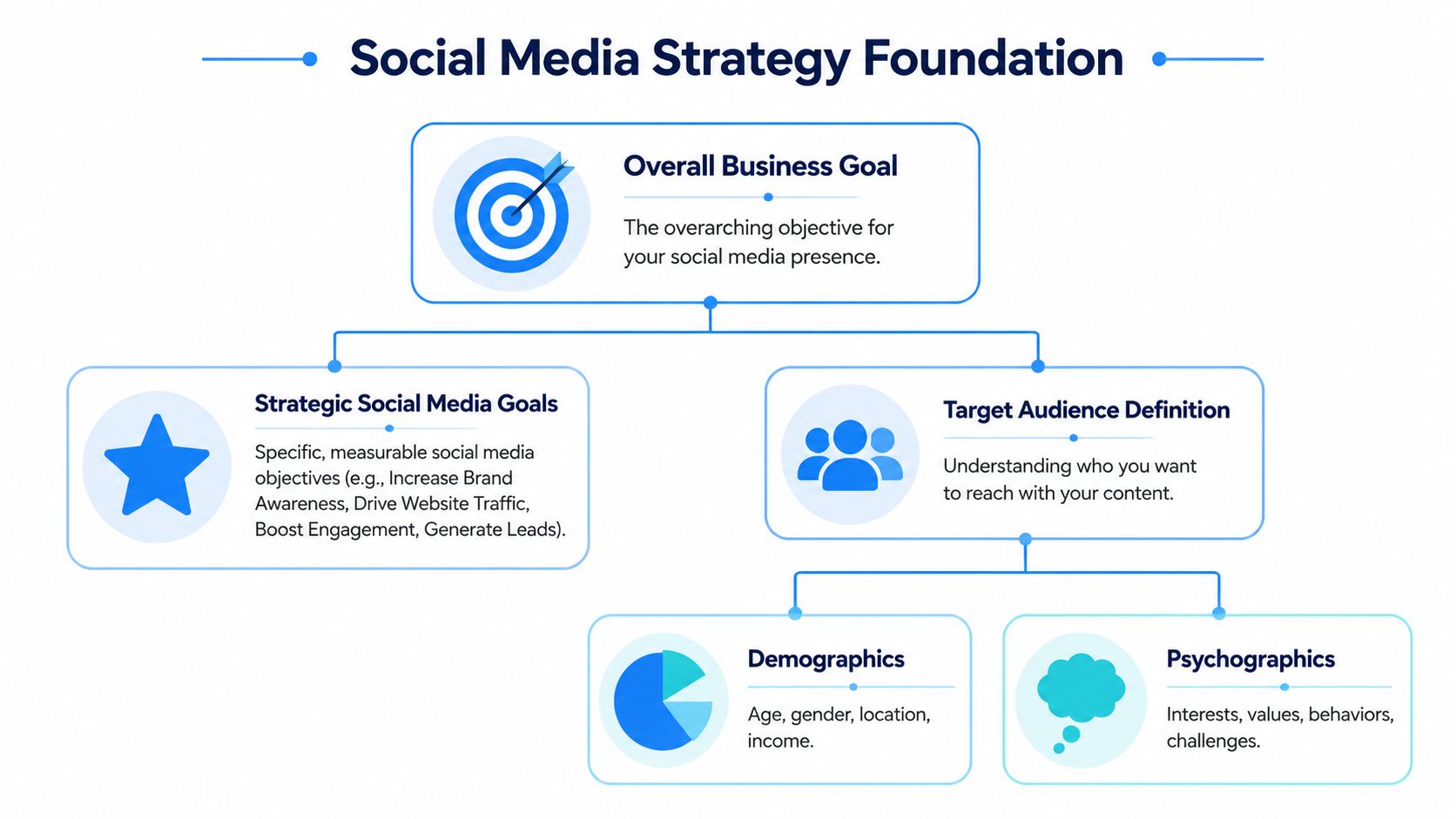
A simple way to structure this is with a working table like this:
| Business priority | Social goal | KPI to watch | What content should do |
|---|---|---|---|
| Raise visibility in a local market | Brand awareness | Reach, engagement rate, shares | Put your expertise and brand point of view in front of the right people |
| Get more qualified visits to the site | Website traffic | Click-throughs, UTM-tagged sessions | Give people a reason to leave the platform and learn more |
| Support sales conversations | Lead generation | Conversions from social traffic | Move readers toward a clear next step |
If your team needs a framework to set clear social media objectives, use one before you build the calendar. Goal confusion at the start becomes reporting confusion later.
A second discipline matters here. Tie social KPIs back to business outcomes, not vanity metrics. That "metrics ladder" approach helps you avoid celebrating activity that doesn't support pipeline, traffic quality, retention, or brand health.
Build an audience profile your team can actually use
A useful audience definition doesn't need to be complicated. It needs to help your team make better decisions in content planning, creative direction, and posting priorities.
For most SMBs, one practical audience profile should answer four questions:
- Who are they: Role, business type, seniority, and buying context.
- What are they trying to solve: Operational pain points, growth blockers, or recurring questions.
- What kind of content do they trust: Educational explainers, proof-oriented examples, founder insights, or tactical how-tos.
- What action do you want them to take: Follow, save, click, subscribe, request a consultation, or start a conversation.
When analytics are thin, don't let that stall the process. Build your first audience profile from customer calls, sales objections, email questions, support themes, and review language. Then refine it over time using direct feedback and platform data. If you want a sharper read on real customer language and emerging conversations, a resource on using AI to decode audience sentiment and emerging conversations can help turn scattered feedback into usable planning inputs.
The best audience persona isn't the most detailed one. It's the one your team actually uses when writing posts.
Develop Content Pillars and Select Formats
Once goals and audience are clear, content planning needs structure. That's where content pillars come in.
Pillars are the recurring themes your brand will talk about consistently. They keep your feed from becoming a random sequence of announcements, trend attempts, and generic tips. They also make production easier because the team isn't starting from zero every week.
Pick pillars that support the business
Most SMBs do well with a short list of recurring themes. You don't need ten. You need a few strong categories that align with your audience and the role social media plays in your funnel.
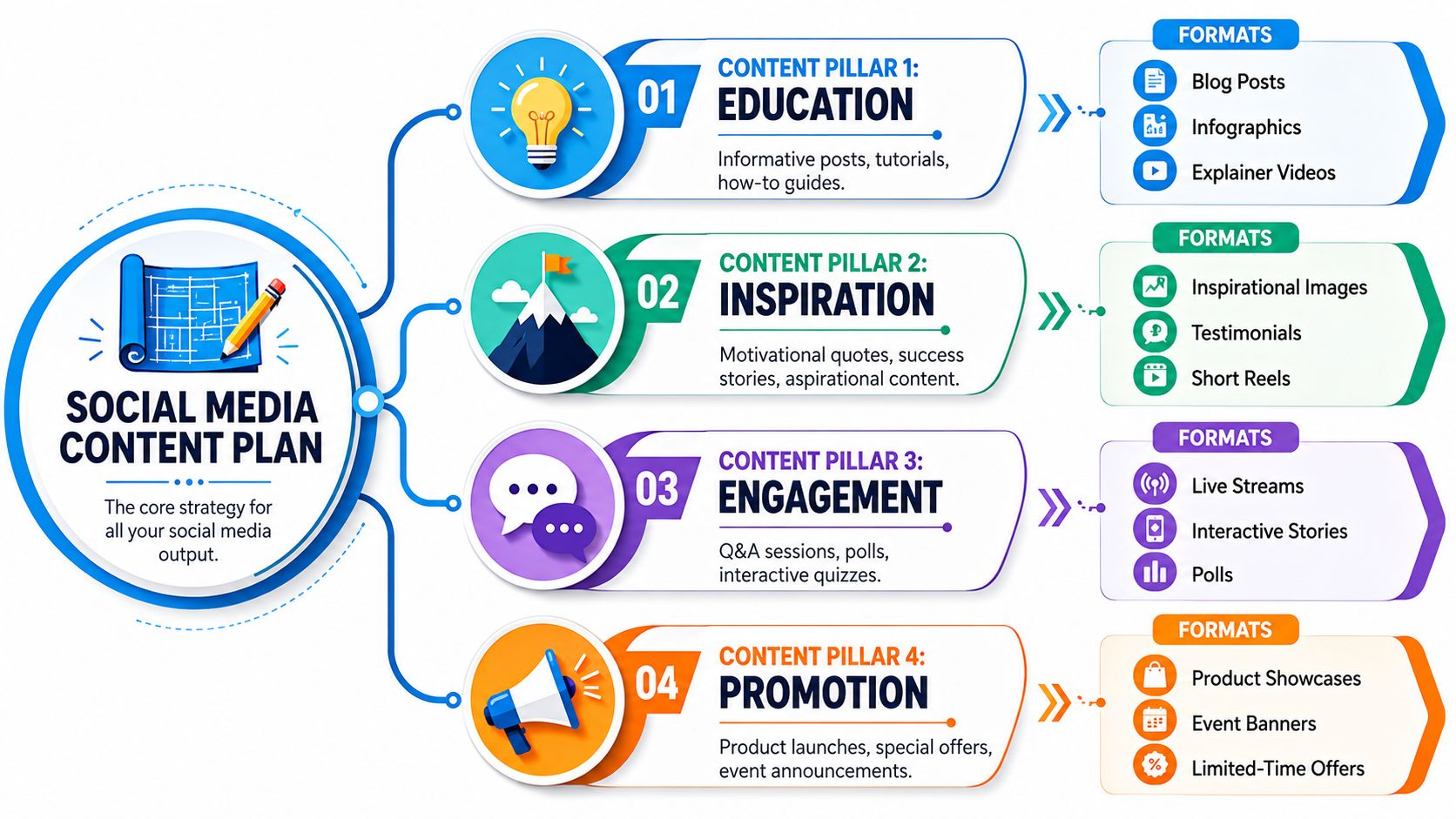
Examples often include:
- Education: Tips, explainers, myths, and process breakdowns that show expertise.
- Proof: Testimonials, case observations, before-and-after thinking, or outcomes framed qualitatively.
- Brand perspective: Founder insights, company values, team practices, or informed opinions on industry changes.
- Promotion: Service offers, event announcements, launches, and calls to action.
A planning framework often cited in industry guidance is the 80-20-50 content mix. In that model, 80% of posts should drive engagement, 20% should be curated from other sources, and 50% of the total content volume should be built to drive traffic back to your website or blog. Used well, that structure helps teams avoid over-promotion while still keeping traffic and conversion goals in view.
Competitor review helps here too, but only if you use it the right way. Mailchimp's guidance on types of social media content recommends studying competitors' strongest posts, noting whether they lean on Reels, hashtags, UGC, influencer partnerships, or paid support, then using that insight to create your own angle instead of copying the format outright.
Match each pillar to the right format
Not every idea belongs in every format. A customer objection may work well as a carousel on LinkedIn or Instagram. A behind-the-scenes moment may perform better as Stories. A point-of-view take from a founder may land best as a short video or text-led post.
Here's a practical matching approach:
| Pillar | Best-fit formats | Why it works |
|---|---|---|
| Education | Carousel, short video, infographic, blog summary | These formats help break down information clearly |
| Proof | Testimonial graphic, case-style post, quote card, short interview clip | Social proof needs context and credibility |
| Brand perspective | Founder video, text post, reel, opinion thread | These formats feel more personal and immediate |
| Promotion | Launch graphic, product video, event post, landing-page teaser | Promotional content needs a direct call to action |
This is also where production efficiency matters. One well-developed idea can become several assets. A webinar can become clips, quote graphics, a recap post, and a traffic-driving article summary. A common mistake is treating every post as a separate assignment. A better system turns one source idea into multiple platform-specific versions.
If your team is building more visuals in-house, a guide on turning prompts into scroll-stopping social content with generative AI can help speed up concepting without making your brand look templated or generic.
Build Your Content Calendar and Posting Cadence
A lot of small businesses do the same thing every month. Someone says, "we need to post more," the team scrambles for ideas, approvals drag, and content goes live late or not at all. A calendar fixes that problem only if it works as an operating system, not a list of post ideas.
Your calendar should give the business one clear view of priorities, production status, approvals, and publishing dates. That matters more than the tool itself. Google Sheets can work. So can Trello, Asana, Airtable, or Notion. Choose the option your team will consistently maintain, because an imperfect system used every week beats a polished one nobody updates.

What your calendar should include
A usable calendar needs enough detail that a post can move from idea to scheduled asset without extra Slack messages, email searches, or last-minute guesswork.
At minimum, track:
- Publish date and platform: So the team can see timing and channel mix quickly.
- Content pillar and business objective: So each post supports a larger goal.
- Working caption and creative brief: So copy and design stay aligned.
- Owner and approval status: So responsibility is clear.
- Link and CTA: So traffic and conversion posts are set up correctly.
- Tracking notes: So measurement is cleaner later.
Good calendars also separate campaign windows, launches, events, and seasonal pushes from evergreen content. That distinction helps teams protect planned promotion without letting the whole month get consumed by reactive posting.
I also recommend adding one simple field many SMBs skip: reuse potential. Mark whether a post can become a Story, short video cut, email snippet, or sales enablement asset later. That is how content planning starts acting like a business system instead of a publishing checklist.
If you need a practical model, this content calendar project estimate example shows how to scope workflow, deliverables, and production expectations before the work starts.
Set a cadence your team can sustain
Cadence should come from capacity, audience behavior, and business priority. If one of those is missing, the plan usually breaks.
For Instagram Stories, frequency guidance from Hootsuite's Instagram Stories strategy guide is useful as a range, not a rule. Active brands publish regularly enough to stay visible, but the right volume still depends on whether your team has something worth showing between promotions, customer proof, founder perspective, and day-to-day brand moments.
That trade-off matters. A business that posts five average pieces a week often gets less from social than one that publishes three strong pieces consistently, answers comments, and leaves room for timely opportunities. More volume creates more production pressure, more review cycles, and more chances for quality to slip.
Use a simple cadence test before you commit:
- Which platforms support the current sales or awareness goal?
- Which formats can the team produce well every month?
- How long do approvals take?
- Which posts need to be scheduled in advance, and which can stay flexible?
- Where will the team get stuck if volume increases by 25 percent?
That last question is the one I use with clients. It exposes whether the issue is strategy, staffing, creative capacity, or approval bottlenecks. Once that is clear, the posting schedule becomes easier to set and easier to keep.
A strong cadence leaves a little open space. Trends, customer wins, local events, and market shifts can still make the calendar. They just should not be carrying the whole program.
Streamline Content Production and Approvals
The fastest way to make social media unsustainable is to create every post from scratch and route each one through too many people.
Most SMBs don't need a complicated studio workflow. They need a repeatable production rhythm that protects quality without eating the week. That usually starts with batching.
Batch work so content creation stops taking over the week
Batching means grouping similar work into focused production blocks. Instead of writing one caption today, filming one clip tomorrow, and designing one graphic the next day, the team handles related tasks together.
That can look like this:
- Planning block: Finalize monthly topics, offers, and campaign priorities.
- Copy block: Draft captions and hooks for the next set of posts in one sitting.
- Creative block: Design graphics, resize assets, and edit short videos together.
- Scheduling block: Load approved posts, links, and tags into the platform.
This works because context switching is expensive. Every time a team stops to rethink audience, platform, offer, and message, production slows down.
A second adjustment matters in current platform conditions. The U.S. Chamber of Commerce summary on social media strategy notes that a 2025 Sprout Social report found 72% of users now discover content through captions and hashtags, while 89% of planning guides still prioritize engagement-first tactics over Social SEO. In practical terms, captions, keywords, and hashtags shouldn't be an afterthought during production. They need to be part of the brief from the start.
Keep approvals light but clear
Approval systems break down when roles are vague. One person checks grammar, another edits messaging, a third adds legal comments late, and posts sit in limbo.
Use a lightweight workflow with defined reviewers:
| Stage | Owner | What gets checked |
|---|---|---|
| Draft | Writer or strategist | Message, hook, CTA, keyword use |
| Creative review | Designer or brand lead | Visual consistency, readability, format fit |
| Final approval | Decision-maker | Accuracy, brand alignment, compliance |
Keep reviewer count low. If five people need to approve routine social posts, the process isn't protecting quality. It's creating drag.
Templates also make a major difference. Standard caption formats, design systems, hashtag libraries, and approval checklists reduce avoidable revisions. They don't limit creativity. They create enough consistency that the team can spend more energy on substance.
Measure Performance to Optimize Your Plan
Publishing is not the finish line. It is the point where planning either gets smarter or starts repeating the same mistakes.
SMBs usually fall into one of two traps here. They either track everything and learn nothing, or they rely on surface signals like likes and impressions without tying them to business goals. A useful measurement system is narrower than many teams expect. It tracks the metrics connected to the goals set at the start, reviews them on a schedule, and turns the results into clear decisions about what to keep, change, or stop.
Use one dashboard and one review rhythm
Measurement breaks down fast when every platform is reported separately. One person pulls Instagram screenshots, another exports LinkedIn data, and nobody has a clean view of what content is driving traffic, leads, or customer response across the full program.
Use one shared dashboard for all active channels. Include the handful of metrics that matter for your goals, such as reach, click-through rate, engagement rate, conversions, and sentiment if brand perception matters to the business. Then set a review cadence the team can sustain. Monthly reviews usually work well for execution decisions. Quarterly reviews are better for strategy decisions.
That structure improves the quality of the questions being asked. Instead of debating whether a post "performed well," the team can examine patterns that lead to better planning:
- Did educational posts generate more qualified clicks than promotional posts?
- Which format earned saves, replies, or shares from the right audience?
- Which topics drew attention but failed to produce site visits or inquiries?
- Are comments pointing to confusion, objections, or stronger interest around a service line?
Use findings to improve the next cycle
Good reporting should change behavior. If a content pillar keeps underperforming, adjust the angle, tighten the audience fit, or reduce how often it appears in the calendar. If short-form video gets reach but weak conversion, the issue may be the offer, the CTA, or the landing experience rather than the format itself. If one channel absorbs time and creates little business value, cut the scope instead of forcing more output.
This is also where social media starts looking less like a posting task and more like an operating system. Measurement helps a business decide which work needs human judgment and which work can be supported with tools or outside specialists. AI can speed up draft analysis, repurposing, tagging, and early pattern spotting. Fractional support can add strategic oversight, reporting discipline, and production capacity without the cost of building a full in-house team.
The point is not more reporting. The point is better decisions.
When measurement is set up well, social becomes easier to manage and easier to scale. The team knows what content earns attention, what content drives action, where approvals and production are wasting effort, and where to invest next. That is how a content plan improves over time instead of becoming a monthly reset.
Conclusion Your Path to Sustainable Growth
The businesses that get the most from social media usually aren't improvising better. They're planning better.
A strong system for how to plan social media content starts with a small number of business-aligned goals. It gets sharper when audience definition is practical, content pillars are clear, the calendar is realistic, and approvals are designed to keep things moving. Then measurement closes the loop and improves the next cycle.
That kind of system helps in two ways. It makes social media more effective, and it makes it easier to manage. Your team spends less time scrambling for ideas, fewer posts get stuck in production, and reporting becomes useful enough to guide actual decisions.
For SMBs, that's the shift. Social media stops being a daily content chore and becomes a repeatable business process. Once that foundation is in place, it's much easier to scale output, add new formats, or bring in outside support without losing consistency.
The next step is simple. Audit your current process thoroughly. Look at your goals, your calendar, your workflow, and your reporting. If any part of the system depends on last-minute effort, that's where to start improving.
If your team needs help turning social media into a repeatable operating system, SharedTEAMS provides fractional marketing support with expert oversight, AI-enabled production workflows, and on-demand execution across strategy, content, design, and analytics. It's a practical fit for SMBs that need more capacity and structure without committing to a traditional full-service retainer.