You're probably in one of two spots right now. Your store is already running ads, but the results feel uneven, hard to explain, and too dependent on one person making judgment calls inside Google Ads. Or you're considering ecommerce PPC marketing for the first time and trying to avoid the usual small business mistake of spending before the system is ready.
That's the right concern. PPC can produce fast demand, but it only becomes a reliable growth channel when the account structure, tracking, creative, product data, and decision rules all work together. For SMBs, that matters even more when you're using a fractional or on-demand agency model. You're not just buying campaign management. You're building a repeatable operating system that another team can step into without guesswork.
Table of Contents
- Defining Your Ecommerce PPC Strategy
- Selecting Your Core PPC Channels
- Optimizing Your Product Feed and Landing Pages
- Structuring Campaigns for Scalable Growth
- Mastering Measurement Bidding and Budgeting
- Implementing a Creative and Ad Testing Workflow
- Your On-Demand Ecommerce PPC Starter Checklist
Defining Your Ecommerce PPC Strategy
Start with business math, not platform settings
Most underperforming ecommerce PPC marketing starts with the wrong first question. The question isn't “Which campaign type should we launch?” It's “What result can this business afford to buy?”
For ecommerce, that usually comes down to ROAS and CPA. ROAS tells you whether ad spend is producing enough revenue to justify scale. CPA tells you what you're paying to acquire a customer or lead. Both matter. If you optimize for clicks or traffic first, you can end up buying a lot of attention that never turns into margin.
A practical strategy starts with four inputs:
- Average order value
- Gross margin by product line
- Repeat purchase behavior
- Break-even acquisition target
If your catalog has wide margin differences, don't set one blanket target for the whole account. High-margin accessories, seasonal products, and hero SKUs often need different thresholds. That's also why category-level planning matters before you touch bidding.
Practical rule: If the business can't define acceptable ROAS or CPA ranges by product group, the account isn't ready to scale.
The channel itself is still worth the effort. Coupler's PPC statistics roundup cites Google research estimating that businesses earn an average of $2 for every $1 spent on PPC advertising, and the same source notes that 93% of marketers consider PPC an effective or highly effective channel, while 45% of SMBs spend between $100 and $10,000 monthly. That doesn't mean every campaign works. It means the channel can work when the economics are clear.
For business owners who want a second perspective on platform mechanics, Trackingplan's Google Ads for ecommerce guide is a useful companion read because it helps connect account setup decisions with measurement discipline.
If your store sells across multiple product types, it also helps to map PPC priorities against broader ecommerce growth work such as merchandising, retention, and website performance. An ecommerce marketing support model can then help keep paid media connected to the rest of the business instead of running in a silo.
Set a budget that protects learning
A starting budget should give you room to learn without creating pressure to overreact. In practice, that means treating the first phase as controlled data collection, not proof of scale.
Use a simple filter when setting the initial spend:
| Decision factor | What to ask |
|---|---|
| Risk tolerance | Can the business absorb early inefficiency while data comes in? |
| Catalog depth | Are you testing a few SKUs or a broad inventory set? |
| Sales cycle | Do buyers purchase on first click or after repeat visits? |
| Operational readiness | Can the team update pages, offers, and feeds quickly? |
Small budgets can work. Thin budgets spread across too many campaigns usually don't. Keep the first setup narrow enough that you can learn what deserves more spend.
Selecting Your Core PPC Channels
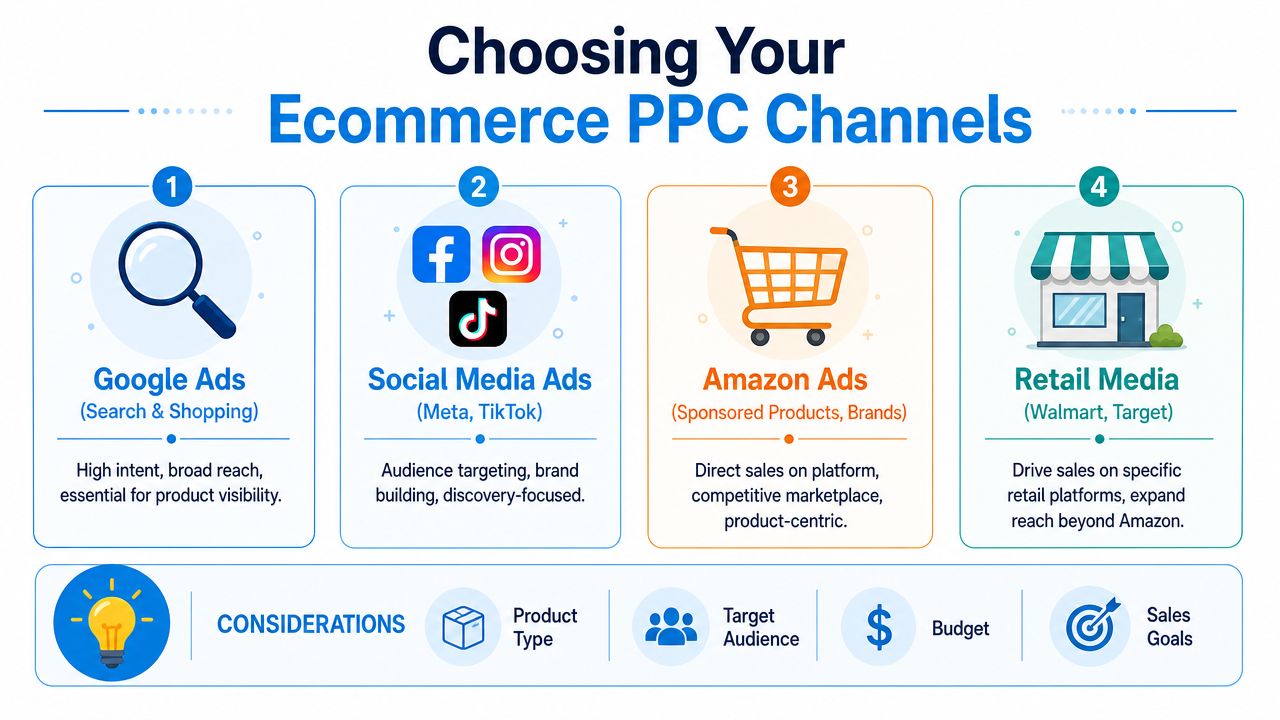
Channel selection is where many SMBs waste money. They try Google Search, Shopping, Meta, Performance Max, and marketplace ads all at once. The result is fragmented data, weak budgets, and no clear signal on what's effective.
When Google should lead
If your products solve an active demand problem, Google usually deserves first priority. Search captures intent. Shopping captures product-level comparison behavior. Performance Max can extend reach across Google inventory when your feed, tracking, and creative assets are in shape.
Use this lens:
- Google Search works best when buyers already know what they want, search with commercial intent, and compare options directly.
- Google Shopping is often the foundation for stores with strong product imagery, competitive pricing, and clean feed data.
- Performance Max can help when you already have enough conversion data and want broader automation across Search, YouTube, Gmail, and other placements.
Shopify's PPC statistics roundup notes that the average PPC conversion rate for Google Ads is 7.52%, compared with 7.72% for Meta ads and 9.89% for Amazon Ads. Those figures don't tell you where your brand should spend by default, but they do show why platform choice should follow business model and purchase context instead of habit.
When social and marketplace ads make more sense
Social ads and marketplace ads solve different problems than search.
Meta is strong when the product needs demonstration, visual appeal, or audience-based discovery. It's often a better fit for impulse-friendly products, lifestyle categories, and brands that need to create demand before they capture it. That doesn't make Meta “better” than search. It means the job is different.
Amazon is different again. If your products already sell there, Amazon Ads can be highly relevant because the shopper is deep in buying mode. In those cases, ad strategy needs to account for marketplace competition, retail readiness, and branded versus non-branded product queries.
A simple comparison helps:
| Channel | Best fit | Common mistake |
|---|---|---|
| Google Search | High-intent purchase terms | Bidding too broadly on low-intent queries |
| Google Shopping | Product-led comparison shopping | Running with weak feed data |
| Performance Max | Scaled accounts with solid tracking | Using it before conversion data is trustworthy |
| Meta | Visual products and demand generation | Sending traffic to generic product pages |
| Amazon Ads | Products sold on Amazon | Ignoring marketplace-specific competition |
If Amazon is a meaningful revenue channel, build that workstream separately from your Google account rather than treating it as an afterthought. A dedicated Amazon advertising setup for ecommerce brands is usually more effective than trying to force marketplace logic into a general PPC process.
Channel selection gets easier when each platform has one clear job. Search captures intent. Social creates interest. Marketplaces close demand where shoppers already browse.
Optimizing Your Product Feed and Landing Pages
The ad account gets most of the attention. The product feed and landing page usually decide whether the account makes money.

Your feed controls more than visibility
For Shopping, Performance Max, and many retail media environments, the feed is the campaign. If titles are vague, images are weak, attributes are incomplete, or variant information is inconsistent, the platform has less context for matching products to demand.
Good feed work is operational, not glamorous. It includes:
- Clear titles: Put product type, brand, size, model, or key differentiator in the title where relevant.
- Complete attributes: Fill in color, material, gender, size, condition, and other fields the platform uses for classification.
- Useful segmentation: Organize products so bidding decisions can follow margin, seasonality, or best-seller status.
- Image quality: Use clean product imagery that supports the way people compare items.
A poor feed can create the illusion that PPC is failing when the underlying issue is asset quality. That's common in SMB accounts where merchandising data, platform setup, and paid media are handled by different people.
Landing page alignment is a conversion issue
Most PPC advice tells you to make the page “relevant.” That's true, but it's not specific enough to fix the problem.
CustomerLabs' analysis of ecommerce conversion issues highlights a gap many teams miss. Even minor visual or messaging disconnects between ad creative and landing pages can reduce conversions by 20% to 30%. When an ad promises one thing and the destination page presents a different visual treatment, offer framing, or purchase path, users feel friction. Trust drops. Action drops with it.
That's why ad-to-page consistency should be audited as tightly as bidding.
Check these points:
- Offer match: If the ad mentions a sale, bundle, or shipping promise, the page should repeat it clearly.
- Visual continuity: Hero image style, product emphasis, and promotional cues should feel connected.
- Message order: Lead with the same value proposition that earned the click.
- Page intent: Send category-level ads to category pages, and SKU-level ads to product pages when possible.
This walkthrough is useful when you're reviewing page experience and commerce flows in more detail:
If your ads are getting clicks but not enough sales, inspect the handoff between ad promise and landing page reality before changing bids.
Structuring Campaigns for Scalable Growth
A scalable account structure does one thing well. It makes budget decisions, reporting, and optimization easier. If the structure hides margin differences, combines unrelated search intent, or mixes too many product types together, you lose control fast.
Build around decision control
The best structure for ecommerce PPC marketing usually follows how the business makes money, not how the ad platform suggests you organize campaigns.
Start with the divisions that affect budget and bidding most:
- Brand vs. non-brand so you can see whether demand is being captured or created
- Category or product family so budgets align with merchandising priorities
- Margin tiers so stronger products can tolerate different acquisition costs
- Promotional groups so sale items don't distort evergreen performance
- Top sellers vs. long tail so proven products don't subsidize weak inventory forever
Inside each campaign, ad groups or asset groups should remain tight enough to preserve relevance. If one ad group contains products or keywords that need different messages, it's too broad.
A simple structure often beats an elegant one. Owners don't need a complex naming convention that only a media buyer understands. They need an account where anyone reviewing performance can answer basic questions quickly: Which product groups are efficient? Which offers are underperforming? Which budget cuts would hurt revenue least?
Keep reporting simple enough to act on
A good campaign map should support weekly decision-making, not just monthly reporting. If the account can't show performance by margin bucket, category, and branded intent, the structure is probably too flat.
Use this as a practical model:
| Layer | Purpose |
|---|---|
| Campaign | Budget control and strategic separation |
| Ad group or asset group | Relevance between search intent, products, and messaging |
| Labels and naming | Clear filtering for promos, seasonality, and ownership |
Teams also underestimate the value of ownership fields. In an on-demand model, assign who owns feed updates, creative requests, landing page changes, exclusions, and performance review. That prevents the common SMB issue where everyone assumes someone else is handling the dependency.
A scalable PPC account isn't the one with the most features turned on. It's the one where budget shifts and performance problems are visible early.
Mastering Measurement Bidding and Budgeting
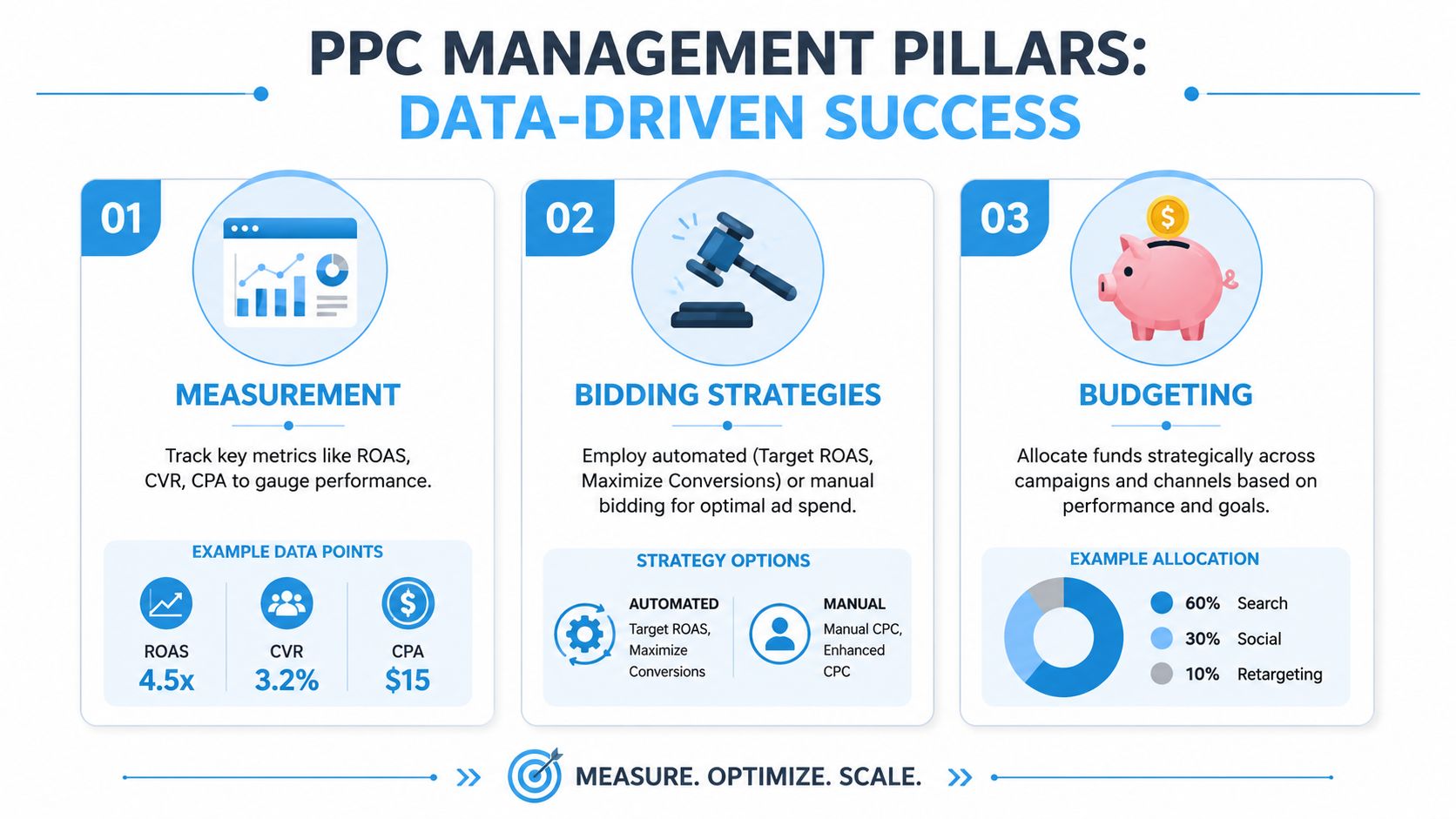
If tracking is weak, bidding gets worse. If bidding is wrong, budget allocation becomes guesswork. These three functions need to work as one system.
Measure what actually drives profit
Start with the metrics that connect to economics:
- ROAS for revenue efficiency
- CPA for acquisition cost discipline
- Conversion rate for landing page and offer quality
- Revenue by product group for allocation decisions
- New customer versus returning customer behavior when your stack supports it
ROAS remains a core benchmark in ecommerce. OuterBox's PPC metrics guide notes that a ROAS of 7.21 indicates $7.21 in revenue for every $1 spent, which gives owners a concrete reference point for campaign viability. That's not a universal target for every store. Margin structure, average order value, and repeat purchase behavior still determine what “good” looks like for your business. But it's far more useful than celebrating click growth.
CPA matters just as much because it forces discipline. A campaign can look efficient on top-line revenue while still bringing in customers at an acquisition cost the business can't sustain.
For tracking, make sure the basics are covered cleanly. GA4 should reflect ecommerce events accurately, and your ad platforms should receive reliable conversion data. In privacy-restricted environments, server-side approaches and conversion APIs can improve data continuity compared with browser-only tracking. What matters most is consistency. The same purchase shouldn't be counted differently across systems without a clear reason.
Choose bidding based on data quality
Automated bidding can work very well, but only when the inputs are trustworthy. If conversion tracking is incomplete, if product groups are mixed together badly, or if the feed is unstable, automation often magnifies the mess.
Use this decision table:
| Bidding approach | Best use case | Main trade-off |
|---|---|---|
| Manual CPC | New accounts, weak data, tight control needs | More hands-on management |
| Maximize Conversions | Accounts seeking volume with usable tracking | Can chase lower-quality conversions if setup is loose |
| Target ROAS | Ecommerce accounts with stable revenue data | Needs enough reliable conversion value data |
| Target CPA | Lead-focused or controlled acquisition scenarios | Less useful if value varies heavily by order |
Google's own cited performance examples show automation can help in the right context, but owners should still treat bidding strategy as a decision tied to data maturity, not a feature upgrade.
Budgeting is a control system
Budgeting works best when it follows evidence rather than optimism. A rigorous ecommerce PPC launch process outlined by ThinkNectar's step-by-step guide recommends starting with a conservative daily budget of 20% to 30% of projected spend and monitoring performance closely for the first 48 hours before scaling. The same guide notes that 50 to 100 conversions per ad variation are needed to reach statistical significance before gradual scaling.
That's a useful discipline for SMBs because it slows down the urge to pour money into campaigns that haven't earned it yet.
Use budgets in three layers:
- Learning budget for early signal collection
- Core budget for proven campaigns and products
- Flex budget for promos, seasonal pushes, and testing
This budgeting structure is especially useful when you work with a fractional team. It gives both sides a shared language for when to hold, when to expand, and when to cut.
Implementing a Creative and Ad Testing Workflow
Creative testing fails when teams treat it like occasional brainstorming. Strong ecommerce PPC marketing uses a repeatable loop. The loop matters more than any single ad idea.
Use a repeatable test loop
A simple framework works best:
- Hypothesize
- Create
- Test
- Analyze
The hypothesis should be specific. Not “make better ads.” Instead, “A price-led message may outperform a quality-led message for comparison shoppers in this category,” or “Lifestyle imagery may improve click quality for gift-oriented products.”
Then create controlled variations. Change one major variable at a time when possible. If you change headline, image, offer, and audience all at once, you won't know what caused the result.
Analysis should use the business metrics that matter for the campaign type. A creative with a stronger click-through rate isn't automatically the winner if it pulls in lower-quality traffic or raises acquisition costs. That's one reason to review creative alongside revenue, CPA, and landing page behavior instead of in isolation.
Test creative like an operating process, not a one-time task. The goal is to build a bank of proven messages by audience, offer type, and product category.
What to test first
Start where the biggest impact is.
- Headlines and hooks: Price, offer framing, urgency, category benefit, or product differentiator
- Primary image style: Clean product shot versus use-case or lifestyle context
- Promotional framing: Percent-off language versus bundle or free shipping emphasis
- CTA language: Shop now, buy now, explore collection, or see colors
- Audience-message fit: Different messages for cold traffic, remarketing, and branded traffic
Creative testing is also easier when the team has a documented intake process. Define who proposes tests, who builds assets, who approves them, and how results are recorded. Without that, testing becomes reactive and inconsistent.
For teams working with dynamic ads and personalized variations, this perspective on dynamic creative and real-time personalization in advertising is helpful because it shows how creative systems can scale without losing message control.
A mature workflow also retires weak concepts. Don't keep old ads running just because they once performed well. Fatigue is real, and stale creative often drags down results before the account makes it obvious.
Your On-Demand Ecommerce PPC Starter Checklist
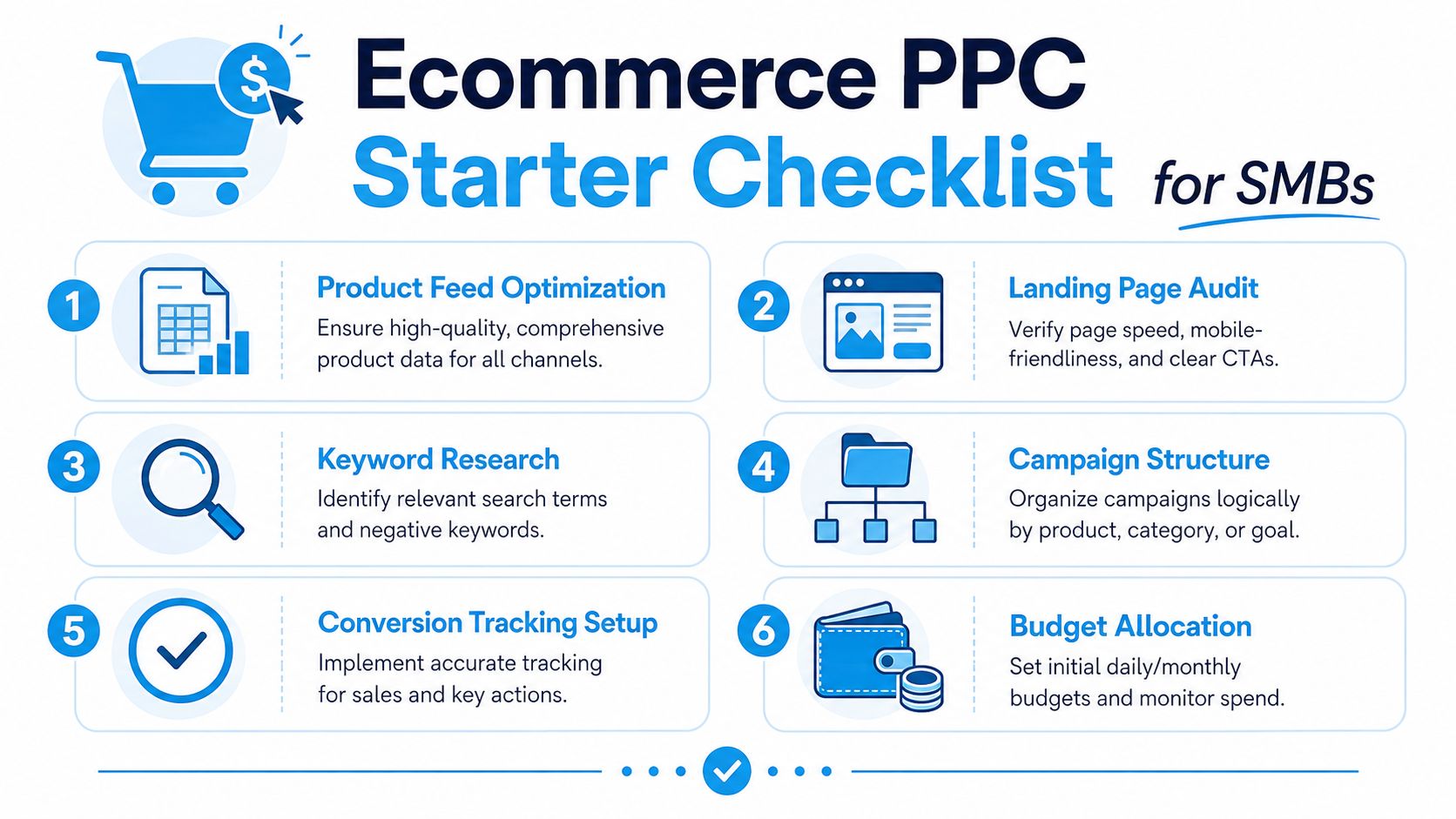
If you plan to manage PPC with a fractional or on-demand team, the handoff matters as much as the strategy. The smoother the handoff, the faster the team can make useful decisions instead of spending time untangling assets, unclear goals, and missing tracking.
The handoff document your team should prepare
Think of this as the operating brief your business should be able to hand to any qualified PPC partner.
Business goals and guardrails
Define target outcomes by channel or product line. Include acceptable ROAS or CPA ranges, margin notes, seasonality issues, inventory constraints, and products you never want pushed aggressively.Catalog structure and feed readiness
List your priority categories, hero SKUs, low-margin products, and promotional items. For shopping campaigns, Improvado's optimization guidance emphasizes using custom labels to segment products by margin, applying aggressive negative keyword strategies, and increasing bids for high-converting devices and locations. The same source notes that failing to adjust bids by performance dimensions can result in a 15% to 20% reduction in efficiency.Landing page map
Match each campaign or product group to its intended destination page. Include notes on promo messaging, inventory volatility, and any pages under redesign.Tracking and platform access
Confirm admin access, conversion actions, GA4 setup, tag ownership, and reporting expectations. If access lives with a former vendor, fix that before launch.Creative asset library
Organize approved logos, product images, videos, copy blocks, brand rules, and offer language. If the partner has to hunt for basic assets, testing slows down immediately.Decision rights
Clarify who can approve spend changes, promotions, page edits, feed fixes, and creative swaps. This one step saves a lot of wasted cycle time.
For owners who want an additional outside perspective, these proven strategies for boosting ecommerce sales are worth reviewing alongside your own checklist. They're useful for stress-testing whether your current setup is too broad, too reactive, or too dependent on one channel.
What the agency should own after handoff
Once the handoff is complete, the external team should be able to take clear responsibility for execution.
That usually includes:
| Agency responsibility | What good looks like |
|---|---|
| Campaign build and structure | Accounts organized around business goals, not platform defaults |
| Budget pacing | Spend follows plan and exceptions are flagged early |
| Search term and negative keyword management | Waste is reduced continuously |
| Feed and asset coordination | Product data issues are surfaced before they become media problems |
| Testing roadmap | Creative, landing page, and bidding tests run on a schedule |
| Reporting | Insights are translated into actions, not just dashboards |
The deeper point is this. SMBs shouldn't use a fractional model as a substitute for clarity. They should use it as a force multiplier. When the business hands off clean inputs, the agency can spend more time optimizing and less time reconstructing intent.
If you want help turning this into a working system, SharedTEAMS supports SMBs with fractional, on-demand marketing execution across PPC, creative, web, and strategy. A practical next step is to audit your current account against the checklist above, identify the gaps in tracking, feed quality, landing pages, and campaign structure, then bring in expert support where your team is losing time or control.