You're probably dealing with one of two problems right now. Either your company publishes content inconsistently and hopes something ranks, or you've published plenty and still can't tie it to pipeline, leads, or sales. Both problems come from the same issue. There isn't a system.
Content marketing SEO works when it stops being treated like a side project for a busy marketer and starts operating like a disciplined growth program. For small businesses and fractional teams, that means building a lean workflow, using AI where it speeds up production, and keeping expert oversight where mistakes are expensive.
Table of Contents
- Aligning Content Marketing SEO with Business Goals
- Audience Research and Topic Authority Planning
- Building a Scalable Content Production Engine
- Essential On-Page and Technical SEO Checks
- Smart Distribution and Internal Linking
- Measuring Performance and Optimizing for ROI
- Resourcing Your Program with a Fractional Model
Aligning Content Marketing SEO with Business Goals
If your content isn't tied to revenue, it's overhead.
Too many businesses still judge content marketing SEO by pageviews, impressions, or ranking screenshots. Those metrics can be useful, but they're not the score. The score is whether content helps lower acquisition costs, generate qualified leads, support sales conversations, or bring in demand that would otherwise require paid spend.
The financial case for treating SEO as a core growth channel is strong. SEO's average return on investment has reached $27.40 for every $1 spent in 2026, with B2B companies achieving the highest returns. This performance is a primary reason why 73% of B2B marketers now include content marketing as a core part of their strategy, according to Amra & Elma's roundup of 2026 SEO and content marketing statistics.
Choose KPIs that executives care about
A useful content KPI has to connect to a business decision. Start there.
| Business goal | Better KPI | Weak KPI |
|---|---|---|
| Generate leads | Demo requests, form fills, qualified inquiries | Sessions |
| Support sales | Assisted conversions, sales-page visits from content | Time on page alone |
| Lower CAC | Organic lead share versus paid dependence | Raw impressions |
| Expand category authority | Rankings for high-intent topic clusters | Total indexed pages |
That changes how you prioritize content. A service comparison page, a pricing explainer, or a decision-stage guide might matter more than a broad awareness article if your real problem is poor lead quality.
Practical rule: Every article should have one primary business job. If you can't name it, don't publish it.
Build around intent, not vanity traffic
Many teams waste months. They publish broad topics because the search volume looks attractive, but the traffic doesn't convert because the intent is wrong.
A stronger approach is to sort content into three buckets:
- Awareness content helps buyers frame the problem.
- Consideration content compares methods, vendors, or tradeoffs.
- Decision content reduces friction before contact or purchase.
Small teams should bias toward consideration and decision content first. That content tends to support revenue faster because it sits closer to action.
If you're also planning for AI-driven search visibility, review Sight AI's strategies. Their guidance is useful because it reinforces a point many businesses miss. Structured, clearly framed answers and strong topical coverage matter more than publishing volume.
Set operating targets before you scale production
You don't need a huge dashboard. You need a short list of numbers your team reviews every month.
Use a simple operating model:
- Content output target tied to priority topics, not arbitrary volume
- Ranking target for cluster pages and buyer-intent terms
- Conversion target by article type
- Refresh target for older pages that already have traction
That last point matters. Content marketing SEO becomes efficient when you treat content like an asset portfolio, not a publishing calendar. Some pages earn attention. Some assist deals. Some deserve expansion. Others should be merged or removed.
That's how you justify budget, keep the program disciplined, and avoid building a bloated library that looks busy but doesn't move the business.
Audience Research and Topic Authority Planning
Bad audience research creates expensive content. You end up writing for people who won't buy, targeting terms you can't win, and covering topics that never build authority.
Good planning starts with a simple question. What does your best customer need to know before they trust you, shortlist you, or contact you?
Start with buying questions, not keyword tools
Keyword tools are useful, but they shouldn't be the first step. Start with real conversations from sales calls, support tickets, intake forms, and proposal objections. Those questions reveal intent, urgency, and language.
Build a basic persona around decision behavior, not demographics alone:
- Problem pressure identifies what pushed them to start looking.
- Decision criteria tells you what they compare before choosing.
- Common objections gives you content topics with direct commercial value.
- Search language helps you match the phrases they use.
- Content preference shows whether they want quick answers, detailed guides, or examples.
For teams using AI-assisted discovery, this guide on smarter keyword research with AI and hidden search opportunities is a practical next read because it helps uncover terms that standard workflows often miss.
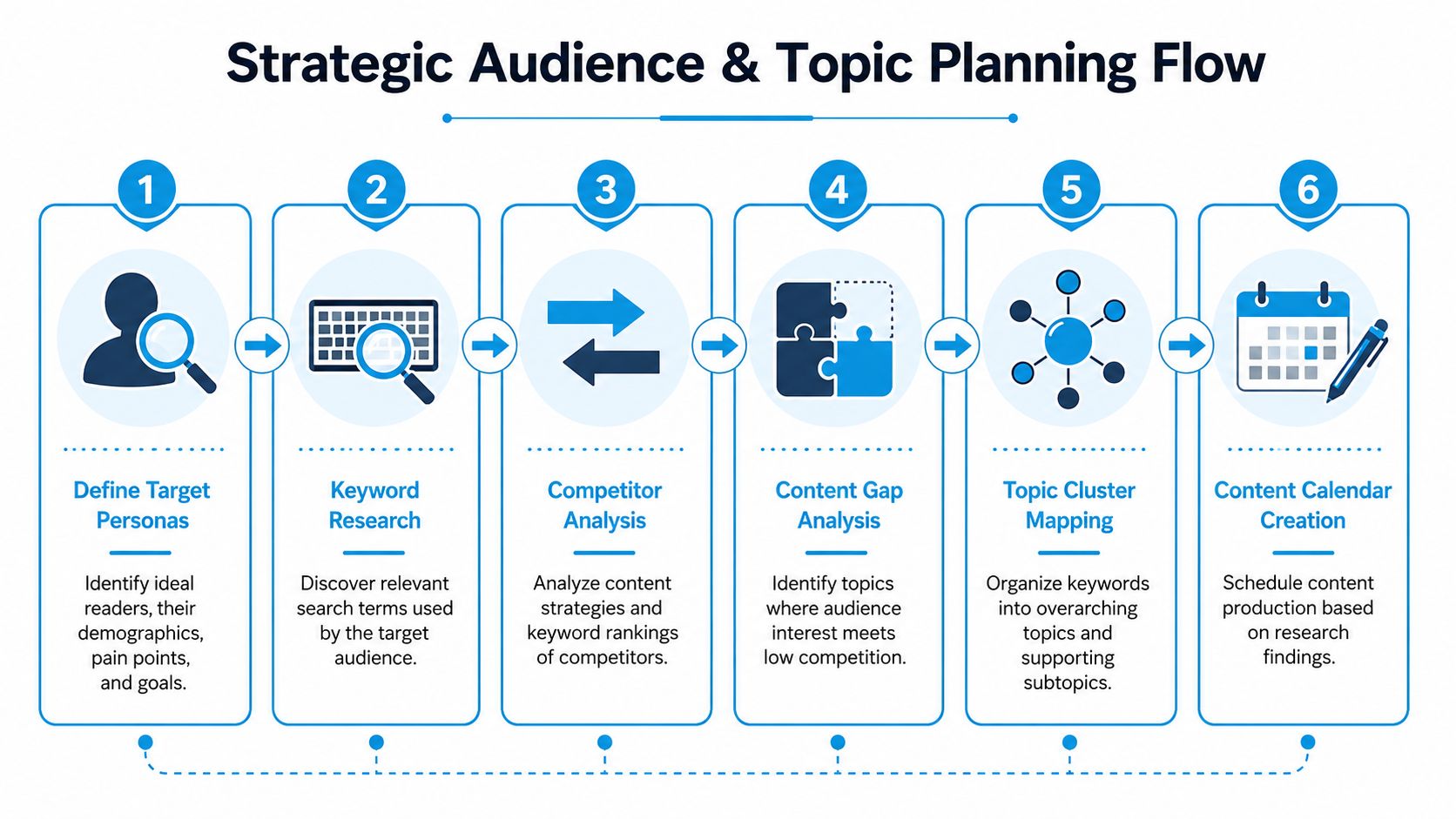
A straightforward planning flow looks like this:
- Collect recurring customer questions from internal teams.
- Group those questions by problem, not by keyword variation.
- Identify which groups map to services, products, or revenue lines.
- Validate search demand and competition after the grouping work is done.
- Prioritize based on fit, intent, and realistic ranking opportunity.
Build clusters that match intent
Topical authority isn't built with isolated blog posts. It's built with connected coverage.
A rigorous method requires 15 to 25 articles per pillar page, with each article often exceeding 2,000 words and including original data and expert insights to support Google's E-E-A-T criteria, based on Nav43's guidance on content SEO strategy. That doesn't mean every SMB needs to produce that all at once. It means your structure should support that depth over time.
Here's a smarter way to map clusters for a smaller team:
| Pillar topic | Supporting content types |
|---|---|
| Core service or solution | Buying guides, implementation steps, FAQs, comparisons |
| Industry problem | Symptoms, causes, mistakes, solutions, cost considerations |
| Use case | Role-based pages, scenario articles, workflow content |
| Strategic theme | Frameworks, checklists, templates, expert commentary |
Don't chase a single keyword. Own the subject buyers need to understand before they're ready to act.
This embedded walkthrough is worth reviewing if you want a visual explanation of planning and authority-building:
Map the calendar to decisions, not dates
A content calendar shouldn't be a list of monthly topics. It should reflect what your market needs at each stage of the buying process.
That means mixing formats intentionally. Publish one pillar page, then release supporting pieces that strengthen it from different angles. Add FAQs, comparison pages, and issue-specific articles that answer narrower search intent. Link them tightly. Update them as language, objections, or offers change.
This is also where many businesses overproduce awareness content because it feels easier to write. Resist that. If resources are tight, start with topics that help a prospect move from uncertainty to decision.
That's how topic authority starts paying off instead of sitting in a spreadsheet.
Building a Scalable Content Production Engine
Most SMB content programs break at the production layer. Strategy exists. Ideas exist. Publishing discipline doesn't.
That happens when one person is expected to research, brief, write, optimize, edit, source visuals, upload, and promote every article. The answer isn't to lower standards. The answer is to build a workflow that separates speed from judgment.
Use AI for speed and humans for judgment
AI is useful in content marketing SEO, but only in the right parts of the workflow. It can accelerate research summaries, first-draft structure, SERP pattern review, metadata options, and content gap identification. It should not own strategy, final claims, or brand judgment.
That hybrid model matters even more for distributed teams. There's a real operational gap in the market here. While 73% of marketing leaders use AI for content creation, only 28% report having structured SOPs for SEO compliance across distributed teams, according to Jeff Bullas' summary of underused content marketing strategies. Small companies feel this gap quickly because they don't have room for sloppy handoffs.
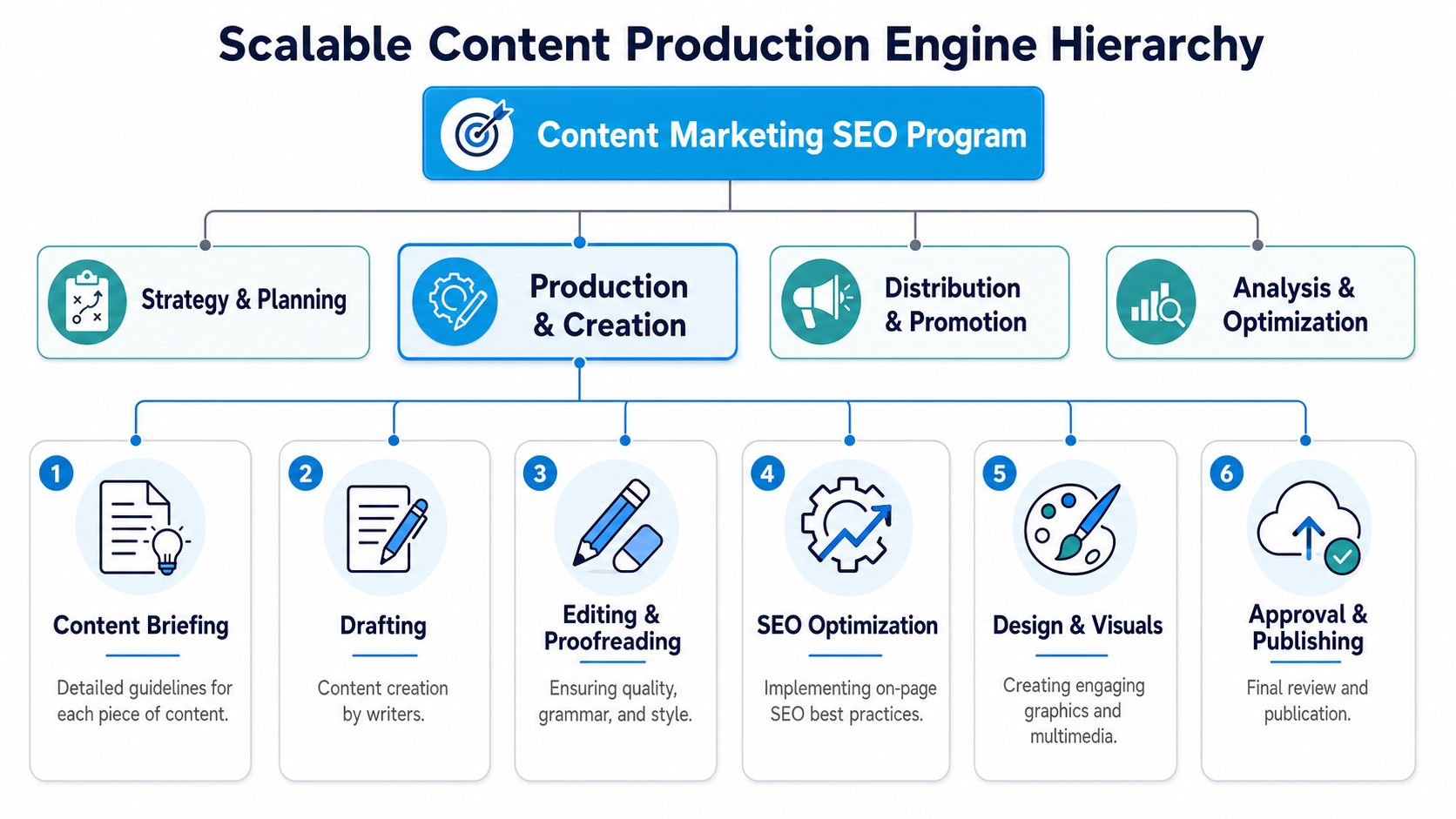
A clean production split looks like this:
- AI handles outline generation, topical gap scans, draft support, and formatting help.
- Strategists handle topic selection, search intent, conversion framing, and internal link planning.
- Editors handle clarity, factual accuracy, structure, and brand voice.
- SEO specialists handle metadata, schema, page structure, and optimization checks.
If you need a reference point for how AI-assisted drafting tools fit into a production stack, SEO Content Writing Platform is one example of the kind of system teams use to accelerate drafting without removing editorial review.
What every brief needs
The content brief is the control center. If the brief is weak, the article will be weak no matter who writes it.
A good brief includes:
- Primary search intent so the writer knows what problem to solve
- Target reader with role, urgency, and likely objections
- Article goal such as lead generation, sales support, or authority building
- Required angle that differentiates the piece from generic search results
- Internal links to include based on cluster logic
- Proof requirements such as examples, visuals, or expert input
- CTA direction that matches the reader's stage
A scalable workflow doesn't mean publishing faster for its own sake. It means removing avoidable effort while protecting the decisions that affect trust and rankings.
Quality has to be designed into the process
Teams often talk about E-E-A-T like it's a writing style. It isn't. It's the output of disciplined inputs.
That means your workflow has to force specific quality behaviors:
| Workflow stage | Required quality control |
|---|---|
| Topic selection | Clear intent and business relevance |
| Briefing | Unique angle and source requirements |
| Drafting | Direct answer, depth, semantic coverage |
| Editing | Accuracy, clarity, originality |
| Optimization | Titles, headings, links, metadata |
| Publishing | Technical QA and performance checks |
Scope discipline is important. Not every article needs to be massive. But if you're building authority around a pillar, superficial content usually stalls on page two because it lacks depth, originality, or semantic range.
A scalable engine for content marketing SEO should feel boring in the best way. The team knows the workflow. The brief standard is consistent. The review process catches weak spots early. And production can expand without quality falling apart.
Essential On-Page and Technical SEO Checks
A strong article can still fail because the page is poorly packaged.
Search engines need clear signals. Readers do too. If your title tag is weak, your meta description is lazy, your headers are disorganized, your images are heavy, or your schema is broken, you're wasting the effort you put into the content itself.
The checks that affect visibility first
Start with the elements that influence click-through, crawlability, and page experience.
Meta descriptions should be 155 to 160 characters, include the primary keyword, and use a direct call to action. Title tags should place the primary keyword near the beginning, based on LLMrefs guidance on content marketing best practices. That's not cosmetic. It affects how clearly your page matches search intent in results.
Your content structure also matters. The strongest format opens with a 40 to 60 word answer to the main question, then uses 2 to 3 bullet points to surface key insights before moving into deeper analysis, according to AV Digital Marketing Media's content structure guidance. That structure improves usability and helps search engines understand the page quickly.
A practical pre-publish standard
Technical SEO isn't optional busywork. It has measurable impact. Minifying code can cut load times by 20% to 40%, and 68% of pages with correct schema markup see higher click-through rates. Yet 42% of marketers fail to test their markup before publishing, according to Semrush's technical SEO overview.
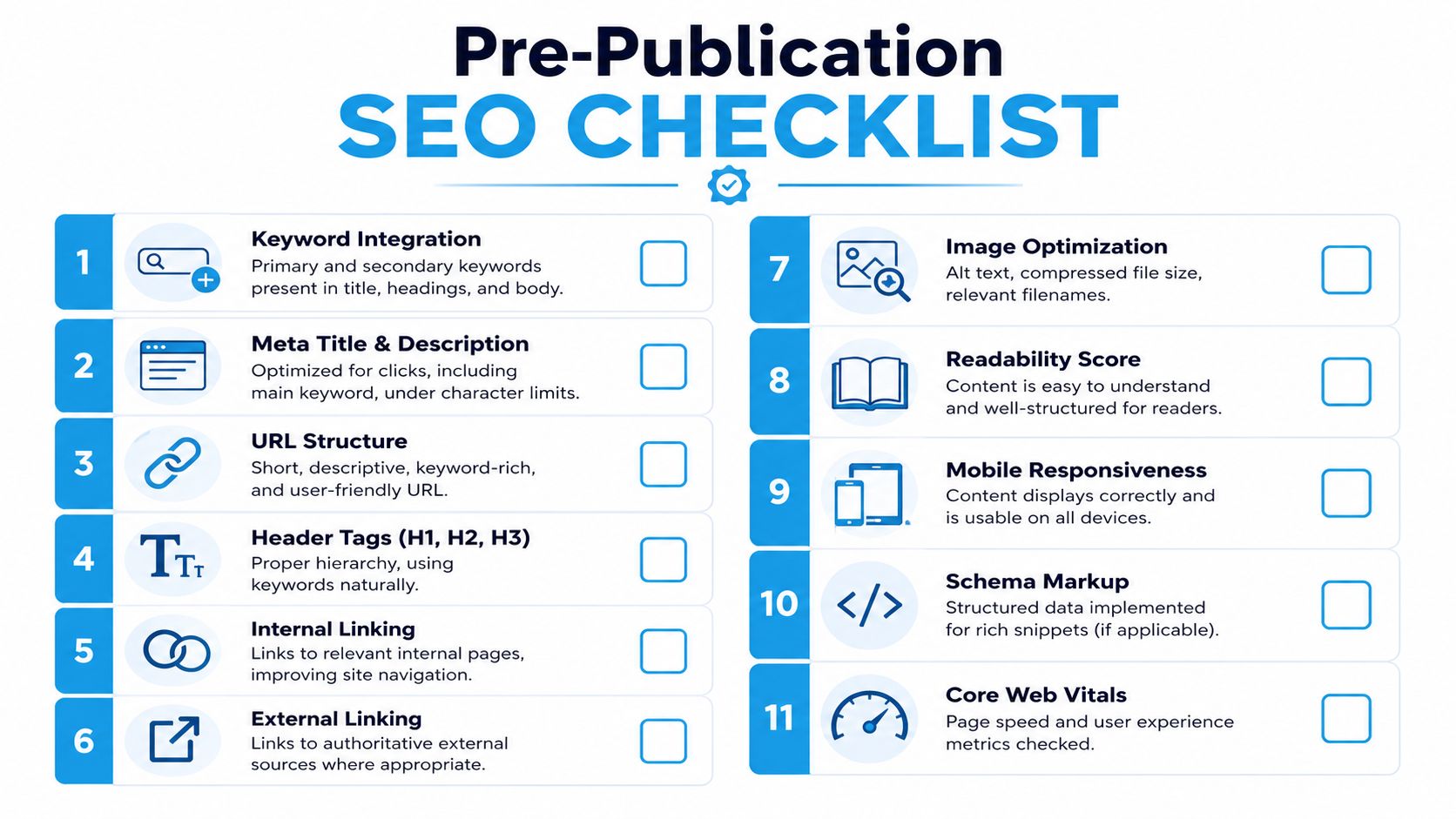
Use a pre-publication checklist every time:
- Title tag check confirms the primary term appears early and reads naturally.
- Meta description review makes sure it's within length guidance and gives a reason to click.
- Header hierarchy audit keeps one clear H1 and logical H2 and H3 structure.
- Image optimization pass compresses files, uses useful alt text, and names files clearly.
- Schema validation checks that markup matches visible content and renders.
- Internal link review ties the page back into the right cluster and service paths.
- Mobile and speed review catches obvious experience issues before indexing.
For teams that want a more systematic approach to AI-assisted optimization and QA, this article on AI and SEO intelligent optimization workflows is a practical reference.
Broken technical details don't just hurt rankings. They waste content investment you already made.
A final point. Don't let marketers guess on technical checks. Put the standards in a reusable checklist, assign ownership, and require signoff before publishing. That one change removes a surprising amount of inconsistency.
Smart Distribution and Internal Linking
Publishing a good article and waiting for rankings is passive marketing. It's also slow.
Content needs early momentum. Not because short-term promotion guarantees rankings, but because distribution creates visibility, earns engagement, and helps your team learn whether the angle is landing with real readers.
Publishing is the midpoint, not the finish line
A simple distribution plan beats a vague multichannel ambition every time. Small teams don't need to be everywhere. They need to be deliberate.
A practical rollout might include:
- Email first to current subscribers, customers, or prospects already close to the problem
- Sales enablement use where reps send the article in active conversations
- Social repurposing with a few sharp excerpts, not generic post captions
- Partner outreach to vendors, associations, or collaborators with overlapping audiences
- Community placement in niche forums or professional groups where the topic is relevant
That mix does two things. It gets immediate exposure, and it tells you whether the piece deserves expansion, repackaging, or stronger CTA treatment.
Internal links should be planned, not added randomly
Internal linking is where content marketing SEO becomes cumulative.
A strong internal link system helps search engines understand your site structure and helps users move toward the next useful page. It also lets you pass context and authority from stronger pages to newer or narrower ones.
Use internal links with intent:
| Link source | Link destination | Why it matters |
|---|---|---|
| High-authority blog post | Related service page | Moves readers toward commercial action |
| Pillar page | Cluster article | Reinforces topical depth |
| Cluster article | Pillar page | Consolidates authority around the core topic |
| Comparison article | Contact or solution page | Supports decision-stage movement |
Most companies underuse old content here. They publish new articles, then forget to go back and add links from existing pages that already have traction. That's a mistake. Older pages often become the fastest way to get a new page discovered, contextualized, and visited.
Internal links should answer one question: where should this reader go next if they want to keep solving the problem?
Anchor text matters too. Use descriptive language, not “learn more” or “read this.” Good anchors tell both users and search engines what they'll find next.
The broader point is simple. Distribution gets attention. Internal linking builds a system. If you do both well, each new article strengthens the rest of the library instead of existing as an isolated asset.
Measuring Performance and Optimizing for ROI
If your reporting stops at traffic, you don't know what your content is doing.
A useful content marketing SEO reporting model shows which pages attract the right visitors, which pages assist revenue, which pages deserve expansion, and which pages should be reworked or retired.
Track business outcomes at the page level
At minimum, every article should be reviewed against a short performance set. Not every page has the same job, so don't force one universal metric on the whole library.
Use a page-level lens:
- Traffic quality through organic sessions tied to relevant queries
- Engagement quality through scroll depth, time on page, or next-page movement
- Conversion support through assisted conversions, form fills, or CTA clicks
- Ranking movement at the topic-cluster level, not just single-term snapshots
- Content efficiency based on whether the article justifies ongoing upkeep
A practical review table helps keep this grounded:
| Article type | Primary success signal | Secondary signal |
|---|---|---|
| Awareness guide | Qualified organic traffic | Newsletter or resource engagement |
| Comparison page | Assisted conversions | Sales-page visits |
| Service-support article | CTA clicks or inquiries | Time on page |
| Cluster support article | Ranking support for pillar topic | Internal click path |
That's enough to make decisions without drowning in dashboards.
Use relaunches to recover value
Most companies underinvest in content refreshes because new content feels more productive. It often isn't.
Data shows that 62% of pages updated with new data and visuals regain ranking traction, according to Orwellix's content gap analysis overview. That's why older content with some existing relevance often deserves attention before you commission another net-new article.
A good relaunch process should include:
- Review whether the search intent has shifted.
- Keep the existing URL if it has any authority worth preserving.
- Replace weak sections with sharper answers and stronger structure.
- Add current examples, visuals, and missing subtopics.
- Improve internal links in and out of the page.
- Recheck metadata and technical packaging.
- Republish only after substantive improvement.
For teams thinking beyond backward-looking reports, this piece on AI forecasting for SEO performance is useful because it pushes measurement toward planning, not just reporting.
Google's guidance also matters here. Updating dates alone isn't enough. Freshness needs real substance. If you relaunch content, add new analysis, better evidence, clearer answers, or broader coverage. Otherwise the update is cosmetic and unlikely to help.
The ROI mindset is simple. Your content library is an asset base. Some pages need more promotion. Some need stronger CTAs. Some need consolidation. Some need a full relaunch. When you measure that way, optimization becomes a profit decision, not a publishing habit.
Resourcing Your Program with a Fractional Model
A complete content marketing SEO program needs more than a writer.
You need strategy, search intent mapping, editing, optimization, technical QA, design support, publishing discipline, and reporting. Most SMBs can't justify hiring all of that in-house. They also shouldn't rely on a loose collection of freelancers and hope the work aligns.
In-house, freelancers, and fractional teams are not equal
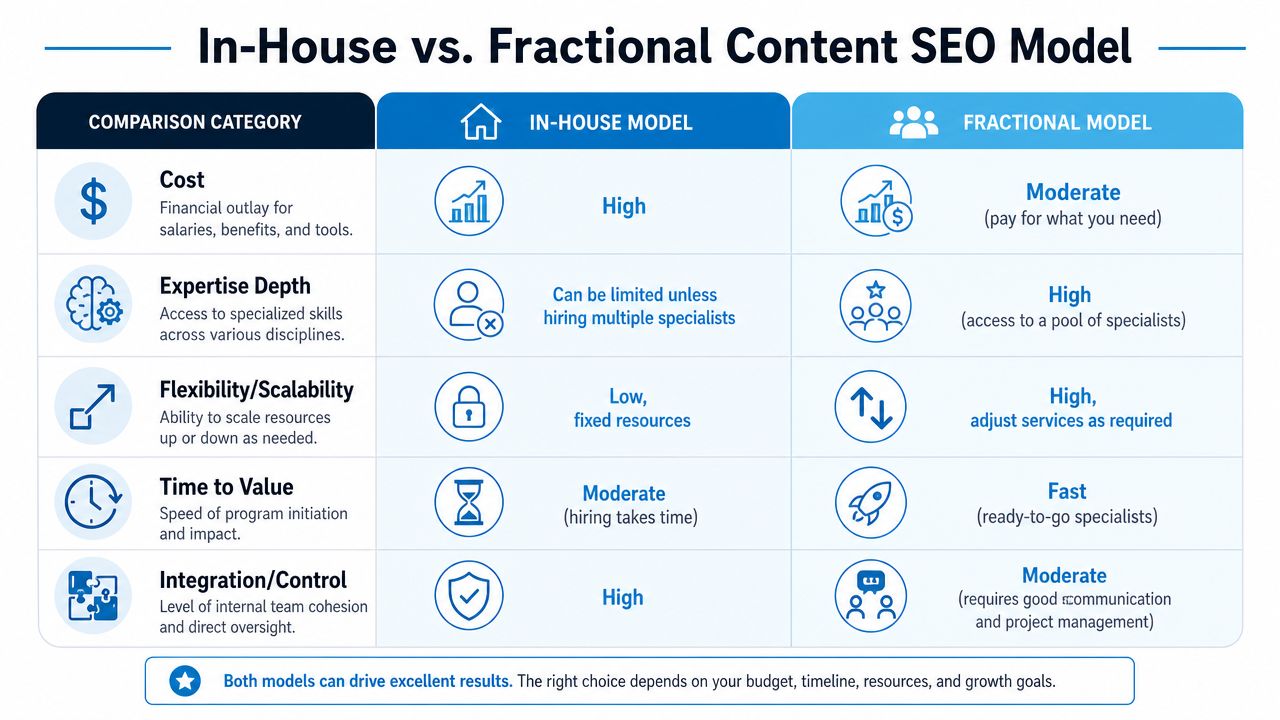
An in-house hire gives you control and close alignment, but one person rarely covers the full stack. A freelancer can solve a specific production gap, but freelancers often need more direction than business owners expect. A fractional model works best when you need coordinated expertise without full-time overhead.
This matters even more in AI-enabled production environments. While 73% of marketing leaders use AI for content creation, only 28% have structured SOPs for SEO compliance across distributed teams, based on Jeff Bullas' coverage of underused content marketing strategies. That gap is exactly where small companies lose efficiency. The tools are there. The operating system isn't.
A side-by-side view makes the tradeoff clearer:
| Model | Best for | Main limitation |
|---|---|---|
| In-house | Daily integration and direct oversight | Limited skill depth unless you hire multiple specialists |
| Freelancers | Tactical execution for isolated needs | Inconsistent process and variable strategic alignment |
| Fractional team | Ongoing execution with specialist coverage | Requires clear communication and a managed workflow |
What to look for in a fractional setup
Not every fractional arrangement is well run. Some are just agency retainers with a different label. The better model has a few clear traits:
- Documented SOPs so AI-assisted work doesn't create inconsistency
- Clear briefing standards across writers, editors, and SEO specialists
- Flexible capacity for periods of heavier production or optimization
- Strategic oversight so output stays tied to business priorities
- Visible workflows that let your team track work without chasing updates
If you're a business owner deciding how to resource the program, use a simple filter. Do you need one pair of hands, or do you need a system? Most companies that want reliable content marketing SEO performance need the second option.
That's why the fractional model is often the right middle ground. It gives you broader expertise than a single hire and more structure than a freelance bench, while keeping costs and management burden in a range that SMBs can support.
If you need a practical way to run content marketing SEO without building a full in-house department, SharedTEAMS offers a fractional model designed for that gap. It combines strategic oversight, AI-enabled workflows, and on-demand execution across SEO, content, design, and marketing operations, so you can build a scalable program without taking on large-agency overhead.