Your company looks established from the outside, but the brand tells a different story. The homepage sounds polished, sales decks use different language, social posts feel generic, and customer emails don't match the promise your website makes. That disconnect doesn't just look messy. It makes buyers hesitate.
A strong brand development strategy fixes that by turning brand from a design task into an operating system for growth. Businesses that implement well-defined brand strategies experience revenue growth of 10% to 20%, according to analysis cited by FUEL for Brands. That lift comes from aligning messaging, customer experience, and value proposition across touchpoints.
For founders and lean marketing teams, the harder problem isn't writing a strategy deck. It's making the strategy usable every day, especially when execution is spread across freelancers, agencies, internal staff, and AI tools. That's where most brand advice falls short.
Table of Contents
- Your Brand Is More Than a Logo It's a Growth Engine
- What Is a Brand Development Strategy Really
- The Five Core Components of a Strong Brand
- A Practical Framework for Building Your Strategy
- How to Measure Your Brand Strategy's Impact
- Common Pitfalls and Your Brand Development Checklist
- Sustaining Your Strategy with a Fractional Team
Your Brand Is More Than a Logo It's a Growth Engine
A founder usually feels the brand problem before they can name it. Leads are coming in, but too many are a poor fit. Sales keeps rewriting the story in every call. The website looks polished, yet prospects still ask, "So what makes you different?" Those are growth issues, not design issues.
A brand earns its keep by reducing friction in how the business is understood and chosen. It helps the right customers recognize themselves in your offer faster. It gives sales a clearer lane than price. It gives marketing a standard for what belongs in the message and what distracts from it.
For small and mid-sized businesses, this matters even more because the team building the brand is often fractional. A founder, a freelance designer, a contract copywriter, an agency running paid media, and one internal marketer can all be pulling in different directions unless the brand gives them a shared brief. Without that operating logic, every new campaign, landing page, and sales deck starts from scratch.
One quick test works well. Ask three people across marketing, sales, and customer success to describe your company in one sentence. If you get three different answers, the market is probably getting three different answers too.
Brand strategy also affects the kind of growth you can sustain. If your customer experience, retention loop, and referral motion matter as much as acquisition, this perspective on experience-driven growth and the shift from funnels to flywheels fits directly into brand planning. If you are trying to increase visibility across search, AI summaries, and other discovery channels, this guide to AI-driven brand growth is a useful complement.
A good brand development strategy gives the business a decision filter. It tells marketing what to repeat, sales what to promise, product what story each release should support, and external partners what they cannot improvise. That is how brand stops being a logo project and starts working like a growth engine.
What Is a Brand Development Strategy Really
A brand development strategy is a documented plan for how your business should be understood, experienced, and remembered. It defines the role your brand plays in the market and gives your team a shared standard for making decisions.
That sounds abstract until you see the alternative. Without strategy, every channel starts improvising. Marketing chases trends. Sales writes its own pitch. Product launches features with no narrative context. Customer service solves tickets well but reinforces nothing distinctive about the company.
It's not the same as branding
Branding is what people usually see first. Your name, logo, typography, color system, website design, and tone of voice all sit in that layer. They matter because they create recognition and signal professionalism.
A brand development strategy sits underneath those choices. It answers questions like these:
- What market position are we claiming
- Who do we serve best
- What do we want customers to trust us for
- What should people consistently expect from us
- What should our team never dilute, even when channels or tactics change
If your visual identity changed tomorrow, a real strategy would still hold. The logo could evolve. The core meaning should not.
It's also not a campaign plan
Campaigns are time-bound. A brand strategy is durable. A paid search push, webinar series, product launch, or email sequence might support the brand, but none of those activities define it on their own.
Founders often get stuck. They invest in execution before they resolve positioning. The result is efficient production of inconsistent work.
A campaign can create attention. A brand strategy decides what that attention means.
A useful way to think about it is this:
| Element | What it does | What happens if it's missing |
|---|---|---|
| Brand strategy | Sets direction and meaning | Teams send mixed signals |
| Brand identity | Makes the brand recognizable | The company feels generic or forgettable |
| Marketing campaigns | Create demand and engagement | Growth becomes sporadic |
Why it matters beyond marketing
A strong brand development strategy helps a business make trade-offs. It clarifies which customers fit best, which messages deserve repetition, and which opportunities look attractive but pull the company off course.
That discipline matters more for resource-constrained businesses than for large organizations. A founder-led company doesn't have room for vague positioning or broad, unfocused messaging. Every offer, sales conversation, and landing page has to reinforce the same case for choosing you.
When the strategy is clear, teams move faster because they aren't debating fundamentals every week. When it's unclear, they produce more work but create less coherence.
The Five Core Components of a Strong Brand
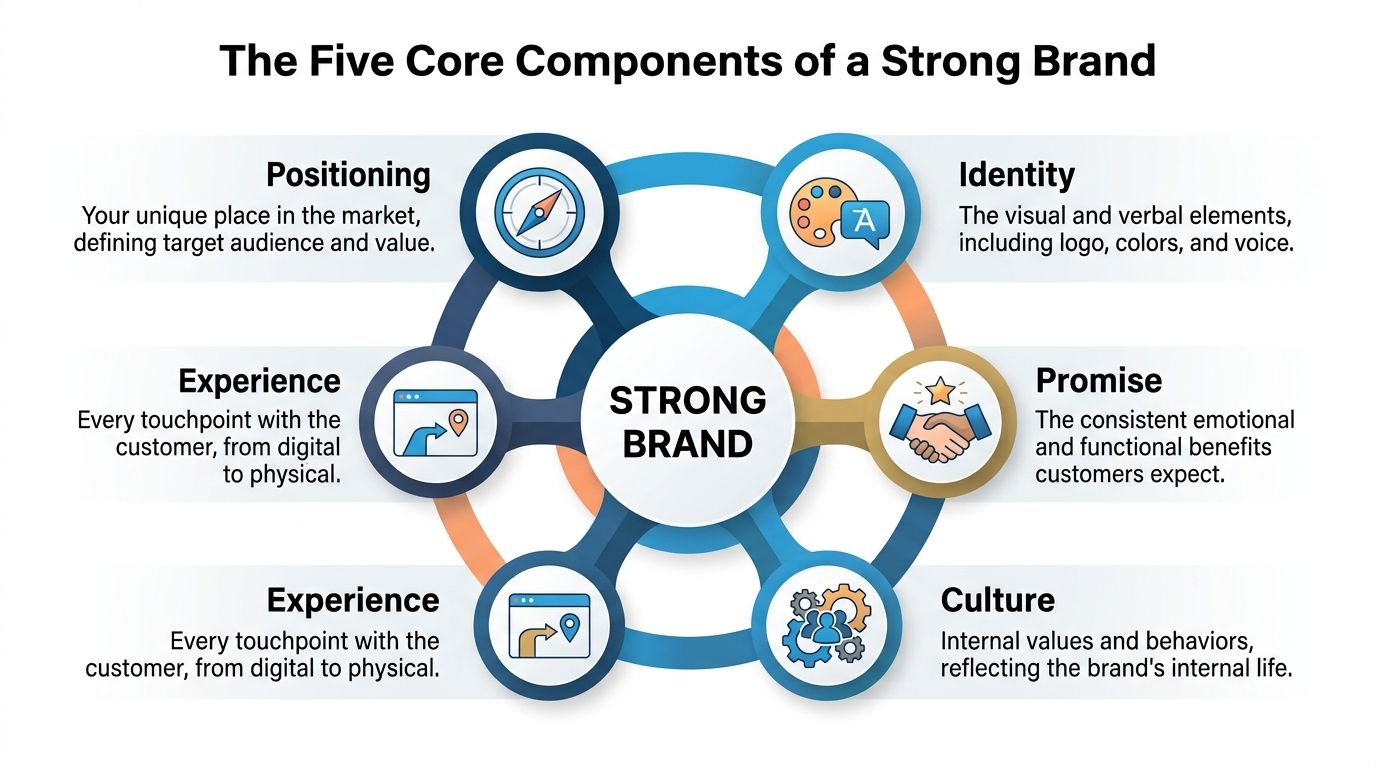
A strong brand isn't built from one decision. It's built from a system. When one part is weak, the rest have to compensate, and that usually leads to overproduction, mixed messaging, or a polished identity that doesn't connect.
Positioning sets the direction
Positioning is your place in the market. It defines who you serve, what problem you solve, and why your approach is meaningfully different. This leads to many brands becoming interchangeable because they describe themselves with category language instead of buyer-relevant language.
Strong positioning usually does three things well:
- Names the audience clearly: Not everyone with a budget is your ideal buyer.
- Frames the value sharply: Buyers should understand the practical and emotional payoff.
- Creates separation: If your closest competitors could say the same thing, it isn't positioning yet.
Identity and messaging make it recognizable
Identity is the visible and verbal expression of the brand. Messaging is how that expression turns into useful communication.
Identity includes your logo, color palette, typography, imagery, motion style, and interface choices. Messaging includes your headline architecture, key claims, proof points, sales narrative, onboarding language, and the phrases your team repeats across channels.
These two components should reinforce each other. If your visual system signals premium precision but your copy sounds broad and casual, the brand starts to feel unstable. If you're exploring how adaptive visual systems work in modern marketing environments, this piece on AI-powered branding and evolving visual identities adds a useful design-layer perspective.
Experience and governance make it real
Experience is what customers encounter. Site navigation, proposal quality, onboarding flow, sales responsiveness, support language, product UI, invoices, and follow-up emails all shape the brand more than a style guide alone ever will.
Governance is what keeps those experiences aligned. It's the least glamorous part of brand work, and often the most valuable. Expert benchmarks summarized by Brand Strategy Sarah indicate that brand consistency is a primary driver of customer loyalty, and top-performing brands filter insights to isolate what is relevant, differentiated, and authentic before defining strategy. That discipline helps teams keep the brand promise consistent across interactions.
Your brand promise fails the moment operations, sales, or service contradict it.
A practical way to evaluate the five components is to ask where friction lives now:
| Component | Healthy signal | Warning sign |
|---|---|---|
| Positioning | Buyers quickly understand fit | Prospects compare you on price alone |
| Identity | Materials feel cohesive | Assets look like they came from different companies |
| Messaging | Teams use similar language | Everyone explains the business differently |
| Experience | Touchpoints reinforce trust | Delivery feels disconnected from promises |
| Governance | Standards are easy to apply | Brand quality depends on who made the asset |
If one of those warning signs feels familiar, don't jump straight to redesign. Find the missing component and fix the system first.
A Practical Framework for Building Your Strategy
A founder hires a designer, a freelance copywriter, and a contract marketer. Six weeks later, the website looks better, the pitch deck says something different from the homepage, and sales is still explaining the company from scratch on every call. That is the common SMB version of brand strategy failure. The problem is rarely effort. It is the lack of a working system that a small, part-time team can apply without constant founder intervention.
A useful brand development strategy creates decisions your team can make this week. It should tell a freelance writer how to frame an offer, help a salesperson explain value with less drift, and give a designer clear rules without a 60-page brand manual.
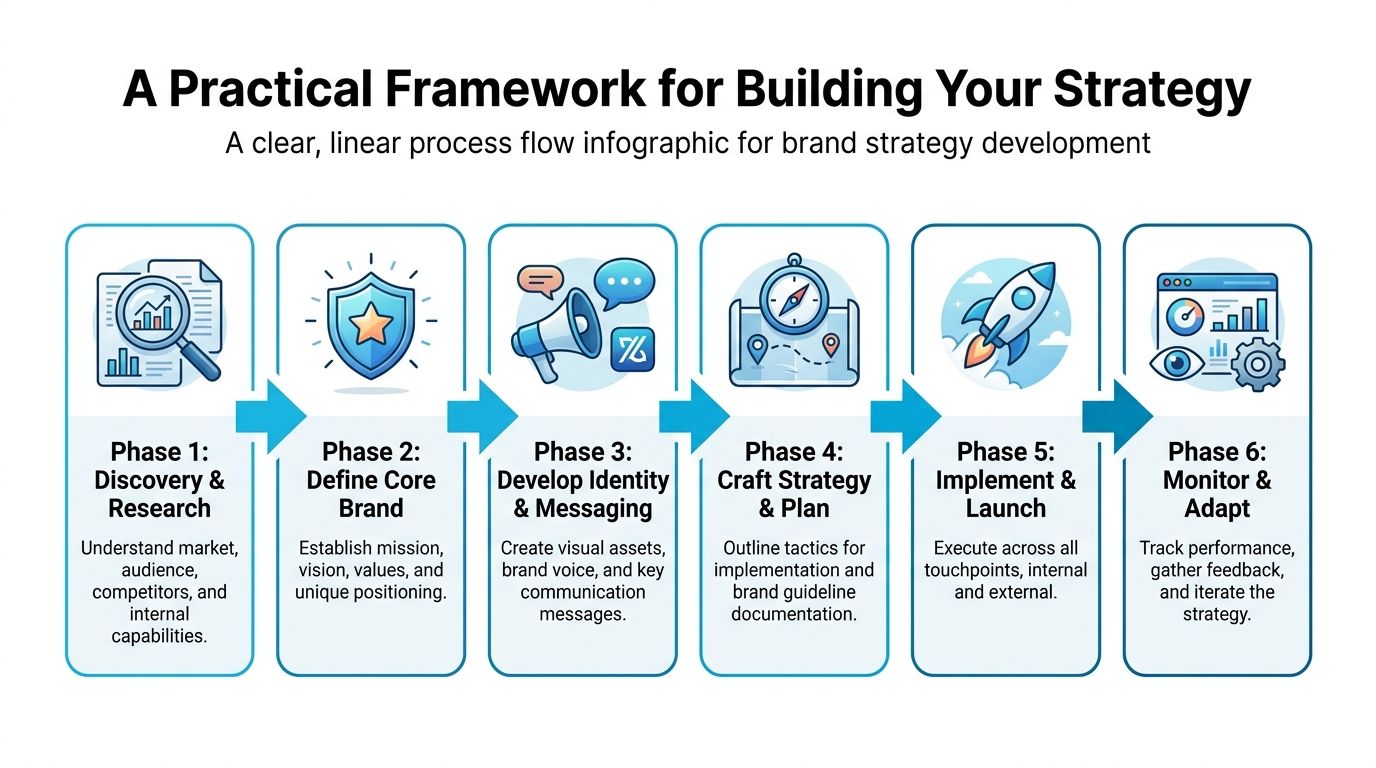
This framework works well for growing companies because it connects strategy to evidence, rollout, and maintenance by a fractional or on-demand team.
Start with reality, not aspiration
Begin with an audit. Review what the business says, what customers hear, and what they experience after they buy. Go beyond the homepage and visual identity. Pull proposal templates, outbound emails, sales decks, onboarding docs, support replies, job posts, product screens, and social content. For a smaller company using contractors, this step often reveals where the brand has fragmented across different contributors.
Then study the category. Map five to ten direct competitors and look for repeated claims, visual patterns, and obvious positioning gaps, as outlined in MetaBrand's brand strategy framework. The goal is to spot where your company sounds interchangeable before you invest in new messaging.
Use a short checklist to keep this stage practical:
- Collect live materials: Use assets the team is using now, not idealized versions sitting in a folder.
- Interview decision-makers and operators: Founders, sales leads, account managers, and support staff usually surface disconnects fast.
- Review customer language: Sales-call notes, testimonials, support tickets, and win-loss feedback often contain better phrasing than internal workshops.
- Flag implementation risk: Note where a fractional team will need templates, approvals, or clearer ownership to apply the strategy consistently.
Define the core and test it before rollout
Once the audit is done, define the strategic core. That usually includes audience focus, positioning, value proposition, brand promise, personality, and message hierarchy.
Keep each part usable. If sales cannot apply it on a call, or a freelance copywriter cannot turn it into a landing page headline, it is still too abstract.
A common mistake is polishing the strategy internally and calling it finished. A better process is to test rough positioning with a small set of customers or prospects before you formalize it. That keeps the final language closer to how buyers judge credibility, relevance, and risk.
Test rough positioning before you polish it. Customers will expose weak strategy faster than an internal review ever will.
A few methods work well:
- Message testing interviews: Show two or three positioning directions and ask which feels clearest, most credible, and most useful.
- Sales-call review: Watch where prospects ask follow-up questions, where they get confused, and where they push the conversation toward price.
- Landing page tests: Compare headline directions to see which framing attracts better-fit engagement, not just more clicks.
For teams trying to improve discoverability in AI-assisted search and answer environments, this guide on how to win citations in AI answers is useful because it connects brand clarity to structured visibility, not just traditional channel performance.
Later in the process, use this video as a useful reset on brand fundamentals and execution discipline:
Launch through the touchpoints that matter first
Rollout works best as a priority sequence. Start with touchpoints that shape buyer perception early and often: homepage messaging, sales narrative, proposal language, email templates, onboarding communication, and core campaign assets.
For a resource-constrained business, do not try to update everything at once. Fix the places where inconsistency costs deals, slows onboarding, or creates extra explanation work for the team. That trade-off matters. A polished social presence helps less than a clear homepage and a sales deck that tells the same story.
Document the brand in a format contractors and part-time specialists can use without guesswork:
- A one-page brand summary: Audience, positioning, promise, and tone.
- A message architecture: Primary claims, proof points, objections, and approved phrasing.
- A visual ruleset: Logo use, typography, imagery, layouts, and template examples.
- A workflow guide: Who can request changes, who approves them, where files live, and which version is current.
Build governance that a fractional team can sustain
The strategy holds up only if someone can maintain it between major projects. In SMBs, that usually means assigning light but clear ownership across a fractional team rather than hiring a full internal brand department.
Set a review cadence. Monthly is often enough for active campaigns and sales materials. Quarterly works for a wider brand check on positioning drift, offer changes, and market shifts. Keep the core stable. Update the edges as the business learns more.
The best version of governance is simple. One source of truth, a short approval path, and templates people will use. If the system depends on the founder reviewing every asset, the strategy will stall as soon as the business gets busy.
How to Measure Your Brand Strategy's Impact
Brand measurement fails when teams either track nothing or track the wrong things. If you only watch follower counts or impressions, you'll confuse activity with progress. If you only watch revenue, you'll miss early signs that the brand is strengthening or drifting.
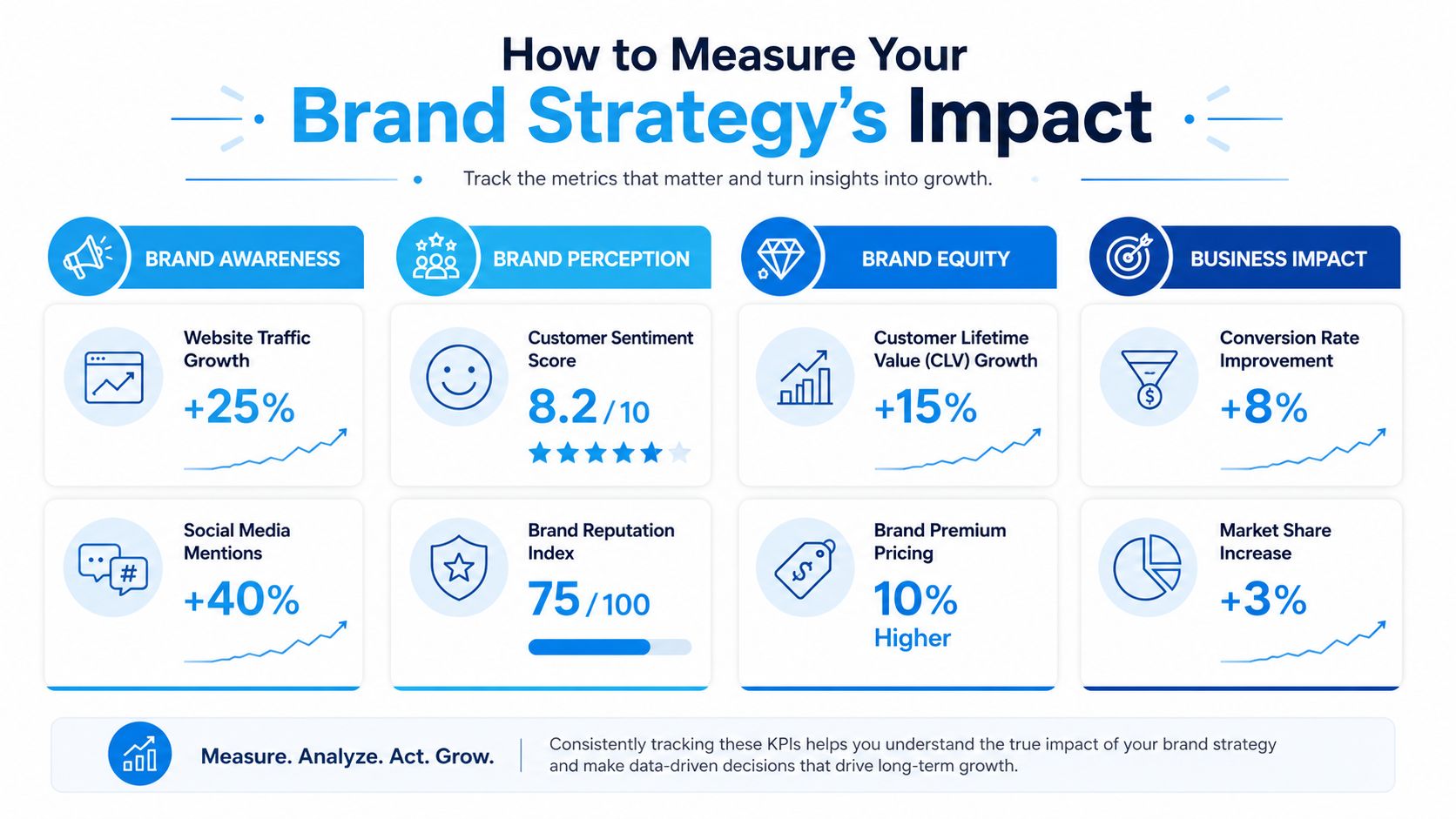
The right scorecard connects brand health to business performance. Companies that track six or more brand strategy metrics grow 2.3x faster than competitors who track fewer, according to Brandigo.
Track outcomes, not just visibility
A useful framework is to split measurement into three groups.
Business outcomes show whether the brand supports commercial performance. Look at lead quality, close-rate patterns, sales-cycle friction, retention trends, referral volume, and whether buyers accept your framing of value or push immediately to price.
Market perception helps you understand what people think before they buy. This can include branded search trends, direct traffic patterns, share of voice in category conversations, review themes, sales-call feedback, and recurring phrases customers use when describing your company.
Internal adoption is where many brand strategies often fail. Measure whether teams are using the positioning, message hierarchy, templates, and brand rules you've established. If sales rewrites the deck every quarter and marketing keeps producing one-off campaign language, the strategy hasn't been operationalized.
Build a scorecard your leadership team will use
A brand scorecard should be simple enough to review consistently. If it takes a separate analytics project to interpret it, it won't survive.
A practical monthly view might look like this:
| Category | What to review | What it tells you |
|---|---|---|
| Commercial | Lead quality, win themes, retention signals | Whether the brand is attracting and supporting the right business |
| Perception | Review language, direct feedback, branded search behavior | Whether the market understands your positioning |
| Execution | Asset consistency, template adoption, message compliance | Whether the strategy is showing up in real work |
Brand measurement should answer two questions. Are buyers understanding us more clearly, and is the business benefiting from that clarity?
Don't try to create a perfect dashboard on day one. Start with a manageable set, use it regularly, and refine it as the strategy matures.
Common Pitfalls and Your Brand Development Checklist
Most brand problems aren't caused by bad intentions. They're caused by partial execution. A company does the positioning work but doesn't update sales materials. Or it invests in a polished identity while leaving service language and onboarding untouched. The result is a brand that looks stronger than it operates.
Where brand strategies break down
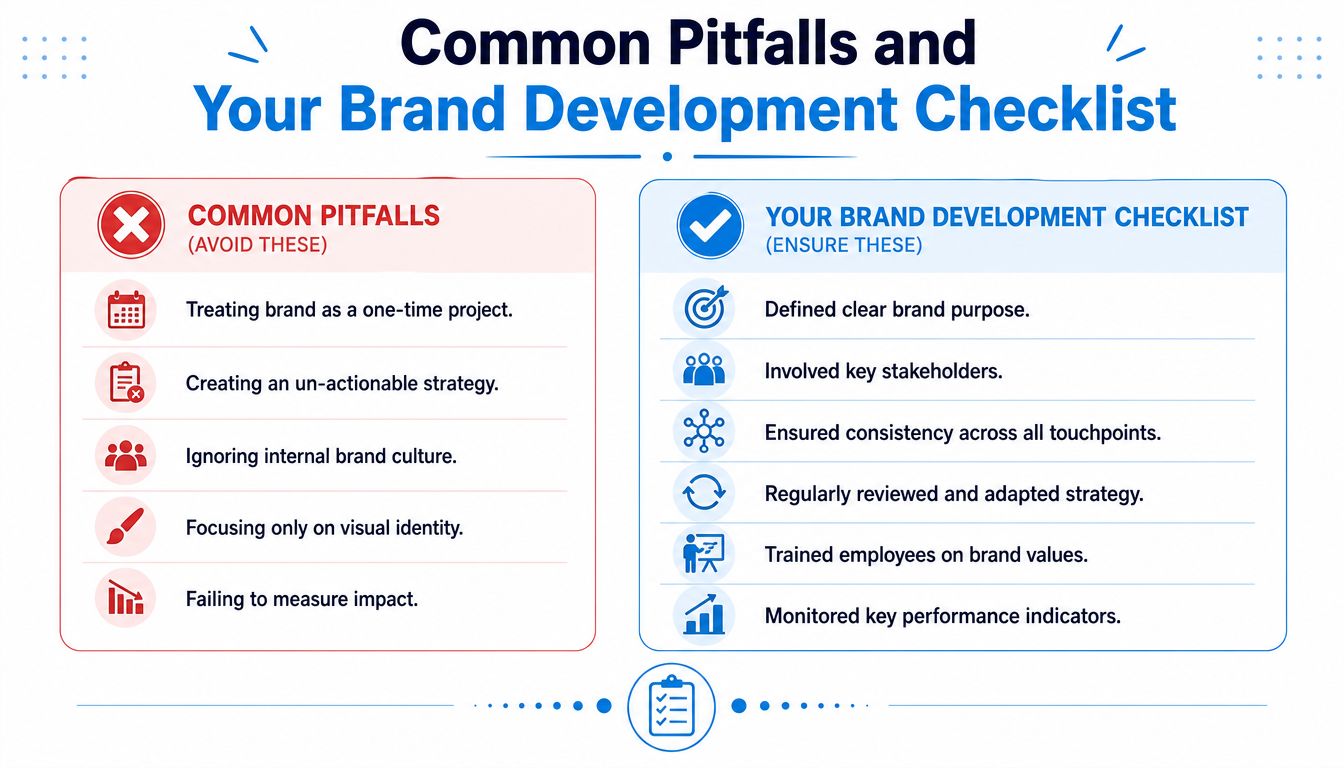
A common failure point is treating brand as a one-time initiative. Teams finish the workshop, approve the visuals, and move on. Then the market changes, new offers appear, or new contributors create assets with no real guidance.
Another problem is creating a strategy that can't survive operations. If your brand promise depends on white-glove responsiveness, but your delivery process is slow and fragmented, customers will feel the contradiction immediately.
These mistakes show up often:
- Overweighting visuals: The redesign launches, but the message stays vague.
- Writing abstract positioning: The language sounds good in a document and weak in a sales conversation.
- Ignoring internal training: Teams can't follow standards they were never taught to use.
- Allowing exceptions everywhere: One rushed pitch deck becomes ten off-brand assets a month later.
- Skipping measurement: Leadership loses confidence because nobody can connect brand work to outcomes.
A practical checklist
Use this as a working audit, not a branding exercise.
- Clear positioning exists: Your team can explain who you serve, what you solve, and why you're different without improvising.
- Brand promise is documented: People know what customers should expect at every meaningful interaction.
- Core messaging is usable: Sales, marketing, and leadership use the same underlying language.
- Visual rules are accessible: Templates, design standards, and approved assets are easy to find and apply.
- Customer experience aligns: Onboarding, support, proposals, and product touchpoints reinforce the brand rather than dilute it.
- Review ownership is assigned: Someone is responsible for approving high-visibility materials.
- Training has happened: New team members and outside contributors know how to work within the system.
- Measurement is active: Brand performance is reviewed with the same discipline as campaign performance.
If several of these are missing, don't rebuild everything at once. Fix the gaps that affect customer understanding first. Usually that's positioning clarity, message consistency, and customer-facing execution.
Sustaining Your Strategy with a Fractional Team
Many small and mid-sized businesses often hit a wall. Most advice on brand development strategy assumes a full-time internal team with stable roles, constant proximity, and a shared culture. In practice, many growing companies rely on freelancers, consultants, agency partners, internal generalists, and AI-enabled production tools.
That operating model creates a specific risk. The brand starts to fragment because every contributor works from a slightly different interpretation. As noted by Ask Attest's guide on brand development, most guides are built for full-time teams and don't address how fractional or on-demand teams maintain consistency. For SMBs, the central challenge is enforcing brand standards across rotating specialists and AI-enabled workflows without a dedicated Brand Manager.
The fix isn't more meetings. It's better infrastructure.
A sustainable setup usually includes a living brand profile, a current message hierarchy, approved templates, clear review checkpoints, and a shared system for project intake and approvals. The more distributed the team, the more important those operating rules become. This perspective on strategic design systems for consistency and conversion is especially relevant if you're trying to reduce drift across multiple asset types.
What works is simple, visible, and repeatable. What fails is tribal knowledge.
When a fractional model is well managed, it can protect brand quality rather than weaken it. The condition is that the strategy has to live inside the workflow, not in a slide deck no one opens after kickoff.
If your team needs help turning brand strategy into an operating system, SharedTEAMS is built for that kind of work. Their model combines strategic guidance, on-demand execution, and a living brand profile that helps keep websites, campaigns, content, and creative aligned without requiring a full internal marketing department. A practical next step is to review your current brand assets, messaging, and workflows, then identify where inconsistency is costing clarity or slowing execution.