You're probably seeing a familiar pattern. The team posts on LinkedIn when someone has time. A product update goes out. Then an event photo. Then a company milestone. A few likes come in, but sales doesn't see better conversations, leadership doesn't see a clear return, and social starts to feel like a chore instead of a channel.
That frustration usually isn't caused by the platform. It's caused by execution without a system. In B2B, social rarely works as a string of isolated posts. It works when the business knows who it's trying to influence, what trust it needs to build, and how content will be produced consistently enough to matter.
For small and mid-sized businesses, that's where the gap shows up. Strategy advice is easy to find. A realistic operating model is not. This absence frequently causes B2B social media marketing to falter, yet it also becomes practical when built correctly.
Table of Contents
- Why Your B2B Social Media Isn't Working
- Defining Strategic Goals for B2B Social
- Choosing the Right Platforms and Audience
- Developing a B2B Content Strategy
- Balancing Organic Reach and Paid Advertising
- Measuring What Matters and Proving ROI
- Building Your Execution Workflow and Team
- Your Next Steps for B2B Social Media Success
Why Your B2B Social Media Isn't Working
A lot of B2B social programs fail in a quiet way. Nobody announces that the effort failed. The company just keeps posting, gets little business value from it, and slowly lowers expectations.
The pattern is usually easy to spot. Content is reactive. Posts are built around internal news instead of buyer concerns. Social gets measured by likes, impressions, or whether the founder personally noticed a post doing well. None of that tells you whether the channel is helping revenue, trust, or deal progression.
In B2B, social has a different job than many teams assume. Buyers often use it to evaluate credibility before they ever fill out a form or talk to sales. According to B2B social media statistics compiled by Amra & Elma, 62% of B2B buyers in 2026 say a brand's social media content directly influences their purchase decision. That means weak content doesn't just miss an awareness opportunity. It can weaken the buying decision itself.
The common breakdown
What usually doesn't work:
- Posting only company updates: Product launches, hiring posts, and event announcements have a place, but they rarely build authority on their own.
- Treating social like a campaign add-on: If content only appears around launches or quarterly pushes, the audience sees inconsistency.
- Expecting direct attribution from every post: B2B social often supports trust before conversion. It doesn't always behave like paid search.
Buyers don't need more branded noise. They need evidence that your team understands the problem they're trying to solve.
What effective programs do differently
Strong B2B social media marketing starts with a more useful question. Not “What should we post this week?” but “What belief, capability, or proof does our buyer need to see before they trust us?”
That shift changes everything. It moves the program away from random activity and toward a repeatable system tied to sales conversations, brand authority, and lead quality.
Defining Strategic Goals for B2B Social
If your goal is “be more active on social,” you don't have a strategy. You have an intention. A strategy starts when social has a defined business job.
Start with business outcomes, not platform activity
Before choosing formats or channels, decide what the program must support inside the business. For most SMBs, B2B social media marketing is usually doing one or more of these jobs:
- Build thought leadership: Show that your team understands buyer problems, trade-offs, and implementation realities.
- Generate qualified demand: Move the right people toward a demo, consultation, or sales conversation.
- Support long sales cycles: Stay visible while buyers research, compare vendors, and build internal consensus.
- Strengthen recruiting and employer brand: Help candidates understand how the company thinks and operates.
- Create market familiarity: Make the brand recognizable before outbound, referrals, or paid campaigns begin.
Each goal changes what you publish. A thought leadership goal calls for strong points of view, industry commentary, and practical guidance. A lead generation goal needs clearer offers, stronger landing pages, and closer coordination with paid campaigns and sales follow-up.
Choose a primary job for your social program
Most small teams get into trouble when they ask one channel to do everything at once. Pick one primary objective and one secondary objective.
A practical way to decide:
| Business situation | Primary social goal | Secondary goal |
|---|---|---|
| Newer brand with low visibility | Thought leadership | Community building |
| Established firm with weak inbound | Lead generation | Nurture and credibility |
| Long sales cycle with multiple stakeholders | Nurture and trust | Lead support |
| Founder-led services business | Authority building | Recruiting |
This also helps with budget decisions. If social is expected to support pipeline, your program should sit alongside other high-ROI B2B growth strategies, not outside them.
Practical rule: Tie every recurring content theme to a business objective. If a post series doesn't support pipeline, trust, recruitment, or market positioning, it probably doesn't need to exist.
Once that's clear, your content calendar gets easier to manage. The team can judge ideas by relevance, not by whether they seem interesting in the moment.
Choosing the Right Platforms and Audience
A common SMB pattern looks like this. The team posts on LinkedIn, repurposes the same update to Facebook and Instagram, tries X for a few weeks, and then concludes that social does not work for B2B. The underlying problem is usually channel sprawl and weak audience definition, not lack of effort.
Why LinkedIn usually comes first
LinkedIn is still the default starting point for B2B because buyers show up there in a professional context, and the platform gives you cleaner ways to align content with role, industry, and company type. Recent reporting from LinkedIn's B2B benchmark coverage and lead generation analysis also reinforces how often it outperforms other social channels for B2B lead generation and client acquisition.
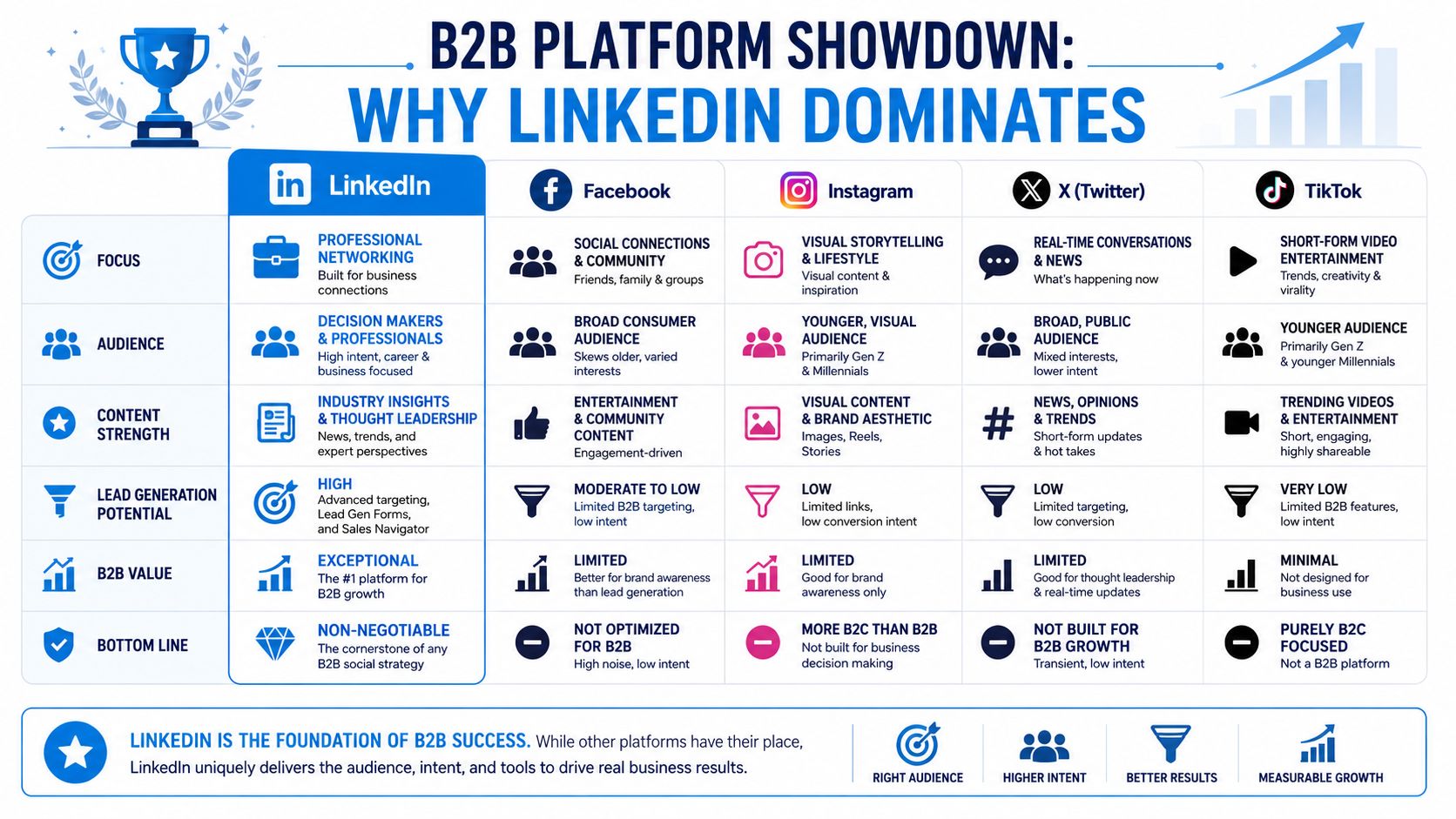
That does not mean the company page should carry the whole program. In practice, founder profiles, sales leaders, and subject-matter experts often drive more reach and more qualified conversations because people respond to people faster than they respond to brands. For a small business without a full content team, that is good news. A practical LinkedIn program can start with one company page, two or three employee voices, and a simple weekly workflow to turn client questions into posts.
For teams that want stronger one-to-one interaction on the platform, this guide for B2B LinkedIn engagement is useful because it focuses on networking behavior, not just posting volume.
Where other platforms fit, if they earn their place
Other channels can work, but each one needs a clear operational reason to exist.
- YouTube: Good for products or services that need explanation, walkthroughs, demos, or longer trust-building content.
- X: Useful in industries where buyers follow fast-moving news, analysts, or niche operator conversations.
- Instagram or Facebook: Better suited to employer brand, events, culture, or visual proof than core demand generation for many B2B firms.
- TikTok: Occasionally effective for founder-led brands or categories with broad professional interest, but rarely the first system an SMB should set up.
Execution matters here more than theory. One well-run primary channel with consistent publishing, comment follow-up, and light paid support will beat four half-maintained accounts every time.
Define the audience with buying context, not job titles
“Operations manager” is not an audience strategy. It is a starting label.
A useful B2B audience definition includes the company type, the buying trigger, the internal blockers, and the people involved in approval. The person who feels the pain first is often not the person who controls budget. The technical evaluator may care about integration risk. The founder or department head may care about speed, margin, or headcount savings. If your posts speak to only one of those concerns, performance stalls even if impressions look healthy.
Use questions like these to tighten the target:
- Which companies are a fit? Define industry, size, geography, business model, and maturity.
- What problem creates urgency? Focus on the operational or commercial issue that pushes a team to act.
- Who is involved in the decision? Separate users, influencers, budget owners, and approvers.
- What objections slow the sale? List the concerns that show up in calls, demos, and procurement.
- What words does the market use? Match the language buyers use in meetings, reviews, and online discussions.
If that picture is still fuzzy, AI-based social listening and audience sentiment analysis can help surface recurring objections, sentiment shifts, and the exact phrases prospects use before your team commits to a content calendar.
The goal is not to be present on every platform. The goal is to build a channel mix your team can realistically run, with messages that match how real buyers evaluate a purchase. That is where B2B social starts to become manageable for a small team.
Developing a B2B Content Strategy
A strong content strategy doesn't start with format. It starts with usefulness. If your audience can't learn from your content, they won't trust your promotions later.
Build around educational value first
B2B brands should use a content mix where 70% to 80% of posts are educational and 20% to 30% are promotional. That balance helps content stay credible and aligns with algorithms that reward stable publishing over erratic bursts of sales-heavy messaging.
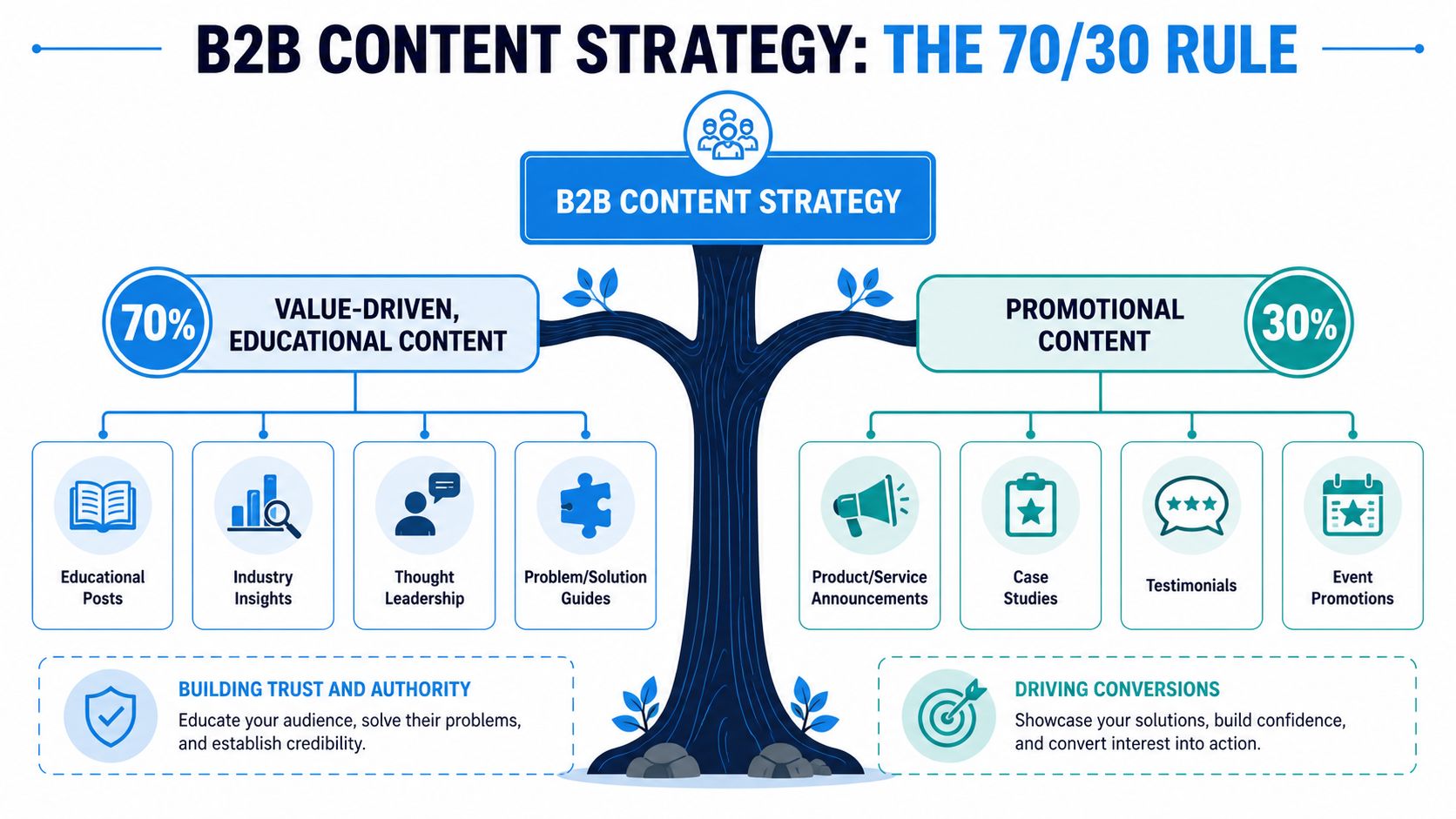
Educational content usually does the heavy lifting early in the funnel. It gives buyers a reason to pay attention before they're ready to convert. Promotional content works better when it appears in a context of earned trust.
Good educational formats include:
- Problem-solution posts: Explain why a recurring issue happens and what teams often miss.
- Point-of-view content: Offer a clear stance on a common industry mistake or trade-off.
- Breakdowns and frameworks: Turn expertise into repeatable guidance.
- Client pattern observations: Share lessons from real work without inventing a case study.
- Short expert videos: Walk through a process, objection, or decision criterion.
A lot of teams struggle to turn rough ideas into polished social assets consistently. For that production side, this resource on using generative AI for social creatives is useful because it focuses on workflow, not hype.
Use content pillars to avoid random posting
Your calendar gets easier when you define a few content pillars and stick to them. Most SMBs can run a solid B2B social media marketing program with three to five pillars.
A practical mix might look like this:
| Content pillar | What it includes | Why it matters |
|---|---|---|
| Industry insight | Trends, commentary, buyer behavior shifts | Shows market awareness |
| Operational expertise | How-to guidance, process tips, lessons learned | Demonstrates competence |
| Proof and credibility | Case patterns, testimonials, implementation observations | Reduces buyer risk |
| Brand and people | Team knowledge, culture, hiring, behind-the-scenes process | Humanizes the company |
These pillars create repetition without making the feed repetitive. The audience starts to understand what your brand knows and how it thinks.
A short training video can help teams visualize this balance in practice:
When to use link-free posts and when to drive traffic
Many teams underperform; they use social only to push people off-platform.
That usually limits reach. Link-free posts often do a better job of starting conversations, earning saves, and building top-of-funnel familiarity. Link-driving posts still matter, but they work best when the audience already has a reason to care.
A practical sequencing model looks like this:
- Use link-free posts for trust building: Stories, checklists, opinion posts, short videos, and image-led insights.
- Use link-driving posts for intent capture: Whitepapers, demos, webinars, service pages, and lead magnets.
- Pair the two intentionally: Publish insight first. Publish the offer after the audience has context.
The post that gets the click isn't always the post that created the demand.
That distinction helps teams stop judging every post by direct traffic alone. Some content is there to open the door. Some is there to convert interest into action.
Balancing Organic Reach and Paid Advertising
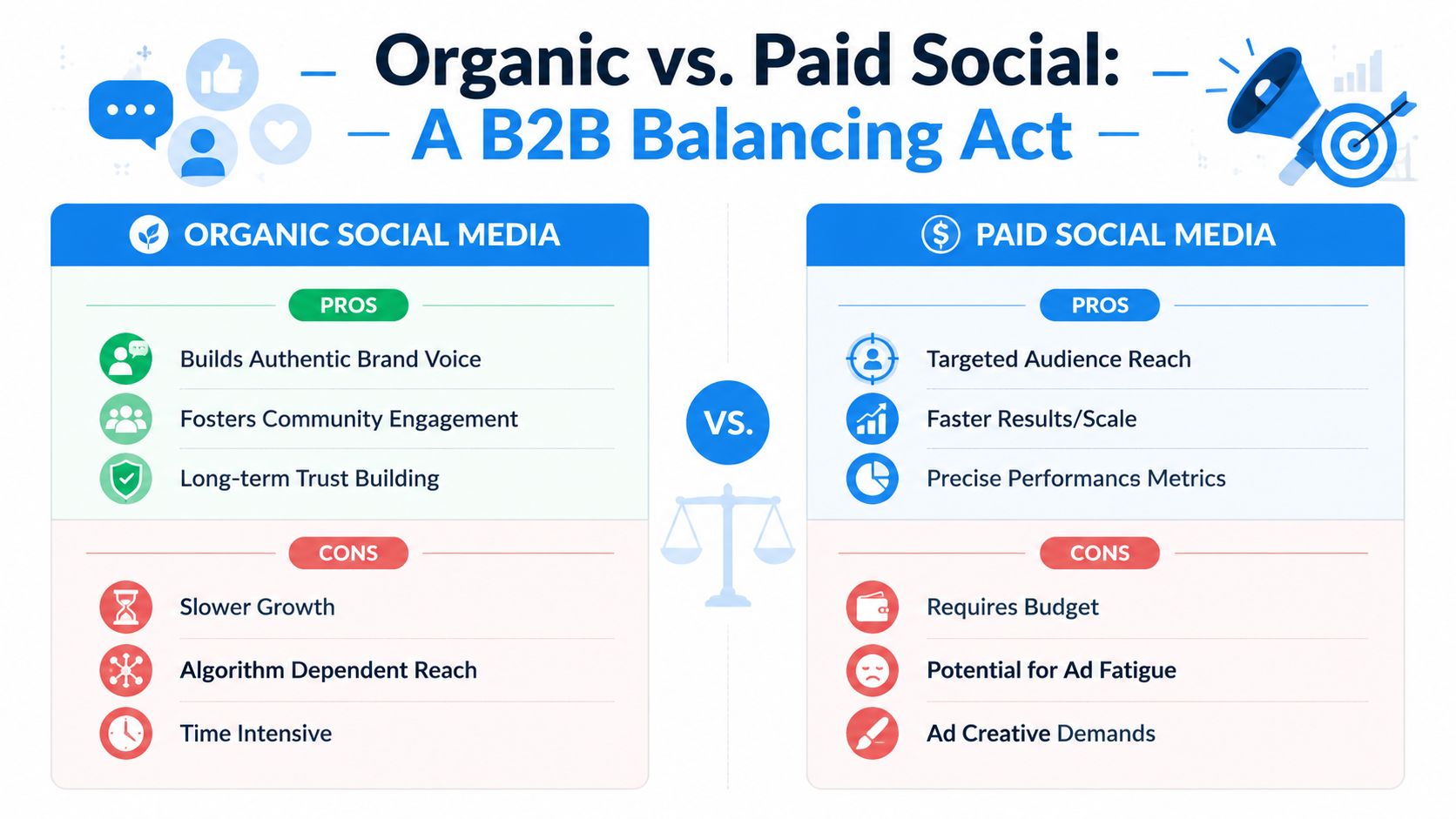
Organic and paid social aren't competing choices. In a healthy B2B program, they do different jobs.
What organic does well
Organic content builds the layer of familiarity that paid campaigns benefit from later. It helps your market see how your team thinks, what problems you solve, and whether you sound credible.
Organic is usually the right place for:
- Thought leadership
- Audience learning
- Executive visibility
- Community interaction
- Brand consistency
It's slower, but it compounds. A buyer may see several posts over time, notice the same themes, and become more receptive when an ad or outreach message appears later.
What paid does better
Paid social is useful when you need controlled reach. It lets you put specific offers in front of a specific audience without waiting for the algorithm to do the work.
Paid is often the better fit for:
- Promoting high-value assets
- Driving webinar registrations
- Running lead generation campaigns
- Reaching named accounts or job functions
- Re-engaging warm audiences
On LinkedIn, common use cases include Sponsored Content for in-feed promotion and Lead Gen Forms for reducing friction on gated offers. The key is targeting carefully and aligning the ad with a strong landing experience or a strong native offer.
How to decide when paid is worth it
A simple decision test helps. Paid social usually makes sense when all three of these are true:
- You know the audience well enough to target them clearly.
- You have a proven message or offer worth amplifying.
- Your follow-up process can handle the response.
If any of those are missing, paid can become expensive noise. Organic can expose those weaknesses early. It tells you whether your message earns attention before you put budget behind it.
Measuring What Matters and Proving ROI
A monthly social report can look busy and still leave an owner with one fair question: did any of this help revenue?
That happens because many teams report what platforms make easy to see, not what the business needs to decide. Follower growth, impressions, and total engagement can signal reach, but they do not show whether social is attracting the right buyers or contributing to pipeline.
Stop reporting vanity metrics to leadership
The strongest B2B social dashboard starts with business impact. CMI and MarketingProfs found in their B2B Content Marketing Benchmarks that marketers often track website traffic, social media analytics, and lead quality. That mix is more useful than reporting shares alone because it ties social activity to buyer movement, not just platform activity.
For founders and revenue leaders, the useful questions are straightforward:
- Is social bringing qualified visitors to the website?
- Do social-sourced leads match the ideal customer profile?
- Are sales conversations getting better because prospects have seen the content first?
- Is social influencing pipeline, even when it does not get credit for the final click?
A closer read on attention metrics and post-click quality signals is often more useful than click-through rate alone.
Build a measurement stack that connects to pipeline
Good measurement does not require an expensive reporting setup. It requires clean habits, clear ownership, and a simple system your team will maintain.
A practical stack looks like this:
| Layer | What to track | Why it matters |
|---|---|---|
| Platform signals | Saves, comments, shares, engagement quality | Shows whether the content is relevant to the audience |
| Website behavior | Sessions from social, time on site, page paths | Shows whether visitors are actually exploring |
| Conversion data | Form fills, booked calls, asset downloads | Shows response to specific offers |
| CRM visibility | Lead source, influenced opportunities, sales notes | Connects social activity to pipeline and deal quality |
SMB execution usually breaks. The posting gets done, but the tracking does not. Links go out without UTM parameters. Campaign names change every month. Sales hears "I've been seeing your posts" on calls, but nobody records it, so social looks weaker on paper than it is in practice.
Fix that first.
Use consistent UTM naming on every campaign link. Make sure your CRM captures source and campaign data in a usable way. Ask sales to log when prospects mention content, company updates, or a founder's posts. That feedback will never be perfect attribution, but it is still valid buying-context data.
Report social as a revenue support channel with measurable influence, not as a content scoreboard.
Building Your Execution Workflow and Team
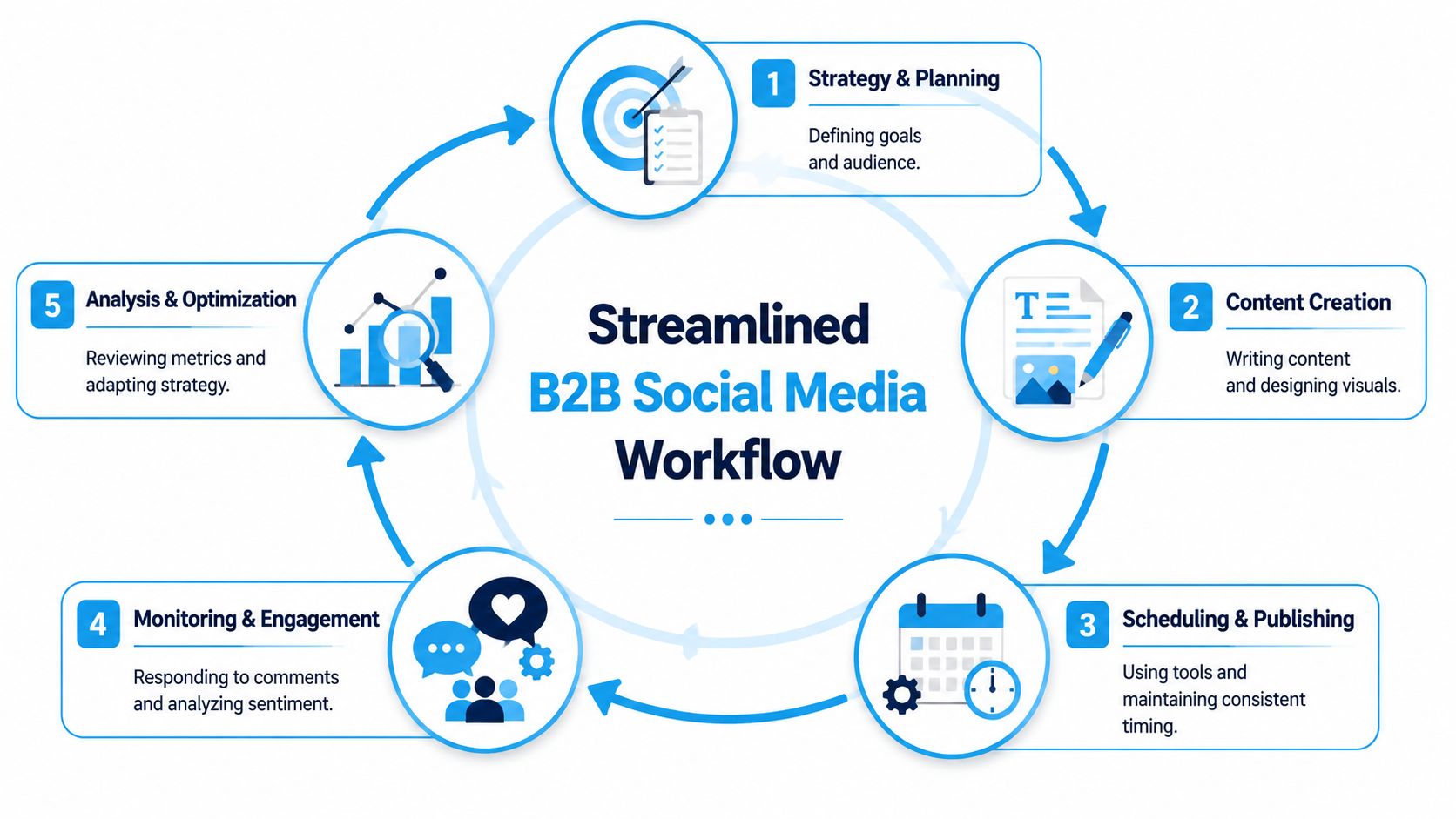
Monday starts with good intentions. By Thursday, the post is still waiting on approval, the founder is pulled into sales calls, and social drops behind again. For many SMBs, that is the primary problem. Strategy is usually not the blocker. Operating the work every week is.
Why execution fails in SMBs
Execution usually breaks for ordinary operational reasons:
- No clear owner: Social gets assigned to whoever has spare time.
- No repeatable process: Each post starts from a blank page.
- Too much reliance on one person: If the founder or marketer gets busy, publishing stops.
- Approval friction: Content sits too long in review and loses relevance.
- Weak repurposing: Useful ideas appear once, then disappear instead of turning into a series.
These are workflow problems, not creativity problems.
That distinction matters because SMBs often respond by chasing better ideas, more tools, or another platform. In practice, they need clearer roles, fewer handoffs, and a content system that can survive a busy month.
The team models most companies consider
Each staffing model solves one problem and creates another.
A full-time social hire can work when the company already has supporting capacity in design, copy, reporting, and campaign planning. Without that support, one person becomes a bottleneck. A marketing generalist gives you flexibility, but social usually gets pushed behind events, email, sales requests, and website updates. An agency adds production capacity, but many SMBs do not need a fixed retainer every month. They need expert help in bursts.
That is why fractional support is often a better fit. It gives the business access to strategy, writing, design, scheduling, and reporting without requiring a full internal department. SharedTEAMS is one example of that model, with fractional, on-demand marketing support and AI-enabled workflows that help teams plan, produce, and improve content without adding full-time headcount.
A practical workflow that actually ships content
The best workflow is the one your team can keep running under normal business pressure.
Use a simple operating rhythm:
- Monthly planning: Choose themes, offers, campaign tie-ins, and the few business priorities social needs to support.
- Weekly insight capture: Pull ideas from sales calls, customer questions, product updates, and leadership conversations.
- Batch production: Draft several posts at once so the team is not rebuilding the process every day.
- Light approval rules: Decide what needs review, who owns it, and what can publish without a long chain of signoff.
- Scheduled publishing and response: Publish consistently, reply to comments, and log useful audience questions for future content.
- Review and adjust: Keep formats and topics that earn qualified attention. Cut the ones that do not.
Small teams do better with fewer moving parts. One strategist, one writer or content operator, a design resource, and a clear approver is often enough to run a credible B2B social program. AI can help with first drafts, repurposing, formatting, and content variations, but it does not replace judgment. Someone still needs to decide what is worth saying, what matches the brand, and what supports the pipeline.
That is the execution standard to aim for. Clear ownership. Repeatable production. Enough flexibility to keep publishing when the week gets messy.
Your Next Steps for B2B Social Media Success
The businesses that get value from B2B social media marketing usually aren't the loudest. They're the most consistent, the most focused, and the most disciplined about tying social to business outcomes.
If your current program feels scattered, audit it against a few simple questions. Do you know the primary goal? Are you publishing for a defined audience? Is your content mostly educational? Are you measuring website traffic, lead quality, and pipeline support instead of vanity metrics? Do you have the workflow capacity to keep going for the next quarter?
If the answer to several of those is no, the issue probably isn't effort. It's operating design.
A realistic B2B social program doesn't require a massive in-house team. It does require a clear strategy, a workable production model, and enough consistency to let trust compound. That's the difference between “we're active on social” and “social is helping the business.”
If you're evaluating how to turn strategy into consistent execution, SharedTEAMS offers a practical next step. Their fractional, on-demand model is built for SMBs that need expert marketing support, flexible production capacity, and a more sustainable way to run social, content, and campaign execution without adding full-time headcount.