You're probably in one of two situations right now. Your team posts when someone has time, the feed looks uneven, and nobody can tell whether social is helping the business. Or you're paying for social media support already, but the work feels slow, generic, and disconnected from actual revenue goals.
That's the core problem with social media content services. Most businesses don't need more posts. They need a system that turns social into a managed marketing function with clear priorities, fast execution, and measurable output. That's especially true for small and mid-sized businesses that can't afford bloated retainers or another full-time hire.
Table of Contents
- Why Your Social Media Needs More Than Just Posts
- What Is Included in Social Media Content Services
- How Social Media Services Are Priced
- Choosing Your Execution Model In-House, Agency, or Fractional
- A Checklist for Vetting Potential Partners
- Measuring Success and Managing the Engagement
- Your Next Step to Strategic Social Media
Why Your Social Media Needs More Than Just Posts
A lot of businesses treat social media like a leftover task. Someone writes a caption, a designer pulls together a graphic, and a post goes live because the calendar says it should. That approach creates activity, not momentum.
Social media content services matter because they replace random output with an operating model. Instead of asking, “What should we post today?” you start asking better questions. Which audience are we trying to move? What business goal does this support? What proof do we have that the content is working?
That shift isn't optional anymore. The global Social Media Management Market was valued at USD 29.93 billion in 2025 and is projected to reach USD 171.62 billion by 2033, growing at a CAGR of 24.8% from 2026 to 2033 according to Grand View Research's social media management market report. Businesses are investing because social now sits inside customer acquisition, brand visibility, support, and retention.
Random posting creates hidden costs
When social lacks structure, the problems pile up fast:
- Inconsistent brand voice: Different people write differently, which weakens trust.
- Slow execution: Every post turns into a new approval cycle.
- Weak measurement: Teams track likes but can't explain business impact.
- Poor reuse of assets: Good ideas get used once and disappear.
Practical rule: If your social process depends on memory, spare time, or one person “owning the password,” you don't have a strategy. You have a risk.
Social needs a system, not just effort
Professional social media content services usually combine planning, production, publishing, and reporting into one workflow. That's what makes social usable at a business level. It's also where AI now plays a practical role. If you want a grounded look at how teams can optimize your social media with AI, that resource is useful because it focuses on standing out without relying on gimmicks.
The important distinction is simple. Posting is a task. Managing social as a channel is a function. Businesses that understand that difference make better investment decisions, especially when they're choosing between a slow retainer and a more agile fractional model.
What Is Included in Social Media Content Services
If you're buying social media content services, you should know exactly what's inside the box. “We'll manage your social” is not a scope. It's a vague promise that usually leads to confusion, rework, and disappointment.
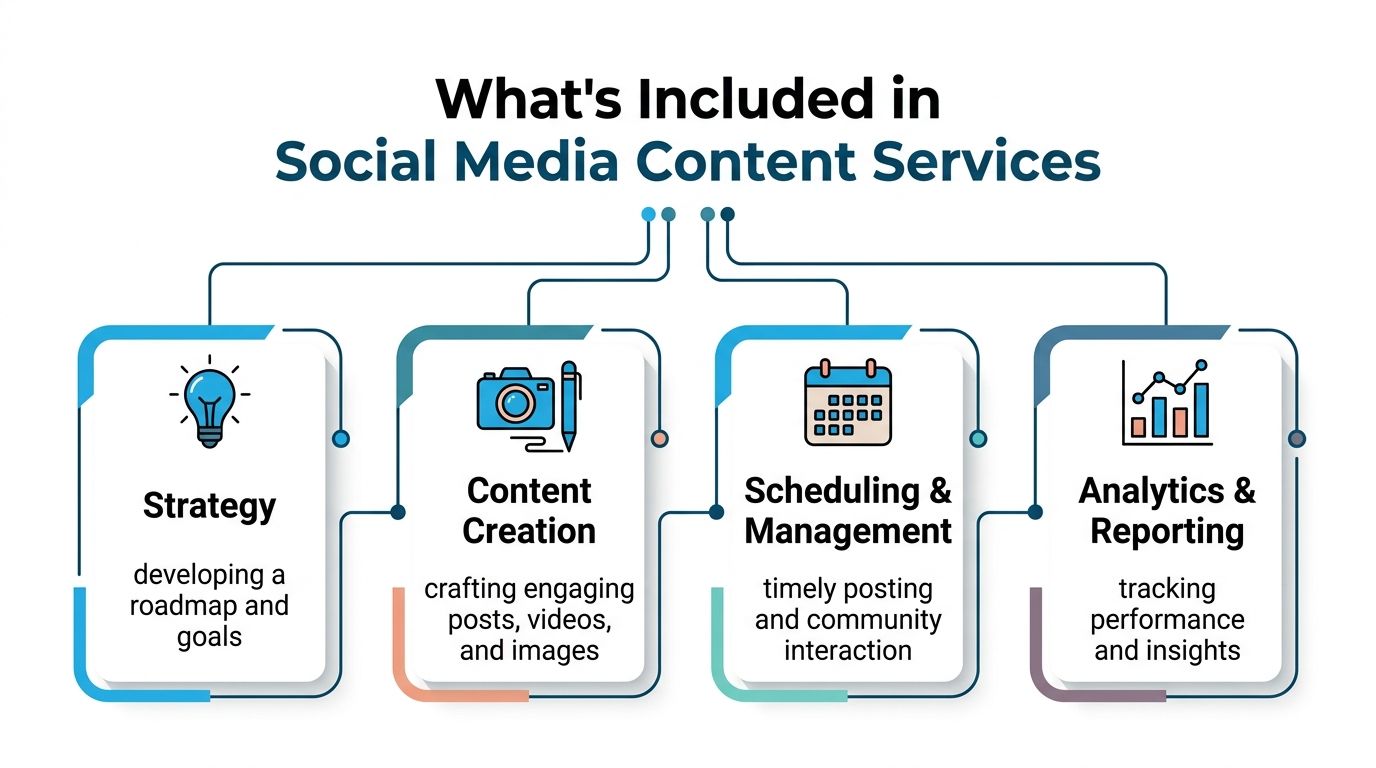
At a minimum, the service should cover strategy, asset creation, publishing operations, and reporting.
Strategy sets the direction
Strategy is the part most providers rush past, and it's the part that determines whether the rest of the work means anything. Here, a team defines audience segments, channel priorities, brand voice, messaging themes, campaign goals, and approval workflow.
A sound social plan also needs a content mix that keeps the feed useful instead of self-centered. Expert social media management frameworks prioritize 50% value-driven posts, 30% curated industry content, and 20% promotional content, as outlined in Adobe's guide to social media marketing. That ratio is practical because it prevents endless sales messaging while still making room for offers and announcements.
Brands lose attention when every post asks for something. Strong social earns attention first.
Content creation produces the assets
This is the visible part of the service. It includes copywriting, graphics, short-form video editing, motion assets, carousels, campaign variations, and platform-specific creative. Good providers don't just make things look polished. They adapt the message to the format and the audience behavior of each platform.
That work moves faster when the team has a repeatable production process and the right tools. If you're evaluating workflow support, a modern social media content creation tool can help speed ideation and repurposing, but it still needs human review for brand fit and factual accuracy. The same principle applies when teams use generative AI for social creatives to turn prompts into production-ready assets. AI helps with speed. It doesn't replace judgment.
Scheduling and management keep the machine running
Publishing isn't just loading posts into a scheduler. It includes calendar management, approvals, posting cadence, light community engagement, and handoff rules when comments or direct messages need support or sales follow-up.
Many businesses underestimate the labor involved. A provider may create strong content but still fail operationally if approvals are messy, posts miss timing windows, or responses sit unanswered.
A useful management scope should define:
- Approval ownership: Who signs off and by when.
- Platform coverage: Which channels are included.
- Community rules: Who responds to comments, messages, and tags.
- Escalation paths: What happens when support or reputation issues appear.
Analytics and reporting connect activity to business goals
Reporting should answer business questions, not just summarize platform metrics. Performance tracking typically includes engagement rate, CTR, ROI, video views, and follower growth so social KPIs can map back to broader business goals, as described in the Adobe framework above.
That means the report should tell you things like which content themes drove traffic, which formats earned qualified clicks, what audience segments engaged, and where content underperformed. If a provider can't explain how reporting links to awareness, lead generation, or conversion support, they're selling output, not management.
How Social Media Services Are Priced
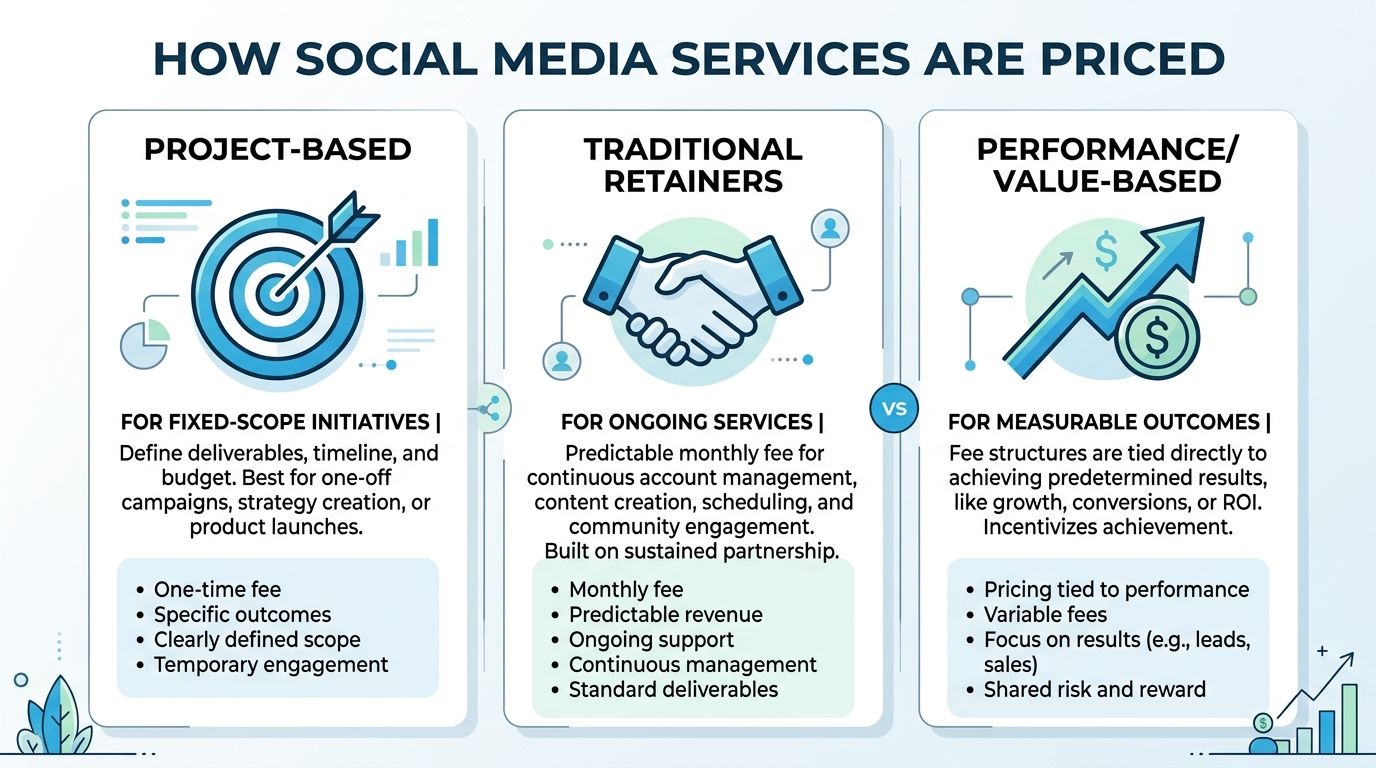
Pricing gets messy because agencies often package unlike services together. One proposal may include strategy, video editing, and reporting. Another may mostly cover posting and light graphics. If you compare monthly fees without comparing scope, you'll make the wrong call.
Three pricing models and what they actually mean
Here's the practical breakdown:
| Model | Best fit | Main benefit | Main drawback |
|---|---|---|---|
| Project-based | Campaign launches, seasonal pushes, one-off asset production | Clear scope and defined timeline | Limited continuity |
| Traditional retainer | Ongoing monthly execution with stable needs | Predictable monthly service | Can become rigid and slow |
| Membership or fractional model | Businesses that need strategy plus flexible execution | Better agility and adjustable scope | Requires disciplined prioritization |
Project work is fine when you need a product launch package, a short campaign, or a set of assets. It's not ideal for a brand trying to maintain continuity, test creative regularly, and respond to market changes.
Traditional retainers can work, but they often reward fixed output over useful output. You end up paying for a quota of posts whether those posts are the right priority or not.
Membership or fractional models are usually better for SMBs because they let you redirect effort as needs change. One month you may need a content sprint. The next month you may need channel cleanup, a campaign landing page, or reporting support. That flexibility is the core value.
What drives the bill up or down
The biggest pricing variable is labor intensity. Short-form video, platform-specific editing, creative versioning, and community management all take time. So does strategy.
According to EmberTribe's breakdown of social media marketing packages, full-service social media content packages can range from $3,000 to $5,000 per month for 25 to 40 posts across 4 to 5 platforms, and adding TikTok can increase monthly costs by $500 to $1,500+ because short-form video production is labor-intensive.
That's why “20 posts per month” tells you almost nothing. You need to know:
- Format mix: Static graphics, carousels, or edited video
- Platform count: LinkedIn is not the same workload as TikTok
- Strategy depth: Calendar filling versus campaign planning
- Reporting detail: Basic dashboard versus business-level insight
If you want a realistic way to think through budget and scope before vendor conversations, reviewing a social media content project estimate framework helps clarify what should be priced separately and what should be bundled.
Choosing Your Execution Model In-House, Agency, or Fractional
Your team needs a product launch campaign live in 10 days. Sales wants sharper LinkedIn content, the founder wants short-form video, and your website needs a landing page update to support the offer. Here, the execution model stops being an org chart question and becomes a profit question.
In-house gives control but ties up budget fast
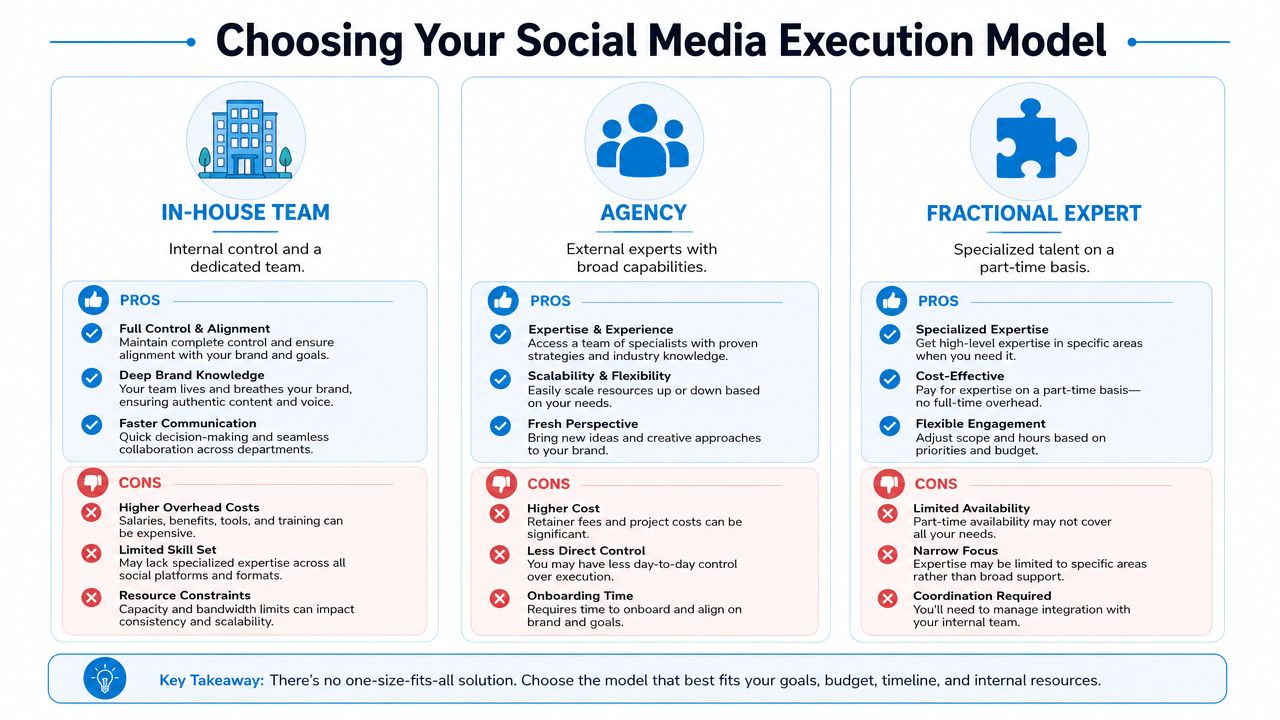
An internal team has one clear advantage. Context. They sit close to product updates, customer feedback, and leadership priorities, which usually improves message accuracy and approval speed.
The cost problem shows up quickly.
Social media content is not a one-person function if you want consistent output and real business value. You need strategy, copy, design, editing, publishing discipline, and performance review. If you hire for all of that internally, you are paying for full-time capacity every month whether the workload is heavy or light. That makes sense for brands with constant volume and enough budget to absorb idle time. It is a poor fit for many SMBs that need bursts of execution, then a strategic reset, then campaign support.
Traditional agencies add capacity but often force you into the wrong economics
Agencies solve the staffing gap, but the standard retainer model creates a different problem. You are usually buying a fixed package of outputs and access hours, not adaptable execution tied to current priorities.
That sounds manageable until the work changes mid-month.
A six-month retainer might cover a set number of posts, a reporting cadence, and a monthly planning call. Then a new offer launches, paid performance drops, or the sales team needs better social proof content for outreach. Now you are asking for scope changes, waiting for approvals, or paying change-order fees. The agency is protecting margin. You are trying to protect momentum.
That trade-off is expensive in ways many businesses miss. Delayed creative testing means slower learning. Slower learning means more budget spent on content themes that never should have made it into production. Rigid retainers also push teams to use what is already in scope instead of what the business needs.
Here's a short discussion of how business owners think through these tradeoffs in practice:
Fractional support usually gives SMBs the best ROI
For many SMBs, fractional is the better operating model because it matches how marketing work really happens. Priorities shift. Campaigns need extra support for a short window. Some months require strategy and creative direction. Other months require production, repurposing, and cleanup.
A fractional or membership model handles that without forcing you to carry full-time overhead or sit inside a bulky retainer. You are buying access to the right level of expertise when it matters, then redirecting effort as needs change.
That is the ROI case.
If an agency retainer locks you into six months of fixed deliverables, you keep paying even when the mix is wrong. If an in-house hire gives you one skill set but the work requires three others, you either accept weaker output or add more payroll. A fractional model avoids both traps. You can put more of your budget into active execution and less into unused capacity, account overhead, and process drag.
Use a simple test. Ask which model lets you do all three of these without friction:
- shift from content production to campaign support inside the same month
- add senior strategy without hiring a senior full-time lead
- scale work up for a launch, then scale it back without carrying the same fixed cost
If the answer is no, the model is too rigid for an SMB.
One example is SharedTEAMS, which uses a membership-based structure to provide senior oversight, on-demand execution, and AI-supported workflows instead of a long agency retainer. That matters because the value is not just lower cost. It is faster reallocation of effort. If your priorities change next week, your social investment should be able to change with them.
A Checklist for Vetting Potential Partners
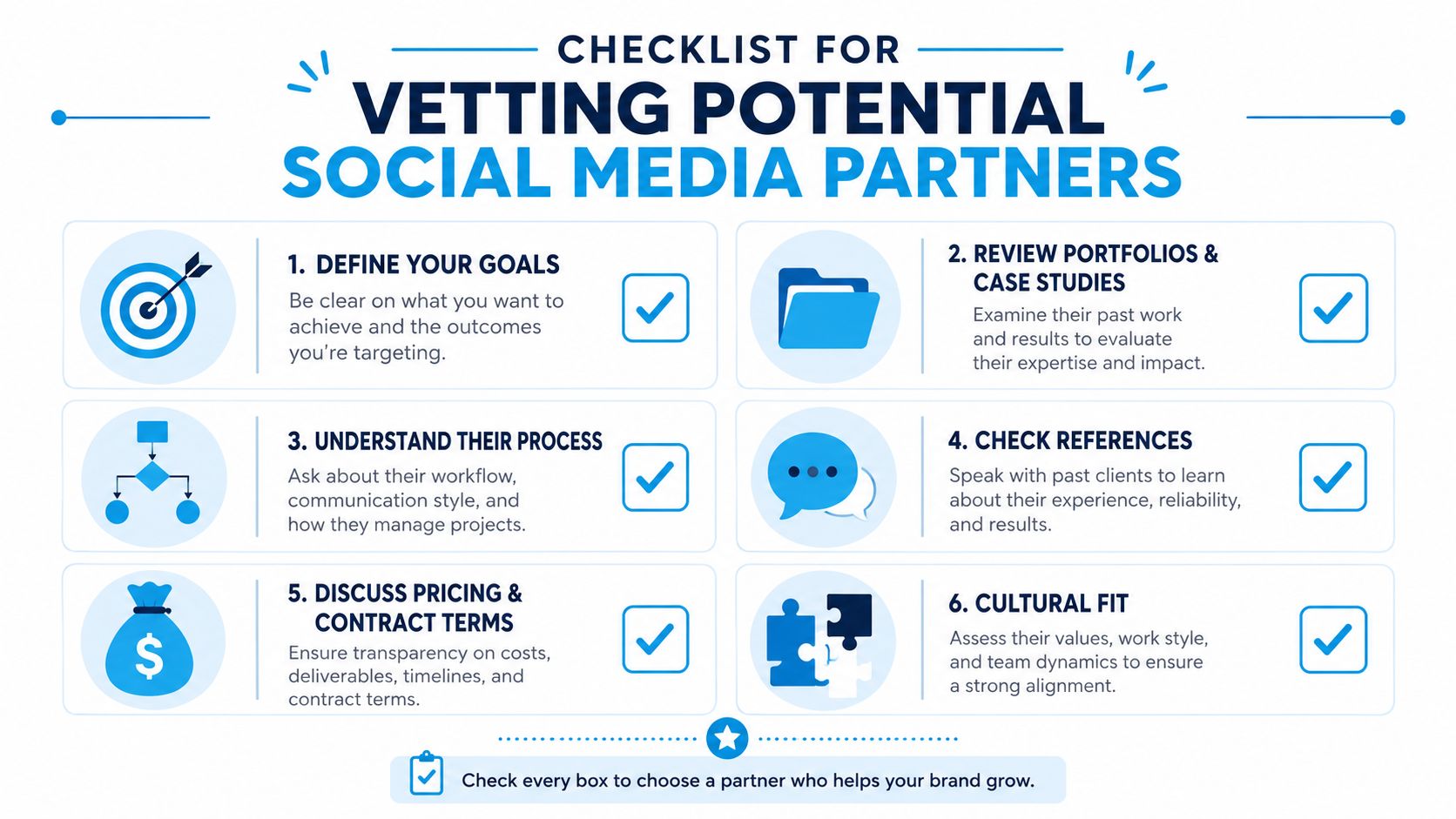
Most businesses ask weak questions in discovery calls. They ask how many posts are included, what platforms are covered, and whether reporting is monthly. Those questions matter, but they don't tell you whether the provider can effectively operate as a strategic partner.
Questions that reveal how a provider actually works
Use questions like these instead:
- How do you build strategy before content production starts? If they skip audience, goals, message themes, and brand standards, expect generic output.
- How do you document brand voice and approval rules? You want a repeatable process, not scattered email feedback.
- What happens when priorities change mid-month? This reveals whether the provider is rigid or adaptable.
- How do you handle community management and escalation? If nobody owns response protocols, the risk falls back on you.
- What does your reporting connect to? Ask how they tie social performance to traffic quality, lead flow, or sales support.
- What tools do you use for planning, collaboration, and analytics? Tool choice won't save a bad process, but weak tooling usually signals weak operations.
A good provider should answer directly and specifically. If they hide behind vague language like “custom approach” or “proprietary process,” push harder.
Red flags you shouldn't ignore
You don't need a perfect partner. You need one that's operationally sound. Watch for these warning signs:
| Red flag | Why it matters |
|---|---|
| They sell by post count alone | That usually means production-first thinking with weak strategy |
| They can't define review timelines | Delays and missed deadlines will become normal |
| They don't clarify who responds to comments or messages | Customer service and reputation issues fall through the cracks |
| They report only on impressions or follower growth | You won't get business-level accountability |
Ask a provider to walk you through a normal month. If they can't explain the sequence from planning to approval to reporting, they probably don't run a mature service.
You should also ask how they handle adjacent needs. Social rarely lives alone. Sometimes a campaign needs paid support, landing page updates, design changes, or messaging adjustments. Providers that understand the broader marketing system usually produce better social work because they know what the content is supposed to support.
Measuring Success and Managing the Engagement
Signing the agreement isn't the finish line. It's the point where execution discipline starts to matter.
A healthy engagement usually begins with brand discovery, audience review, message alignment, and content planning. After that, there should be a predictable rhythm for draft review, approvals, publishing, and monthly performance discussion. If that rhythm isn't documented, the engagement will drift.
What a healthy workflow looks like
The strongest setups usually include service expectations in writing. That can mean informal operating rules or formal service level agreements. Either way, you need clarity on turnaround times, revision expectations, approval windows, and who owns community response.
That last point is critical. In 2026, 73% of consumers say they will switch to a competitor if a brand fails to respond on social media, according to Sprout Social's social media statistics. Response handling is not an optional add-on. It's part of the strategy.
If your provider is also helping monitor mentions, trends, and audience reactions, stronger reporting often comes from combining content performance with social listening and AI-driven audience sentiment analysis. That makes the engagement more useful because it connects what you publish with how people respond.
What to measure beyond likes
Don't let reporting get trapped in vanity metrics. Likes and follower counts can be useful context, but they're not enough to evaluate ROI.
Focus your review around questions like these:
- Did social drive qualified traffic to the right pages?
- Which content themes generated meaningful clicks or inquiries?
- Did response times support customer trust or create friction?
- What should we stop, improve, or test next?
Good social reporting should change next month's decisions. If it doesn't affect budget, creative direction, or workflow, it's not doing enough.
When you manage the engagement this way, social stops being a content factory and becomes part of business operations. That's the point.
Your Next Step to Strategic Social Media
You approve a monthly social retainer, then the quarter shifts. Sales needs launch support. Customer questions spike. A new offer needs testing fast. The agency scope stays the same, the meetings keep coming, and your team is still waiting on work that no longer matches the priority.
That is the key decision point.
Strategic social media is not about buying a set number of posts. It is about choosing an operating model that lets you redirect budget, get senior input when decisions matter, and ship work without paying for layers of overhead that slow everything down.
Traditional retainers fit businesses with stable needs, fixed campaigns, and predictable approval cycles. Many SMBs do not work that way. Priorities change week to week. Budgets are watched closely. Speed matters because delay costs pipeline, response quality, and momentum.
That is why fractional or membership models often produce better ROI. You get strategy and execution, but with more room to shift effort between planning, creative, reporting, and channel support as the business changes. You are paying for useful output and decision-making capacity, not a rigid package built around agency utilization targets.
Make the next step practical. Audit your current setup. Review what your team is publishing, how long approvals take, where requests get stuck, and whether social activity is helping revenue, retention, or customer experience. If the model is slow, expensive, or disconnected from business goals, replace the model before you buy more content.
If you want a concrete benchmark, SharedTEAMS offers a strategic marketing audit, brand profile setup, and on-demand project planning. That gives you a way to compare your current process against a more flexible fractional approach before you commit to a long-term engagement.