You probably have some version of this problem right now. Your website sounds polished, your sales deck sounds different, your social posts drift by platform, and the freelancer you hired last month made a good-looking asset that still didn't feel like your company. The issue usually isn't effort. It's that the brand guide exists as a static file instead of an operating system.
A useful brand management strategy template doesn't stop at mission, logo rules, and tone of voice. It has to work inside real production conditions. That means short project kickoffs, outside partners, AI-assisted workflows, campaign analytics, and fast approvals. If it can't survive those conditions, it won't guide anything for long.
Table of Contents
- Why Most Brand Strategy Templates Fail
- The Core Components of Your Brand Strategy Template
- How to Customize the Template with Specific Examples
- Establishing Brand Governance and Your Rollout Plan
- Integrating KPIs for a Data-Informed Brand Strategy
- Conclusion From Template to Lasting Brand Impact
Why Most Brand Strategy Templates Fail
A founder hires a freelance designer, brings in a fractional CMO, adds a paid media contractor, and starts using AI for first drafts. The brand guide gets shared on day one. Two weeks later, the website sounds restrained, the ads read like hard sell copy, and the email nurture sequence feels like it came from a different company.
That failure usually starts with the template itself. It records the brand in broad terms, but it does not help people make day-to-day decisions while work is moving.
That matters most in SMB teams that rely on outside specialists. A static document rarely tells a contractor how far they can stretch the voice, which claims need approval, what message to lead with for a specific segment, or how to judge whether AI-generated copy matches the brand standard. Under production pressure, people fill in the gaps themselves. Consistency slips fast.
Static guidance breaks under production pressure
A typical brand template covers the expected basics:
- Purpose language: A mission statement, often too broad to guide trade-offs
- Visual rules: Logo files, colors, and typography standards
- Voice notes: A few adjectives such as “confident,” “friendly,” or “creative”
Those ingredients are useful. On their own, they do not run the work.
The test happens in execution. A landing page gets built for a new audience. Sales asks for vertical-specific messaging. Paid social needs sharper hooks than the homepage. An AI draft comes back clean, readable, and slightly wrong in tone. If the template cannot help the team resolve those choices quickly, it turns into a reference file rather than a true management tool.
I see the same pattern in underperforming brand systems. The strategy lives in one document, the examples live somewhere else, approvals happen in Slack, and no one is fully sure which version is current.
A living brand profile works better
A better model is a living brand profile. It gets used inside the workflow, updated when positioning sharpens, and checked against actual output across web, email, sales collateral, paid media, and AI prompts.
That means the template needs a few operational features that older brand books usually miss. It needs version control. It needs clear approval ownership. It needs message priorities by audience or offer. It needs real examples of good and bad execution. It also needs guidance that works for people outside the core team, especially fractional leaders, freelancers, agencies, and AI-assisted production.
This is the same shift behind adaptive marketing frameworks that replace annual planning with ongoing adjustment. Brand strategy has to work the same way. It has to stay current enough to direct live work.
If your current guide gets ignored, the fix is rarely a longer PDF. The fix is a template the team can use while shipping.
The Core Components of Your Brand Strategy Template
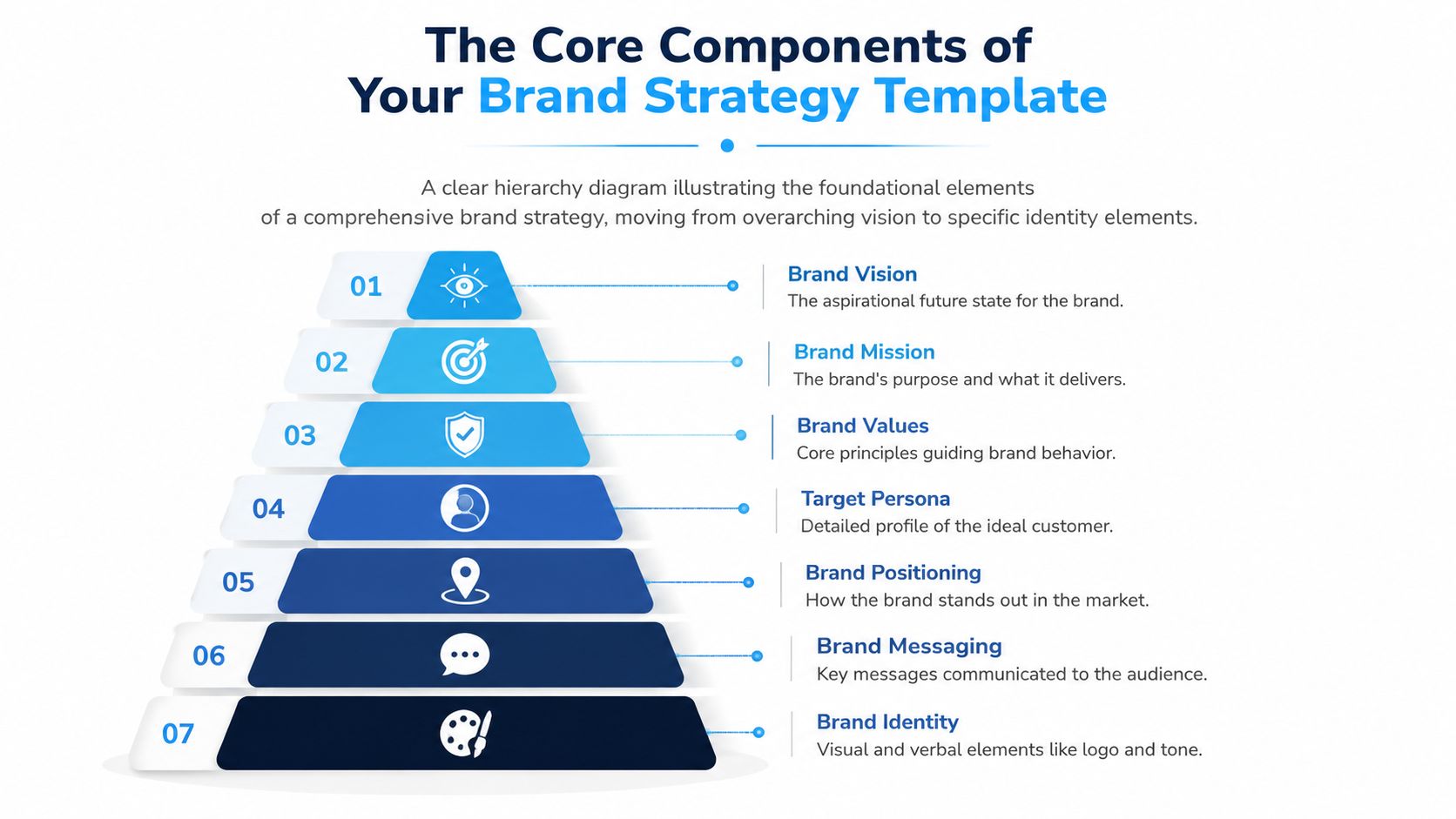
A complete brand management strategy template needs more than a list of brand adjectives. It needs core strategy, usable direction, and practical rules that connect planning to execution.
Start With Strategic Foundations
The fundamental base of the template should be explicit. According to Oktopost's essential brand strategy template, a complete brand strategy template must define Values, Mission, Promise, Identity, and Tagline. Those five elements keep the document from turning into a vague summary.
Here's how each one functions in practice:
| Component | What it does | Common mistake |
|---|---|---|
| Values | Defines what the brand protects and rewards | Listing generic virtues no one uses |
| Mission | States what the brand is trying to achieve | Writing a slogan instead of a direction |
| Promise | Clarifies what customers should reliably expect | Making claims the business can't support |
| Identity | Covers visual, audio, and voice assets | Treating design as separate from meaning |
| Tagline | Distills the brand into a memorable phrase | Forcing cleverness over clarity |
The strongest templates also include vision. Vision isn't one of the five required elements above, but it helps leaders align the business around where the brand is headed, not just how it looks today.
Define Audience Positioning and Messaging
Once the foundation is set, the next layer is market-facing clarity. Many templates often get thin at this point.
Your audience section should identify who the brand serves, what problem matters most to them, what they're comparing you against, and what decision criteria they use. That's different from a broad demographic summary. A useful persona for brand work includes buying triggers, objections, desired outcomes, and channel behavior.
Then positioning has to answer the hard question. Why this brand, for this audience, instead of another option or the status quo?
A practical template should include:
- Primary audience profiles: The decision-maker, influencer, and end user if they differ
- Positioning statement: A plain-language articulation of where the brand fits
- Category framing: The market context you want to own
- Proof points: Evidence types that support the promise without overclaiming
- Message hierarchy: Core message, support messages, and channel-specific adaptations
The useful test is simple. Can a copywriter, sales rep, and designer all read the same section and make aligned decisions from it?
Brand messaging also needs direct ties to production systems. If your organization already uses a component-based content process, a strategic design system for brand consistency and conversion can help translate these messaging rules into repeatable assets.
Translate Strategy Into Identity Rules
Identity isn't just logo placement. It's the full expression layer.
That includes:
- Visual identity: Logo rules, color palette, typography, layout principles, photography style, icon treatment
- Verbal identity: Tone of voice, sentence style, vocabulary preferences, banned phrases, reading level
- Audio identity: Relevant for podcast intros, video stings, hold music, or sonic branding
- Usage examples: Real samples of on-brand and off-brand executions
What works best is connecting identity rules back to strategy. If one of your values is precision, your tone shouldn't rely on inflated claims. If your positioning is premium but practical, your design system shouldn't lean on decorative clutter.
A brand management strategy template becomes useful when each component informs the next. Values shape voice. Audience sharpens messaging. Positioning guides proof. Identity makes all of it recognizable.
How to Customize the Template with Specific Examples
The fastest way to weaken a brand strategy template is to fill it with phrases that could belong to any company. “Creative.” “Customer-centric.” “Trusted partner.” Those terms aren't wrong. They're just empty unless you define what they mean in your business.

Brandfolder's guidance on developing brand strategy makes the standard clear. Teams should “not be too generic, be as specific as possible.” That's the difference between a document people skim and a document they can build from.
What Generic Entries Look Like
Take a fictional B2B software company that sells workflow automation for accounting firms.
Here's what weak template language often looks like:
- Positioning statement: We provide advanced solutions for modern businesses.
- Value proposition: We help clients improve efficiency and drive growth.
- Brand voice: Professional, friendly, and forward-thinking.
- Brand promise: Great service and excellent results.
None of this creates usable direction. A paid media manager can't write sharper ads from it. A sales rep can't handle objections with it. A designer can't decide whether the brand should feel conservative, premium, or disruptive.
A Better Example for a B2B Tech Brand
Now rewrite those same sections with specifics.
| Template section | Weak version | Stronger version |
|---|---|---|
| Positioning | Innovative solutions for modern businesses | Workflow automation software for accounting firms that need to reduce manual intake without replacing existing systems |
| Value proposition | Improve efficiency and drive growth | Helps accounting teams process client paperwork faster by reducing repetitive admin work and cleaning intake before review |
| Voice | Professional and friendly | Calm, precise, and helpful. Explains technical benefits without jargon. Never sounds flashy or casual |
| Promise | Great service and excellent results | Gives finance teams clearer workflows, fewer preventable handoff errors, and faster project setup |
That stronger version works because it limits interpretation. It tells the team who the brand serves, what pain it solves, and how the brand should sound while doing it.
After you draft your written sections, it helps to hear another strategist talk through how brand foundations translate into execution:
How to Pressure Test Your Draft
Good brand language should survive contact with real work. Use these checks before you finalize the template.
- Swap test: If a competitor could paste your wording into their website without changing much, it's too generic.
- Channel test: If the statement sounds fine in a board deck but useless in ad copy or sales emails, it needs to be more concrete.
- Proof test: If the promise can't be supported by actual delivery, rewrite it.
- Onboarding test: If a new freelancer still needs a long meeting to understand the brand after reading the template, the document isn't specific enough.
Write statements that help someone make a decision, not statements that sound polished in a workshop.
One practical method is to add paired examples directly into the template:
- Say this: “We help regional law firms present complex services in language clients can easily understand.”
- Not this: “We simplify communication for better outcomes.”
That “good versus vague” pattern speeds up onboarding. It also reduces the usual drift that happens when multiple writers, designers, and contractors interpret the same brand in different ways.
Establishing Brand Governance and Your Rollout Plan
A strong template still fails if nobody owns it. Governance is what turns brand standards into repeatable behavior.
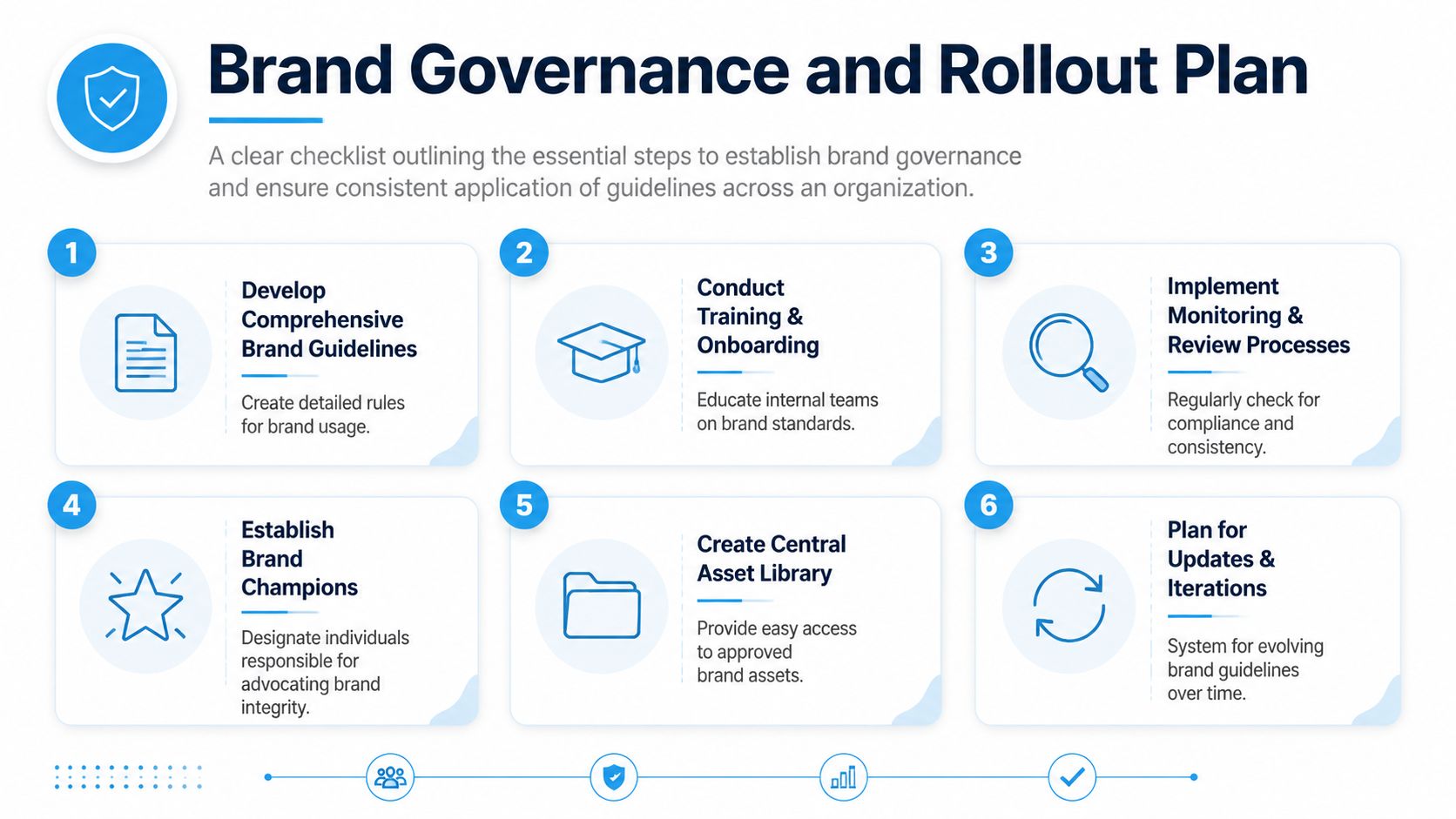
The operational questions are straightforward, and they should be answered in writing. Canva's brand management guidance recommends a governance structure that defines who manages the brand, who approves assets, what the review and update cycles are, and how new vendors are onboarded. Those aren't administrative details. They determine whether the brand stays coherent once work starts moving.
The Four Governance Decisions to Make Early
Some companies assign brand ownership too loosely. That creates approval bottlenecks or, worse, silent inconsistency.
A practical governance model should answer:
Who manages the brand
One person doesn't need to create everything, but one role should own the standard, maintain the template, and resolve gray areas.Who approves what
Not every social post needs executive review. High-risk assets like homepage copy, sales collateral, investor decks, and campaign launches usually need tighter oversight than routine production.How often the standards are reviewed
A brand shouldn't change weekly. But the guidance should be reviewed often enough to account for new offers, audience insights, or channel expansion.How vendors and new hires are onboarded
Many companies lose consistency at this stage. Agencies, freelancers, and internal hires need more than a link to the logo files. They need message priorities, examples, and approval paths.
A brand breaks at the edges first. Vendor onboarding, rush campaigns, and last-minute sales materials are where weak governance shows up.
A Practical Rollout Sequence
Once governance is set, rollout should follow a clear order. Don't try to refresh everything at once.
- Start with high-visibility assets: Website homepage, core service pages, sales deck, email signatures, and social bios
- Then update active campaign systems: Ad creative templates, landing page modules, lead magnets, and nurture emails
- Next train internal teams: Sales, customer success, recruiting, and leadership often shape the brand as much as marketing does
- Then onboard external partners: Share the current brand template, examples, asset library, and review process before new work begins
- Finally create an update rhythm: Capture recurring questions, revise weak sections, and document approved exceptions
What works is a staged rollout with explicit ownership. What doesn't work is sending a final PDF to the company and assuming adoption will happen on its own.
Integrating KPIs for a Data-Informed Brand Strategy
Brand strategy shouldn't float above performance data. It should respond to it.
That doesn't mean rewriting your positioning every month. It means using evidence to refine message emphasis, creative direction, and channel execution. Thus, a modern brand management strategy template becomes more than a planning document.
Adobe Business's 2025 marketing plan guide notes that multi-touch attribution models reveal 42% more brand perception shifts than last-touch metrics, which is a strong argument for tracking brand influence across the full funnel rather than only measuring final conversion points. Standard templates rarely show how to feed those insights back into brand decisions.
What to Measure
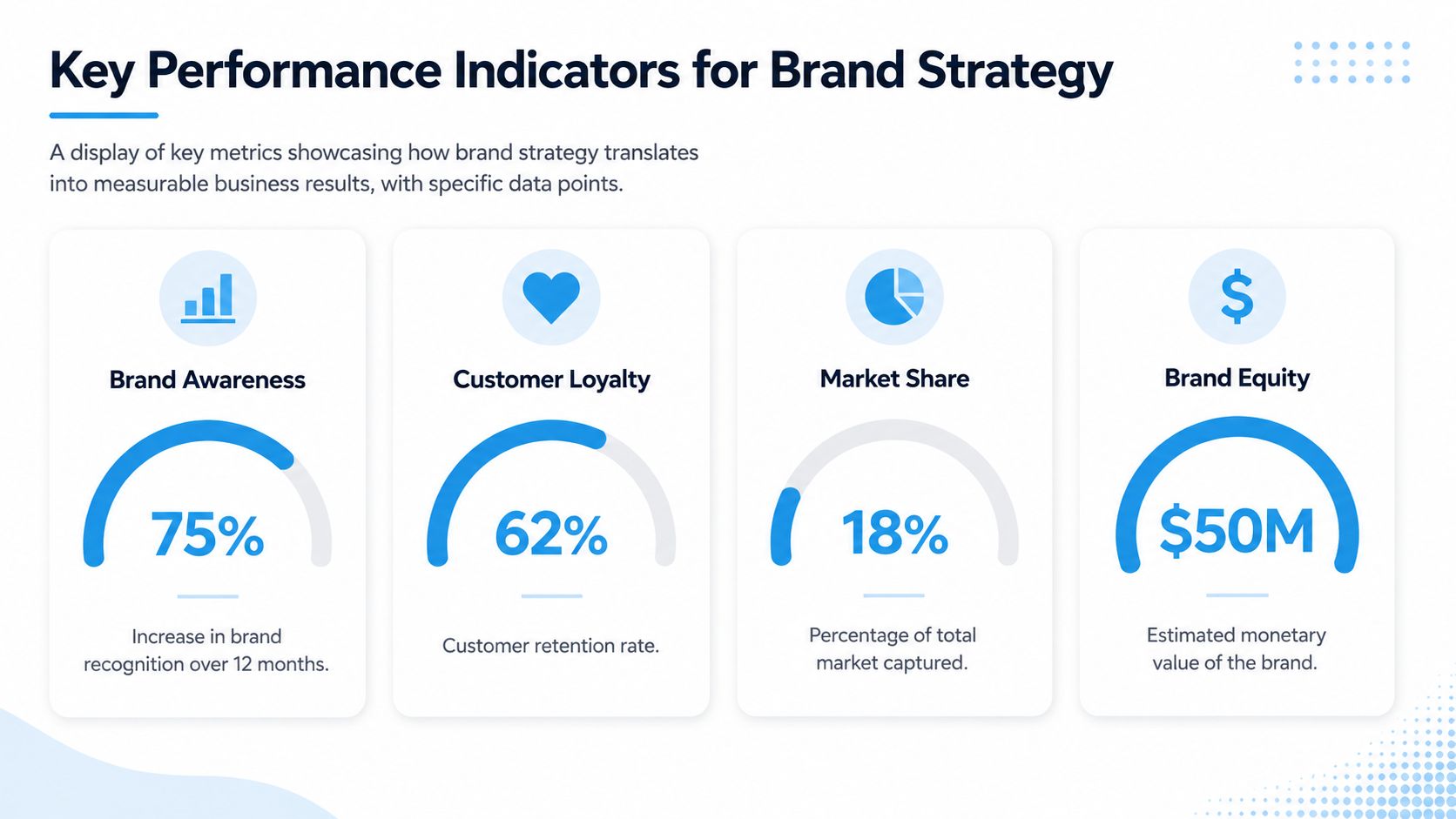
The right KPI set depends on your model, but teams generally should track both awareness signals and perception signals.
A useful scorecard often includes:
- Awareness indicators: Direct traffic trends, branded search behavior, media mentions, social engagement quality, and sales team feedback on recognition
- Perception indicators: Message recall in customer interviews, sentiment in reviews, objection patterns in calls, and conversion quality from brand-led campaigns
- Execution indicators: Approval speed, template adoption, asset reuse, and consistency across live channels
If you track visibility, it also helps to understand the differences between SoM and SoV. Too many teams treat share of voice as a brand health metric without asking whether that attention lines up with market traction.
How to Build the Feedback Loop
The operational move is simple. Attach performance review points to parts of the template.
For example:
| KPI insight | Brand implication | Template update |
|---|---|---|
| Paid social drives clicks but weak lead quality | Message may be broad or attracting the wrong segment | Tighten audience language and proof points |
| Sales calls show repeated confusion about the offer | Positioning isn't clear enough | Rewrite category framing and top-line messaging |
| Organic content earns attention on one topic cluster | The market is responding to a specific value angle | Elevate that theme in message hierarchy |
This process works best when the team reviews brand and campaign data together, not in separate meetings. A planning system that connects forecasting, execution, and ongoing optimization is much easier to manage when it's built into the workflow, which is the same logic behind predictive planning with AI-assisted campaign roadmaps.
Brand strategy gets stronger when message decisions are informed by evidence, not defended by opinion.
Conclusion From Template to Lasting Brand Impact
A brand management strategy template is useful only if people can run work from it. That means it has to do more than define identity. It has to guide messaging, approvals, onboarding, asset usage, and ongoing updates.
The practical version is always more operational than inspirational. It includes clear foundations, specific language, governance rules, and a measurement loop that keeps the brand current instead of frozen. It also depends on execution discipline. BrandLife's brand management guidance points to three essentials for consistency across channels: a centralized Digital Asset Management platform, clear approval processes, and regular team training. That combination is what keeps standards alive after the workshop ends.
If you're refining your broader visibility strategy too, resources like ClipCreator.ai brand awareness tips can help you think through how awareness-building activities connect with the brand system you've documented.
The next step is straightforward. Review your current brand guide and ask one hard question. Can an internal team, freelancer, agency partner, or AI-assisted workflow use it to produce aligned work without extra interpretation? If not, the issue isn't branding effort. It's template design.
If you need help turning a static brand guide into a working system, SharedTEAMS can help. As a fractional, on-demand marketing department, SharedTEAMS supports brand strategy, messaging, campaign execution, creative production, and living brand profile management so SMBs can maintain consistency without building a full in-house team first.