You've probably seen the pattern already. A product page gets traffic, the images look fine, pricing is competitive, and still the page doesn't sell the way it should. In most cases, the problem isn't the product. It's the copy doing too little work at the exact moment a buyer needs clarity.
Knowing how to write product descriptions well matters because the description is where interest either sharpens into intent or falls apart into hesitation. Strong copy answers practical questions, makes the value feel concrete, and reduces the friction that keeps someone from clicking Buy Now. Weak copy fills space.
For many, the bigger challenge isn't writing one good description. It's building a repeatable system that produces strong descriptions across dozens or hundreds of SKUs, adapts them for different channels, and improves them over time. That's where an AI-assisted workflow helps, as long as people still handle positioning, judgment, and refinement.
Table of Contents
- Why Most Product Descriptions Fail to Convert
- The Anatomy of a High-Converting Description
- Optimizing for Search Engines and Human Scanners
- Adapting Descriptions for Key Marketing Channels
- A Modern Workflow for Production and Optimization
- Putting Your Product Description Plan into Action
Why Most Product Descriptions Fail to Convert
A page can attract qualified traffic and still underperform because the description doesn't close the gap between curiosity and confidence. Buyers arrive with questions in mind. If the copy doesn't answer them quickly, they delay the decision or leave.
That's expensive. Detailed, benefit-focused descriptions can increase sales by up to 30%, and a 2024 CXL analysis found that 72% of online shoppers abandon their purchase if product information is unclear or missing key specs (CXL on product descriptions). The description isn't supporting copy. It's part of the conversion mechanism.
Traffic is not the same as purchase readiness
A lot of product pages are written as if the visitor is already sold. That's a mistake. Most buyers are still evaluating fit, risk, and usefulness.
They're asking practical questions such as:
- Will this solve my specific problem: Buyers want relevance, not a generic pitch.
- Can I trust what I'm reading: Vague claims lower confidence fast.
- What happens after I buy: Shipping, setup, dimensions, materials, and compatibility still matter.
When teams treat product descriptions like catalog filler, they usually end up with flat feature lists, recycled manufacturer language, and headlines that say almost nothing. None of that helps a hesitant buyer move forward.
Practical rule: If a competitor could swap in your description without changing a word, the copy is too generic.
What weak descriptions usually get wrong
The most common issue is that the writing describes the product instead of selling the outcome. “Made with durable fabric” is filler unless the buyer understands what that durability means in daily use. “Compact design” means little unless the copy explains where it fits and why that matters.
Another problem is missing specificity. Generic superlatives like “premium,” “effective,” and “high quality” don't create trust on their own. They often read like placeholders for proof.
A third issue is poor structure. Buyers scan before they read. If they hit a wall of text, they won't hunt for the answer. Teams working on broader conversion improvements often run into this same pattern, which is why these essential CRO insights for agencies are useful beyond landing pages alone.
The practical fix is to write descriptions that do four jobs at once: clarify, persuade, reassure, and direct. That requires a structure, not just better word choice.
The Anatomy of a High-Converting Description
The best product descriptions aren't clever by accident. They follow a sequence that matches how buyers evaluate a purchase. Good copy earns attention, builds relevance, reduces uncertainty, and then makes the next step obvious.
A reliable structure comes from a six-part framework: create a compelling hero section, cement emotional connection, link features to end-user benefits, simplify language, pre-empt buyer objections, and embed a clear call-to-action (ProductLed framework for product descriptions).
Use a six-part structure
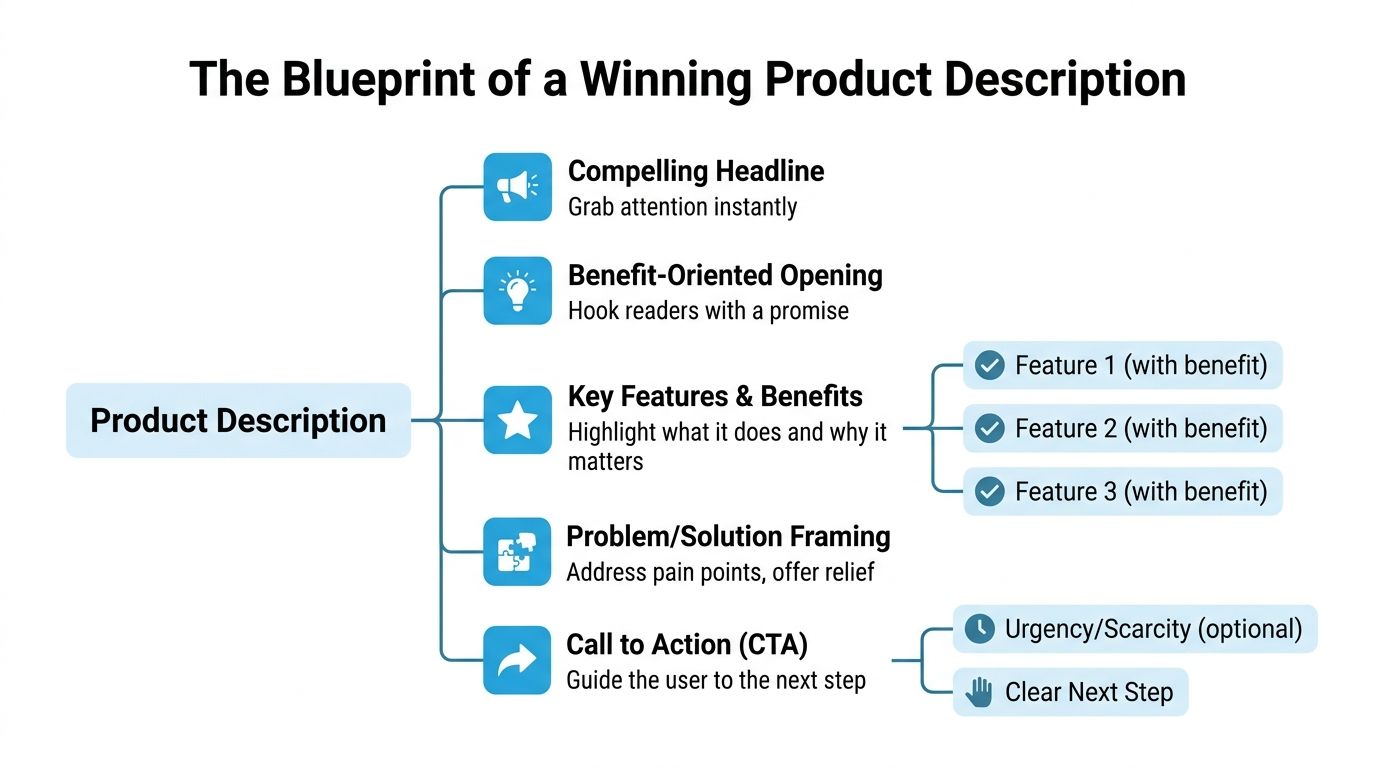
Here's what that looks like in practice.
1. Hero section
Start with a headline and opening lines that state the main promise clearly. This isn't the place for brand poetry. Lead with the product's most valuable outcome.
If you're selling a standing desk, “A stable desk for focused work in small offices” is stronger than “Improve your workspace.”
2. Emotional connection
Show the situation the buyer wants to improve. That creates relevance. You're not manufacturing emotion. You're naming a frustration, aspiration, or desired state the audience already recognizes.
A travel mug buyer isn't shopping for stainless steel. They want coffee that stays hot through the commute and a lid that won't leak in a bag.
3. Features tied to benefits
Features matter only when they explain a result. Don't write “triple-layer insulation” and stop there. Write what that means in use.
4. Simplified language
Shorter language usually wins. Dense copy creates processing friction. If a sentence sounds impressive but slows understanding, cut it.
Clear copy often outperforms clever copy because buyers don't need to admire the writing. They need to trust the decision.
Translate features into outcomes
Most descriptions get better fast when you take the product attribute and finish the thought for the customer.
| Feature | Weak copy | Stronger copy |
|---|---|---|
| Waterproof canvas | Waterproof canvas exterior | Waterproof canvas helps protect contents during commutes and light rain |
| 12-hour battery | Long battery life | Up to 12-hour battery life supports a full workday without constant charging |
| Tempered glass lid | Durable lid | Tempered glass lid lets buyers monitor cooking without lifting the cover |
The same principle applies to visual design. Product page imagery, layout, and hierarchy should support the copy rather than compete with it. Teams refining those page elements may also want to review neurodesign and psychology-informed visuals that boost user engagement.
Keep only the strongest proof points
Don't describe every possible feature. Prioritize the few that matter most to the buying decision. In practice, that usually means choosing the top three value-driving features and developing them properly instead of cramming in ten weak bullets.
Use this sequence:
- Lead with the main result: What does the product help the customer do, avoid, or improve?
- Support with selected features: Focus on the attributes that make that result believable.
- Resolve objections: Cover practical concerns such as sizing, compatibility, care, setup, or materials.
- Close with direction: Tell the reader what to do next.
A high-converting description is rarely long for the sake of being long. It's complete where buyers need confidence and concise where they just need confirmation.
Optimizing for Search Engines and Human Scanners
A strong description still needs to be discoverable. Search visibility and readability aren't separate tasks. They support each other when the copy is structured well.
SEO-optimized product descriptions matter because 68% of consumers begin their purchase journey via search engines, and product pages with structured data and skimmable bullet points see a 35% higher click-through rate from search results (Mailchimp on writing product descriptions).
Write for discovery first
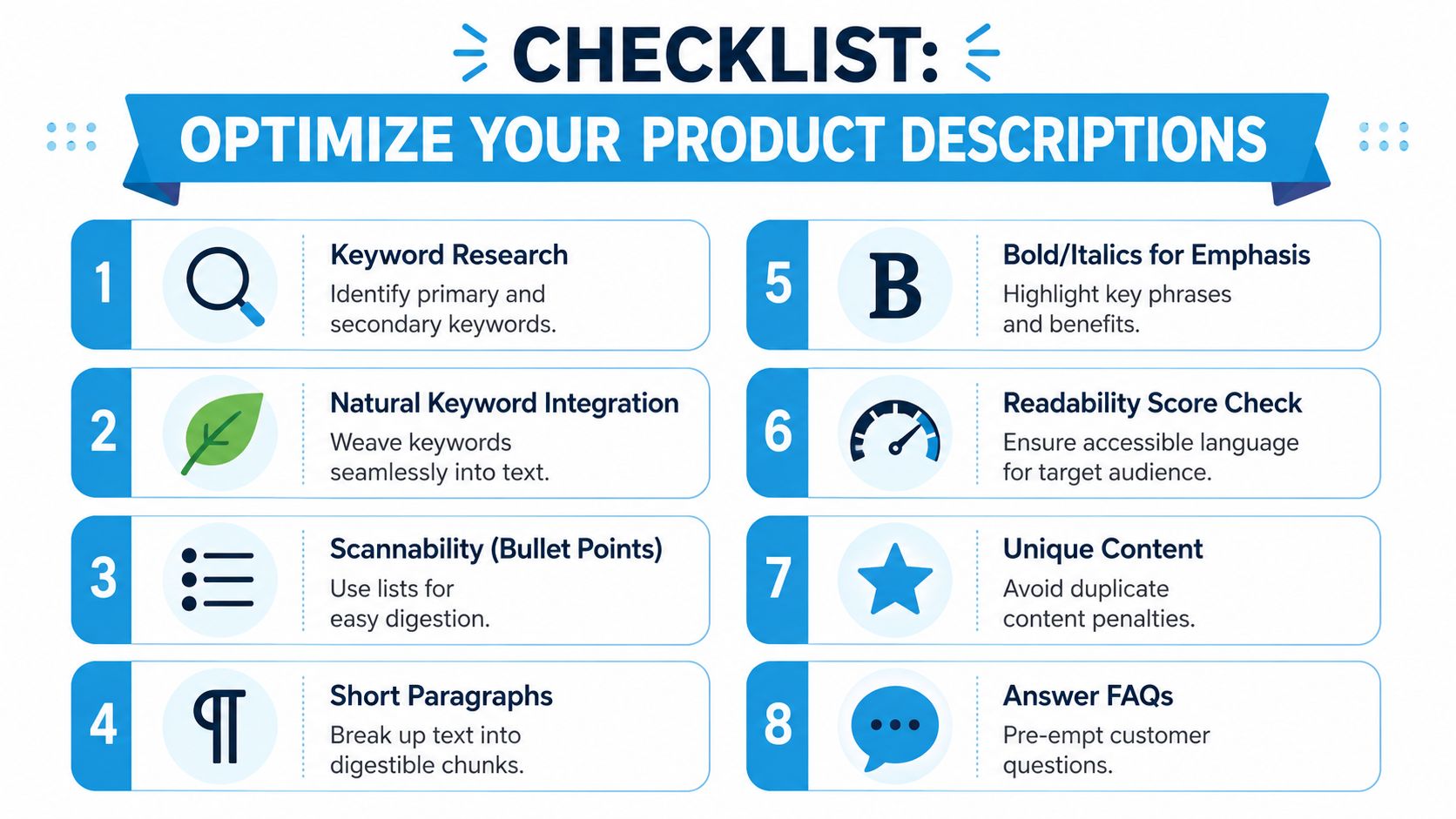
Start with the language buyers use. Not internal product names. Not campaign slogans. Search terms.
For a product like the OXO Brew Pour-Over Coffee Maker, that might mean building copy around phrases such as “pour-over coffee maker,” “single cup coffee dripper,” or “manual coffee brewer,” depending on audience intent. The primary phrase should appear naturally in the product title, opening copy, and one subheading if relevant.
A good supporting resource for this stage is smarter keyword research with AI for hidden search opportunities, especially when teams need to scale keyword mapping across many products.
Format for scanning behavior
Most buyers don't read a product page in order. They scan for confirmation.
That changes how you should format descriptions:
- Keep paragraphs short: Dense blocks look harder than they are and often go unread.
- Use bullets only for specs: Specifications, dimensions, materials, compatibility, and package contents belong in bullet form.
- Front-load meaning: Put the important nouns and outcomes near the start of sentences.
- Make subheads useful: “Materials and care” is better than a vague label like “Details.”
This walkthrough is worth watching if you want a practical companion to the formatting and SEO side of product page writing.
Use search language without sounding mechanical
A common SEO mistake is overloading descriptions with repeated keywords. That usually makes the copy worse for humans without helping rankings in a meaningful way.
Instead, build semantic coverage naturally. If the product is a ceramic Dutch oven, related language might include braising, oven-safe cooking, enamel coating, stovetop use, and heat retention. Those terms support search relevance while also helping the buyer understand fit.
The best product page SEO often feels invisible because it reads like clear sales copy, not optimization work.
One more practical note. Unique descriptions matter. Reusing the same copy across your site, marketplaces, and campaign landing pages weakens your ability to match platform intent. Each version should be adapted to the channel and the search behavior behind it.
Adapting Descriptions for Key Marketing Channels
One description rarely performs well everywhere. A product page can support detail, reassurance, and richer storytelling. A marketplace listing needs structure and search alignment. Social posts need speed and focus. Email needs a single message tied to a click.
That's why channel adaptation should be built into the production process, not treated as cleanup work after the main description is written.
What changes by channel
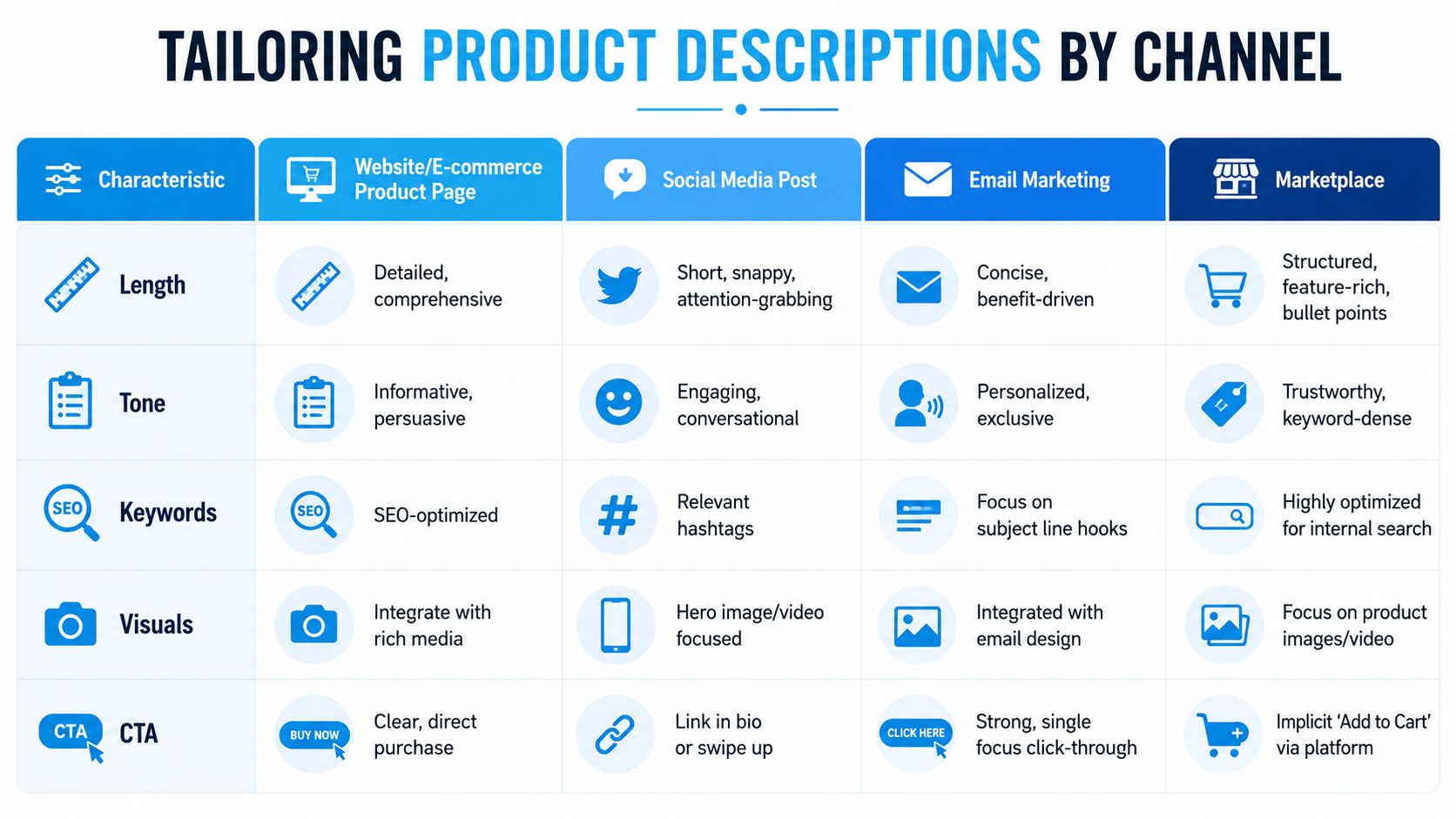
The core positioning should stay consistent. The expression needs to change.
Website product page copy has room to handle context, objections, specifications, and the CTA. Such copy allows you to explain why the product exists, who it's for, and what makes it worth choosing.
Marketplace copy usually needs tighter keyword alignment and more rigid formatting. Buyers there compare options quickly, so clarity often matters more than brand voice.
Social media needs one angle. Not five. Pick the most attention-worthy use case, visual outcome, or buyer problem and write toward that. A strong caption supports the creative rather than trying to replace the product page.
Email sits somewhere in between. It needs enough description to create interest, but not so much that it competes with the landing page.
A practical channel comparison
BigCommerce's guidance is useful here: keep paragraphs under three lines and use bullet points exclusively for specifications because big walls of text reduce readability and can push buyers away, especially on mobile-first channels (BigCommerce on product description formatting).
Here's a simple comparison to use with your team:
| Channel | What the copy must do | What to avoid |
|---|---|---|
| Website | Build confidence and answer objections | Long intros that delay the value |
| Marketplace | Match search intent and make specs easy to compare | Brand-heavy language with weak specifics |
| Social post | Stop the scroll and push one action | Trying to summarize the entire product |
| Create urgency or relevance around a click | Multiple competing CTAs |
Teams using personalization across channels can scale this work more effectively with a modular content system. This approach is similar to the ideas in AI personalization at scale that still feels one-to-one.
The key trade-off is simple. The more limited the space, the narrower the message needs to be. Don't compress a full product page into an Instagram caption. Extract the best angle for the context.
A Modern Workflow for Production and Optimization
Most businesses don't struggle because they can't write one decent description. They struggle because they need fifty, then two hundred, then constant revisions for new products, seasonal campaigns, and channel variants. At that point, quality depends less on individual writing talent and more on workflow design.
A modern content operation treats product descriptions as a repeatable production system with clear inputs, review steps, and testing loops.
Build an operating system, not a writing task
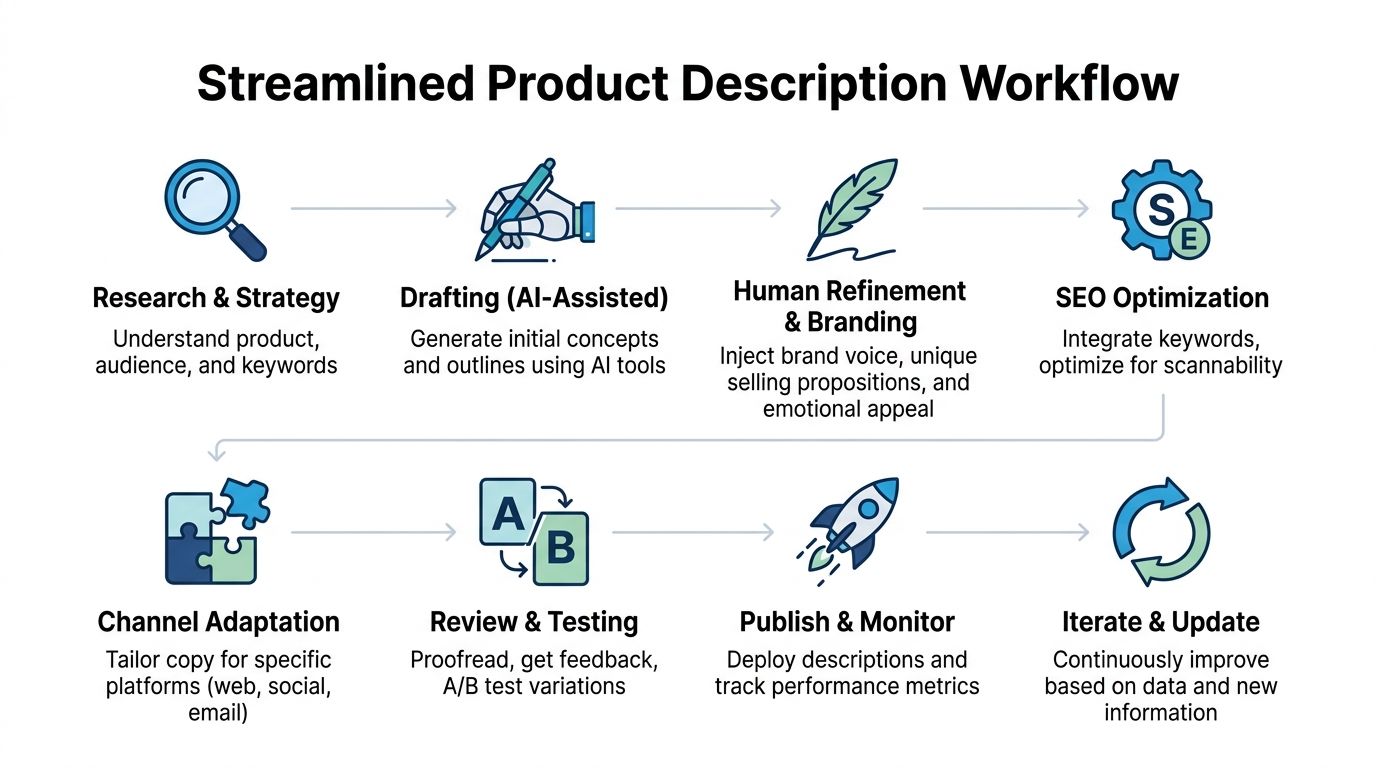
A workable process usually looks like this:
Collect source inputs
Pull product specs, customer reviews, sales call notes, support tickets, and competitor positioning into one brief.Define message priorities
Decide the primary buyer, top use case, core objection, and strongest proof points before any drafting starts.Generate a draft systemically
Use AI to produce structured first drafts, variant headlines, benefit statements, spec summaries, and channel adaptations.Apply expert review
A strategist or experienced copy editor checks factual accuracy, brand fit, compliance concerns, and clarity.Publish in versions
Create the core website description, then adapt for marketplace, email, paid social, and organic social.Test and update
Compare alternate headlines, opening hooks, and CTA language on high-traffic products first.
That process works because it separates what machines do well from what people do well.
Where AI helps and where it does not
AI is useful for speed, consistency, and first-draft range. It can summarize product attributes, propose formatting structures, and turn one approved positioning statement into several channel-ready versions.
It is not reliable as an unsupervised strategist. It doesn't know which claims are risky, which promises clash with your actual customer experience, or which sentence weakens the brand.
Use AI for:
- Draft generation: Create initial copy blocks from approved inputs.
- Variation production: Produce alternate hooks, subject lines, and benefit phrasings.
- Channel adaptation: Rework one core description into versions for email, paid ads, or marketplaces.
- Maintenance work: Refresh seasonal wording, update formatting, and standardize tone.
Keep human oversight on:
- Positioning decisions: What matters most to the buyer.
- Fact checking: Materials, dimensions, compatibility, compliance, and product limitations.
- Final voice: The difference between “acceptable” and persuasive usually comes from editing.
- Testing priorities: Which variables to test first and which products justify the effort.
A useful supplemental read for teams building this kind of pipeline is this guide for e-commerce product descriptions, particularly for thinking through how AI fits into production rather than replacing review.
AI should shorten the path to a usable draft. It should not decide what the product promise is.
Add an AI-search layer early
There's another reason workflow matters now. AI-native search engines and shoppable LLMs drive 35% of e-commerce traffic in major markets, and structuring problem-solution-mechanism logic in the first 50 words can better satisfy LLM inference patterns (The Stitch Writer on AI-native product description structure).
That changes the opening of your description.
Instead of starting with branding language, lead with:
- Problem: What issue or need the buyer has
- Solution: How the product addresses it
- Mechanism: What specific feature or design element makes that outcome possible
For example, a noise-canceling headset description could open with a buyer problem around distraction, state the benefit of focused calls, and then identify the mechanism such as active noise cancellation and dual microphones. That structure helps people quickly. It also makes the page easier for AI-driven retrieval systems to interpret.
For fractional teams, a documented workflow becomes a strategic advantage. One clear system lets specialists, editors, and AI tools work from the same rules without recreating the process every time.
Putting Your Product Description Plan into Action
The fastest way to improve results is to stop treating product descriptions as isolated writing assignments. They work better when they're built from a standard, reviewed for clarity, adapted by channel, and improved through testing.
Start with an audit of your current pages
Pick three products that already get meaningful traffic. Don't start with your weakest sellers. Start where better copy can influence real demand.
Review each one against these questions:
- Does the opening state the main outcome clearly: Or does it waste space on generic branding?
- Are features translated into buyer benefits: Or are they just listed?
- Are the strongest objections answered: Think sizing, materials, setup, compatibility, or care.
- Is the page easy to scan: Especially on mobile.
- Is there a clear next step: The CTA should feel obvious, not implied.
This exercise usually reveals the same issue across many pages. Teams often discover they have the product knowledge already. They just haven't organized it into persuasive copy.
Use a simple execution checklist
For your next round of updates, keep the process tight:
- Write the first 50 words carefully: Lead with buyer problem, solution, and mechanism.
- Focus on the top three value-driving features: Don't bury the page in low-value detail.
- Separate persuasion from specifications: Narrative for value, bullets for specs.
- Create channel variants intentionally: Website, marketplace, email, and social need different versions.
- Review with a human editor before publishing: AI can accelerate output, but it can't own the final standard.
- Test one variable at a time: Start with the headline, opening paragraph, or CTA.
Teams that build this into a working cadence usually produce better copy faster, and they avoid the constant reset that comes from starting from scratch on every product.
If your current process is inconsistent, overloaded, or dependent on whoever has time that week, it may be time to bring structure to the work. A fractional team can help when you need strategy, production capacity, and expert review without building a full in-house content operation.
If you want help turning product description writing into a scalable marketing system, SharedTEAMS supports SMBs with fractional strategy, AI-assisted production workflows, content execution, SEO and GEO support, web updates, and ongoing optimization. It's a practical fit for teams that need expert oversight and flexible execution without adding full-time headcount.