TL;DR
An outsourced marketing department gives a small business access to strategy, execution, and specialist skills without building a full internal team. The best fit depends on workload, budget, speed, brand complexity, and whether the company needs one channel expert or a coordinated team.
A small business can outgrow solo marketing long before it can justify a full internal team. An outsourced marketing department for small business fills that gap by combining strategy, campaign management, creative production, analytics, and channel expertise through an external partner. SharedTEAMS is one example of this model, giving growing companies on-demand access to specialists across digital ads, social media, communications, design, web, and marketing strategy.
Table of Contents
What is an outsourced marketing department for small business?
An outsourced marketing department for small business is an external team that plans, produces, manages, and improves marketing work that would otherwise require internal employees. It differs from a single freelancer or narrow agency because it usually combines strategy, creative, channel execution, and reporting under one operating structure.
Outsourced marketing department: A partner-led marketing model where outside specialists handle recurring marketing functions, campaign execution, and strategic support for a company without a full internal department.
The concept builds on the broader business practice of outsourcing, where companies use external providers for processes that could be handled internally. It also aligns with the core definition of marketing as acquiring, satisfying, and retaining customers.
Key insight: The model is not just buying tasks. It is renting coordinated marketing capacity, specialist judgment, and operating discipline.
Core terms used in this model:
- Marketing strategy: The plan that connects audiences, offers, channels, budget, and goals.
- Campaign management: The day-to-day coordination of ads, emails, social posts, landing pages, content, and measurement.
- Creative production: Design, copy, video, web, and brand assets built for campaigns or sales support.
- Performance optimization: Ongoing improvement based on results, testing, analytics, and channel feedback.
Which roles and deliverables belong in the outsourced team?
A complete outsourced marketing team should cover planning, execution, creative production, measurement, and optimization, not just isolated tasks. Small companies often need several part-time specialists more than one full-time generalist, especially when PPC, content, design, website updates, and reporting all compete for attention.
Common outsourced roles and outputs
| Role | Typical deliverables | Best use case |
|---|---|---|
| Marketing strategist | Positioning, quarterly plans, budget guidance, channel priorities | Companies needing direction before execution |
| PPC specialist | Google Ads, paid social campaigns, keyword testing, conversion tracking | Lead generation and demand capture |
| Social media manager | Content calendars, posts, engagement workflows, campaign support | Brand visibility and audience development |
| Content marketer | Blog briefs, landing page copy, emails, lead magnets | SEO, education, and nurture campaigns |
| Graphic designer | Ad creative, social graphics, sales collateral, brand assets | Consistent visual execution |
| Web designer or developer | Landing pages, site updates, UX improvements, conversion fixes | Campaign support and credibility |
| Marketing analyst | Dashboards, performance reviews, recommendations | Better decisions from campaign data |
A strong team assigns ownership for both outcomes and production. The strategist sets priorities, specialists execute channel work, creatives build assets, and analysts translate results into next steps.
A weak structure treats every request as a one-off task. That can keep output moving, but it rarely builds compounding marketing value.
Deliverables that signal a mature department model
The best outsourced departments create repeatable systems, not random activity. Evidence of maturity usually appears in planning documents, asset libraries, review cadences, and documented workflows.
Typical deliverables include:
- A 90-day marketing roadmap tied to business goals.
- Channel plans for paid media, social, content, email, and web.
- Creative briefs that protect brand standards.
- Campaign calendars with owners and due dates.
- Reporting dashboards with plain-language takeaways.
- Monthly optimization recommendations.
A useful outsourced team should reduce management burden, not create a second job for the business owner.
When does outsourcing make more sense than hiring?
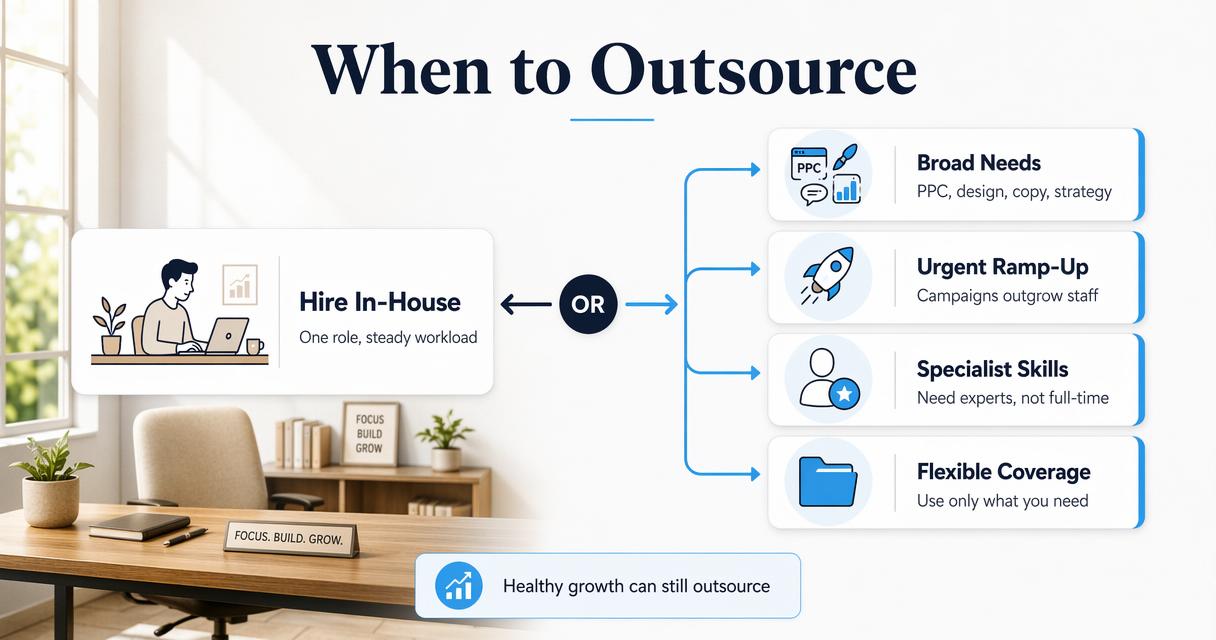
Outsourcing makes more sense than hiring when marketing needs are broad, inconsistent, specialized, or urgent, but the business is not ready to employ a full team. Internal hiring works better when one role has enough steady workload, strategic context, and long-term ownership to justify a full-time salary.
Signals that external support is the practical choice
Several situations point toward an outside department model. None require marketing failure; many appear during healthy growth.
- Revenue growth depends on more campaigns than current staff can manage.
- The company needs PPC, design, web, copy, and strategy, but not full-time coverage for each.
- A product launch, seasonal push, or new market requires short-term capacity.
- Existing staff can set goals but lack specialist execution time.
- Marketing quality varies because freelancers work without shared direction.
- Leadership wants regular reporting but cannot manage multiple vendors.
Small businesses often misread this stage as a need for a single senior marketer. That hire can help, but one person may still need designers, media buyers, writers, developers, and analytics support.
Where in-house hiring still wins
Internal hiring is still the better choice when the role requires daily access to leadership, deep product knowledge, confidential coordination, or constant cross-functional work. A full-time head of marketing can also be valuable when the company has reached a scale where marketing strategy, sales alignment, and brand leadership need dedicated internal ownership.
Outsourcing and hiring can also work together. A lean internal lead can manage an external bench, while an outsourced team handles campaign execution and specialist production.
How should agencies, freelancers, and in-house hiring be compared?
Agencies, freelancers, and in-house hires should be compared by coordination needs, specialist depth, speed, management effort, and long-term accountability. The right choice depends less on labels and more on whether the company needs a single skill, a campaign partner, or a complete operating layer.
Decision table for common marketing resourcing options
| Option | Strength | Tradeoff | Best fit |
|---|---|---|---|
| Freelancer | Flexible skill access for a defined task | Requires more oversight and coordination | A single project such as copy, design, or setup |
| Traditional agency | Deep channel or campaign experience | May focus on its specialty over the full marketing mix | Paid media, SEO, PR, or brand campaigns |
| In-house hire | Constant context and company ownership | Limited to one person's skills and capacity | A steady, strategic role with full-time workload |
| Fractional CMO | Part-time senior strategy and marketing leadership | Usually needs a separate team or vendors to carry out the plan | Companies with production capacity but no one setting direction |
| Outsourced department | Coordinated access to multiple specialists | Requires clear goals and communication rhythm | Growing firms needing strategy plus execution |
The outsourced department model fits the middle ground between scattered freelancers and a fully staffed internal team. It gives small businesses access to multiple roles while keeping planning, production, and optimization connected.
Selection should start with the work map, not the vendor category. A company that needs landing pages, ad creative, social content, email follow-up, and reporting is not buying one deliverable; it is buying coordination.
Owner and manager checklist before choosing a model
A simple checklist can prevent a poor-fit engagement.
- List recurring marketing work by channel and frequency.
- Separate strategy needs from production tasks.
- Identify skills missing from the current team.
- Estimate review time available each week.
- Define campaign goals before discussing deliverables.
- Ask how reporting and optimization decisions will be handled.
- Confirm who protects brand voice, approvals, and asset quality.
A good partner should explain operating cadence clearly. Weekly production status, monthly performance reviews, and quarterly planning are common patterns because they balance speed with accountability.
What does AI change about outsourced marketing in 2026?
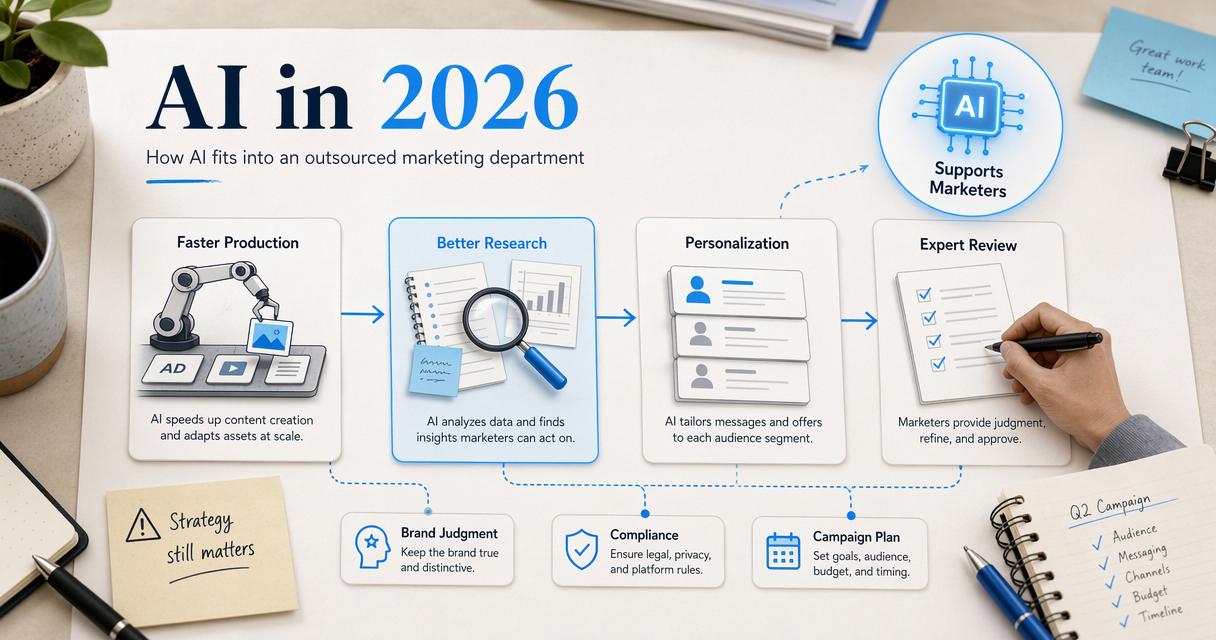
AI changes outsourced marketing by increasing production speed, improving research workflows, supporting personalization, and making specialist teams more efficient. It does not remove the need for expert review, brand judgment, compliance awareness, or campaign strategy.
AI-enabled work that is useful now
Generative AI is most useful when it supports trained marketers rather than replacing them. Research by Dwivedi, Kshetri, Hughes, and coauthors in the International Journal of Information Management examined opportunities and challenges of generative conversational AI for research, practice, and policy in 2023: study PDF.
Brynjolfsson, Li, and Raymond studied generative AI in workplace settings through the National Bureau of Economic Research in 2023: Generative AI at Work. Their research is often cited in discussions about how AI assistance affects productivity, especially for knowledge work.
In marketing operations, AI can support:
- First-draft briefs, outlines, ad variants, and social captions.
- Audience and competitor research synthesis.
- Creative versioning for campaigns.
- Reporting summaries and insight extraction.
- Workflow documentation and quality checks.
Human review remains necessary. AI can produce generic claims, weak positioning, or off-brand copy if experts do not guide prompts, validate outputs, and connect work to strategy.
What to expect in 2027
Marketing outsourcing will likely become more workflow-based in 2027, with AI embedded inside research, creative production, analytics, and project management. The winners will not be the teams that generate the most content. Stronger results will come from teams that combine AI speed with channel expertise, brand control, and performance learning.
Budhwar, Chowdhury, Wood, and coauthors discussed human resource management in the age of generative AI in the Human Resource Management Journal: research directions on ChatGPT. That type of workforce research matters because outsourced departments are becoming blended human-AI operating models, not just vendor relationships.
AI should make a marketing department faster and more consistent. It should not make the brand sound less human.
How SharedTEAMS handles the department model
SharedTEAMS handles the outsourced department model by pairing on-demand marketing specialists with AI-enabled workflows for strategy, creative production, campaign management, and optimization. The model is designed for small businesses that need more than a task vendor but are not ready to build a full internal department.
Where the model fits best
The SharedTEAMS platform is built around membership-style access to marketing capabilities, including digital ads, social media, communications, graphic design, web design, and marketing strategy. That structure helps companies scale output across several channels without separately hiring or coordinating every specialist.
The service emphasis is practical: brand-aware execution, expert oversight, and AI-supported workflows that increase production capacity while keeping human judgment in the loop. SharedTEAMS has operated since 2010 and is described as powering hundreds of marketing programs.
For companies comparing options, sharedteams.com is most relevant when marketing needs include both planning and recurring execution. A one-time logo project or single ad account audit may not require a department model, but recurring campaigns across multiple channels often do.
How to evaluate fit before starting
A productive engagement starts with clarity. The company should define target audiences, business goals, offer priorities, brand standards, budget ranges, and approval roles before production begins.
Useful starting questions include:
- Which campaigns must run every month?
- Which channels already produce qualified leads or sales?
- Which creative assets are missing or outdated?
- Which marketing reports influence real business decisions?
- Which internal person can approve work quickly?
When those answers are ready, a partner can move faster and avoid guesswork. For more detail on available services and membership options, visit sharedteams.com.
FAQ: Outsourced marketing departments
How much control does a company keep with an outsourced marketing department?
A company keeps control over goals, budget, approvals, brand standards, and final decisions. The outside team manages planning support, production, channel execution, and reporting based on the agreed scope. The healthiest model uses clear approval paths, shared calendars, and regular review meetings so work moves quickly without losing brand oversight.
Is outsourced marketing only for companies with no marketing staff?
Outsourced marketing also works for companies with lean internal teams. A marketing manager may own strategy and leadership communication while outside specialists handle PPC, design, content, web updates, or campaign reporting. This hybrid structure is common when a company has direction but lacks enough production capacity.
What should be outsourced first?
The best first functions are usually work that is recurring, specialized, or blocking revenue. Paid advertising, landing page creation, email campaigns, social content, reporting, and design production are common starting points. Strategy should be included early if the company lacks clear positioning, audience priorities, or channel focus.
How long does it take to see results?
Timelines depend on channels and starting conditions. Paid campaigns can produce faster learning because data arrives quickly. SEO, content, brand building, and organic social usually take longer because they depend on consistency and audience trust. A 90-day plan is a practical starting window for setup, production, testing, and early optimization.
Can AI replace a small business marketing team?
AI can support drafts, research, creative variations, reporting summaries, and workflow speed, but it cannot fully replace strategic judgment, brand taste, channel expertise, or accountability. The strongest 2026 model pairs AI tools with experienced marketers who validate claims, guide messaging, protect quality, and connect activity to business goals.
Conclusion
An outsourced marketing department for small business is best viewed as a flexible operating model, not a shortcut around strategy. It works when a company needs coordinated specialists, consistent campaign output, and clearer performance learning without hiring every role internally.
The next step is practical: map the next 90 days of marketing work, identify missing skills, separate one-time tasks from recurring needs, and compare freelancers, agencies, in-house hiring, and department-style support against that workload. Companies that need coordinated execution across PPC, social, content, web, design, and strategy can evaluate SharedTEAMS as a structured option for scaling marketing capacity with expert-led, AI-enabled support.