Most advice on how to optimize content for AI search engines is too vague to be useful. “Write high-quality content” isn't wrong, but it's incomplete. AI systems don't consume a page the way a person does. They pull apart sections, extract answer blocks, and reuse the clearest units.
That changes the job. The target isn't just a strong article. It's a page built from citable components. If your best insight sits halfway down a long introduction, or if a section needs surrounding context to make sense, AI search may skip it in favor of something structurally simpler.
The practical shift is from writing long-form narratives to engineering atomic, self-contained content units. That structure helps both machines and busy readers. Executives scanning for a decision can find the point faster. AI models can isolate, summarize, and cite the point with less friction.
Table of Contents
- Beyond Keywords and Quality Content
- Understanding Modern AI Search Behavior
- The Atomic Answer Framework for Content
- Applying Advanced Semantic and Entity Optimization
- Technical Execution and Performance Measurement
- Building a Reproducible AI Content Workflow
Beyond Keywords and Quality Content
Keyword targeting and content quality still matter, but they're no longer enough on their own. AI search rewards pages that make extraction easy. A useful article with weak structure can lose to a less ambitious page that answers each subtopic cleanly, directly, and in a format the model can quote without rewriting.
That's the part many teams miss. Traditional SEO trained writers to build momentum, introduce context, and develop an argument over time. That style can work for human readers. It often works poorly for systems that scan for answer candidates, entity relationships, and compact context blocks.
The trade-off is real. Narrative writing can feel richer. Atomic writing can feel more constrained. But if you want AI visibility, structure has to carry more weight than literary flow.
What stops content from being cited
Several patterns consistently weaken AI search performance even when the topic choice is right.
- Long scene-setting intros bury the actual answer and force the model to infer the point.
- Broad H2s such as “Strategy” or “Best Practices” don't signal a specific retrieval target.
- Mixed-topic sections make it hard for a system to isolate one complete idea.
- Generic anchor text weakens semantic clarity and reduces the usefulness of your internal linking graph.
Clear structure doesn't reduce expertise. It makes expertise easier to extract.
A better standard is simple. Each section should answer a specific buyer question, lead with the answer, then support that answer with evidence, context, and action. That's a different workflow than “write an extensive article and hope the strongest lines get picked up.”
Here's the deeper implication for teams: content strategy now needs an editorial architecture, not just a topic calendar. If your process starts with keywords and ends with publishing, you're missing the layer that determines whether AI systems can reuse what you wrote.
Understanding Modern AI Search Behavior
AI search systems don't move through your page in a patient, linear way. They identify patterns, pull relevant chunks, compare competing chunks, and assemble responses from the material that feels most self-sufficient. That's why clean extraction often beats elegant storytelling.
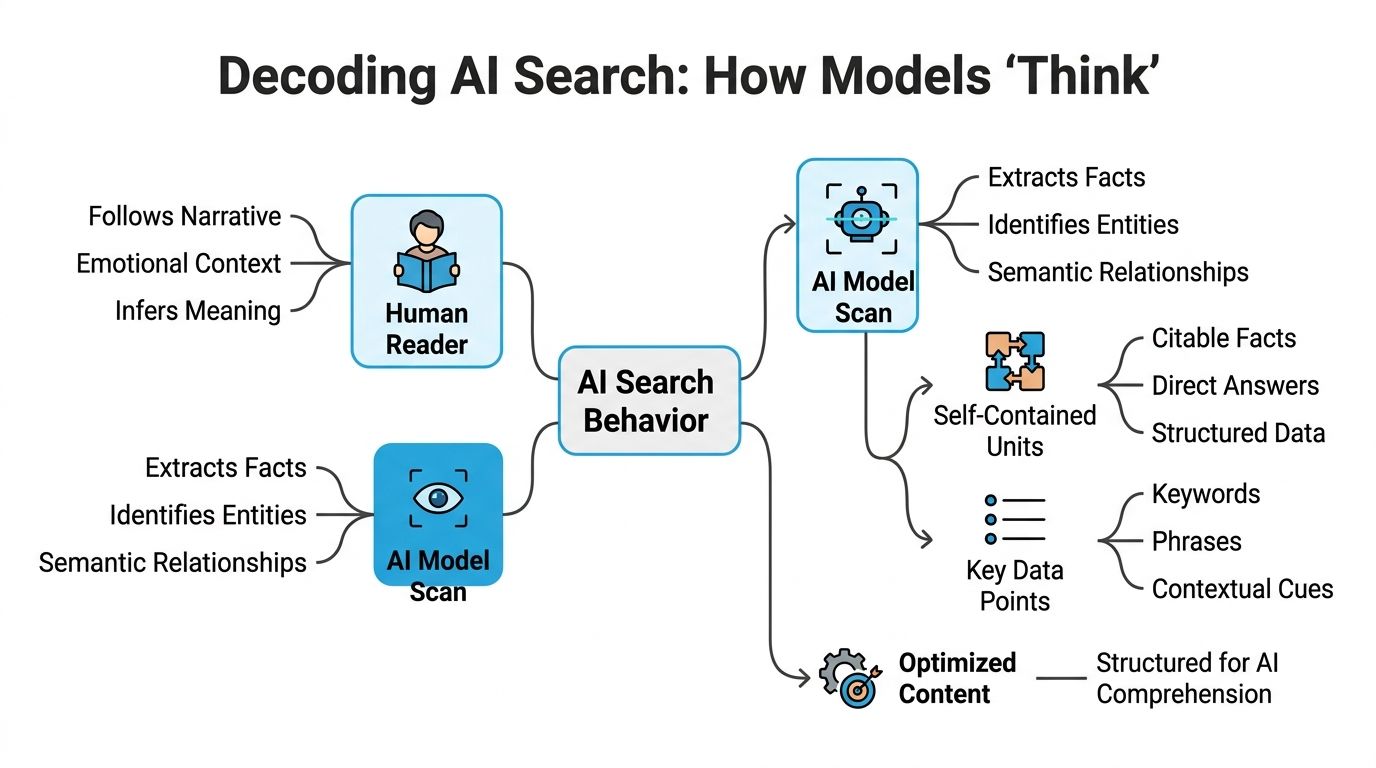
AI search extracts before it interprets
A useful way to think about modern search is this: the model isn't “reading your article.” It's evaluating whether a section can stand on its own. That puts pressure on formatting, heading logic, and paragraph discipline.
According to Otterly's guidance on optimizing content for AI search, a strict Self-Contained Content Unit architecture, where every section starts with a direct declarative answer of 40 to 60 words, can increase the probability of citation in AI Overviews by 30 to 40% compared to narrative flows. The same guidance also stresses a logical H1 to H2 to H3 hierarchy, buyer-question H2s, and plain-language readability.
That explains why many “good” articles underperform. They assume the reader will stay for the full argument. AI systems often won't.
For a complementary breakdown of how question-driven search experiences work, the LLMrefs guide to AI search is worth reviewing. It helps clarify why answer formatting now affects discovery, not just usability.
What a self-contained content unit looks like
A strong self-contained unit has a narrow purpose. The heading names the question or claim. The first paragraph answers it directly. Everything after that supports the answer instead of wandering into adjacent ideas.
A weak unit usually has one of three problems:
| Pattern | Why it fails | Better approach |
|---|---|---|
| Broad heading | The topic is too vague to map to a question | Write H2s as buyer questions |
| Delayed answer | The point appears after context and setup | Put the answer in the first paragraph |
| Mixed intent | Advice, definitions, and examples compete in one block | Keep one intent per section |
If a section can't be quoted on its own, it usually won't be cited.
This is also where teams should rethink old content assumptions. A page can still be thorough, but each part of it must be independently useful. That distinction matters more than ever in generative search, and it's central to the shift described in this overview of how generative search engines are changing SEO.
The Atomic Answer Framework for Content
The most reliable way to optimize content for AI search engines is to standardize how every page and every section is built. That means replacing loose article structures with a repeatable editorial framework that treats each heading as an answer target.
Start with the page-level answer
Every page should open with a short answer placed immediately under the main heading. Per Elementor's AI search optimization guidance, the strongest format is a direct, declarative answer of 40 to 60 words above the fold, before supporting visuals or promotional copy.
That opening summary does two jobs. It helps the reader confirm relevance fast, and it gives AI systems a clean top-level interpretation of the page. Teams that skip this usually force both users and models to work too hard to identify the page's main claim.
Turn every H2 into a standalone answer block
The next step is where the greatest opportunity lies. Treat each H2 as a question a buyer, evaluator, or stakeholder would ask. Then answer it immediately.
A practical pattern looks like this:
- Question-led H2 that matches a real information need.
- Direct answer paragraph that resolves the heading in plain language.
- Support layer with examples, reasoning, proof, or trade-offs.
- Practical takeaway that tells the reader what to do next.
This is more demanding than standard blog writing because it removes the safety net of vague transitions. Every section has to earn its place.
A practical editorial template
Here's the version I'd use in a working content brief for a team.
- Page summary under H1: Write a 40 to 60 word answer that states the page's main position.
- H2 structure: Phrase H2s as specific questions, not abstract topics.
- Section opening: Answer the H2 before adding nuance.
- Section body: Add supporting detail only if it strengthens the answer.
- Takeaway: End the section with an action, decision rule, or implementation note.
For example, don't write an H2 like “Content Structure.” Write “How should content be structured for AI search?” Then follow it with a direct answer. After that, explain the mechanics.
Practical rule: If the first paragraph under an H2 could be pasted into a search answer with no edits, the structure is probably strong enough.
There's also an editorial discipline here that many teams need to relearn. Don't let a section explain three things because the writer had extra material. Split the ideas. Create another H3 or another H2. AI retrieval improves when each chunk has one clear job.
A second mistake is using one format for humans and another for search. That creates awkward copy. The better approach is to use one strong format that serves both. Well-structured, answer-first content is easier to skim, easier to brief, and easier to update.
This also pairs well with a broader zero-click content strategy, especially for brands that need visibility even when users don't click through from every search surface.
Applying Advanced Semantic and Entity Optimization
Once the structure is right, the next question is whether the page signals real expertise. AI systems don't just look for matching phrases. They evaluate how concepts relate to each other and whether your content demonstrates a coherent understanding of the topic area.
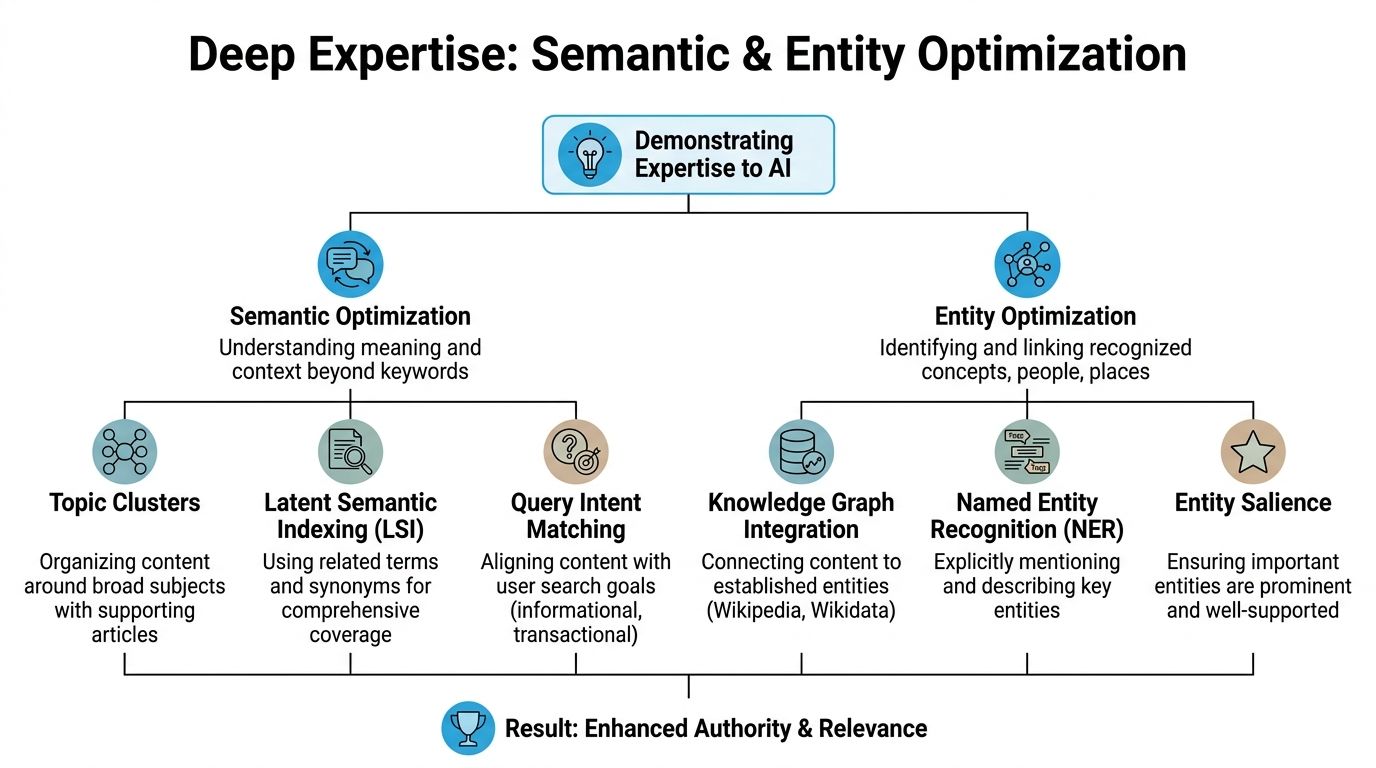
Authority comes from relationships, not repetition
Many teams still approach optimization as keyword placement plus light synonym use. That's too shallow for AI search. Strong pages build a semantic field around the main topic. They connect definitions, methods, adjacent concepts, decision criteria, and recognized entities in a way that feels complete.
If you're comparing frameworks and terminology across sources, this AI search optimization guide is a useful supplemental reference. It's especially helpful for teams trying to connect semantic coverage with practical on-page decisions.
The point isn't to stuff related terms into a draft. The point is to make your expertise legible. If you publish an article on AI search optimization, a strong page will naturally reference things like AI Overviews, schema, query intent, internal linking, content structure, and entity clarity because those concepts belong together.
Use brand labeling to protect original thinking
One overlooked issue is that AI systems often flatten original frameworks into generic advice. If your team has a distinct method but never names it, the model may paraphrase the concept without preserving your ownership of the idea.
According to the cited guidance from this YouTube discussion on brand labeling in AI citation behavior, explicitly naming a proprietary framework, such as “The [Brand] Method,” showed 30 to 40% higher citation retention in 2025 to 2026 data. That matters for firms trying to turn expertise into remembered brand association, not just raw impressions.
Embed the video below if you want a broader look at how AI and search behavior are evolving.
A practical intersection of branding and SEO emerges. A named framework gives AI a stable label to attach to an idea. Without that label, your originality becomes easier to summarize and easier to detach from your brand.
What strong entity optimization looks like in practice
Entity optimization is less mysterious than it sounds. It usually comes down to precision.
- Name the important concepts clearly: Don't rely on pronouns and implied references when a specific term would remove ambiguity.
- Support each major entity with context: If you mention schema, explain its role. If you mention AI Overviews, define the context in the same section.
- Keep related entities close together: Spread-out references weaken semantic cohesion.
- Use descriptive internal anchors: Links should name the topic, not hide behind generic prompts.
A useful editorial test is to review a section and ask whether a new reader could identify the topic, the entities involved, and your point of view without reading the rest of the page. If not, the content is probably still too dependent on surrounding context.
For teams working deeper into topic authority, this guide to entity SEO and optimizing for topics instead of keywords is a strong internal reference point.
Technical Execution and Performance Measurement
Good structure and semantic depth won't carry the full load if the page is technically unclear. AI search still depends on crawlability, page interpretation, and machine-readable signals. Teams often treat technical SEO as a separate layer, but for AI visibility it's tightly connected to content extraction.
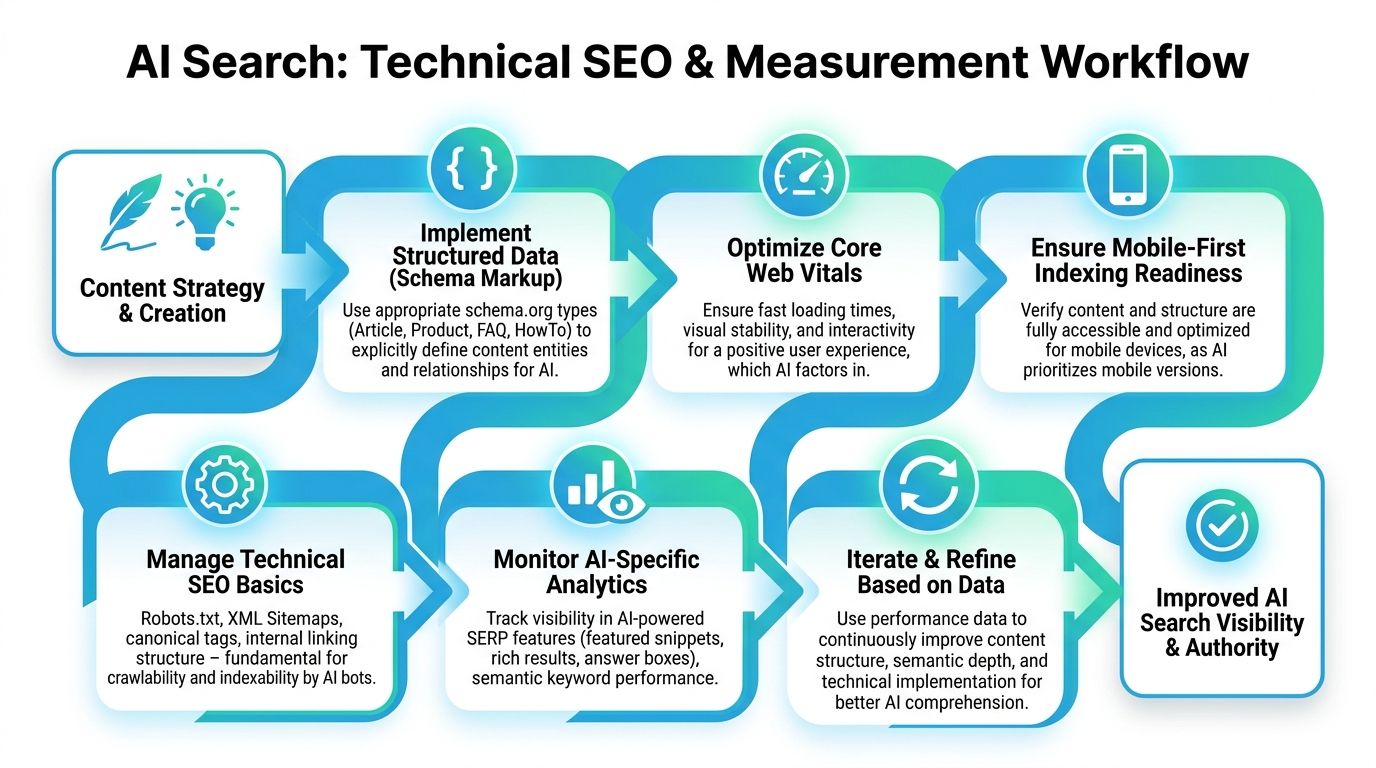
Technical signals still shape AI visibility
Start with the basics that make your content easy to parse. Use semantic HTML. Apply appropriate schema types where they are applicable to the page. Keep your internal linking system descriptive and organized. Make sure the mobile version preserves the same key content and structure.
The practical schema set depends on the page. An explainer may benefit from Article schema. A step-based guide may be a candidate for HowTo. A Q&A resource may suit FAQ markup. The key is accuracy. Don't add markup because it exists. Add it because it clarifies the content's real format.
A common execution problem is fragmentation between teams. Writers create the copy, developers implement templates, and no one checks whether the structured data still reflects the final page. That gap leads to pages that are readable to humans but less clear to machines.
Use sleeper page refreshes before creating more content
Many teams reach for net-new content too quickly. In practice, some of the best opportunities sit in older pages that already have topic relevance and indexing history but weak formatting.
The cited recommendation from Digital Marketing Institute's article on optimizing content for AI search calls this the Sleeper Page Refresh strategy. Restructuring legacy pages into atomic, self-contained sections, instead of just adding fresh text, increased AI citation likelihood by 40% compared to standard updates.
That finding lines up with what practitioners see in audits. A page doesn't always need more material. It often needs better chunking, cleaner headings, and stronger answer placement.
Old content usually fails because of packaging, not because the topic is dead.
A practical refresh workflow looks like this:
| Audit focus | What to check | What to change |
|---|---|---|
| Heading logic | Are H2s specific and question-led? | Rewrite vague headings |
| Section openings | Is the answer delayed? | Move the answer to the first paragraph |
| Content density | Are ideas mixed together? | Split into separate units |
| Markup fit | Does schema match the page type? | Correct or simplify implementation |
Measure visibility, not just rankings
Traditional rank tracking still has value, but it won't tell you enough about AI search performance. Teams need to watch whether pages appear in AI-generated answer surfaces, whether branded methods are preserved in citations, and whether refreshed content gains more visible reuse in search summaries.
The measurement mindset should shift from “Where do we rank?” to “Which sections are being selected?” That changes how you audit pages after publishing. Review answers in AI search interfaces. Compare which parts of your page seem easiest to reuse. Check whether your section openings are doing the work you intended.
This is slower than checking a position report, but it produces better decisions. If one page earns visibility and another doesn't, the gap is often structural before it's topical.
Building a Reproducible AI Content Workflow
The biggest mistake teams make is treating AI search optimization as a one-time content update. It isn't. It's a production system. If the workflow doesn't change, results stay inconsistent because every writer, editor, and strategist falls back into their own habits.
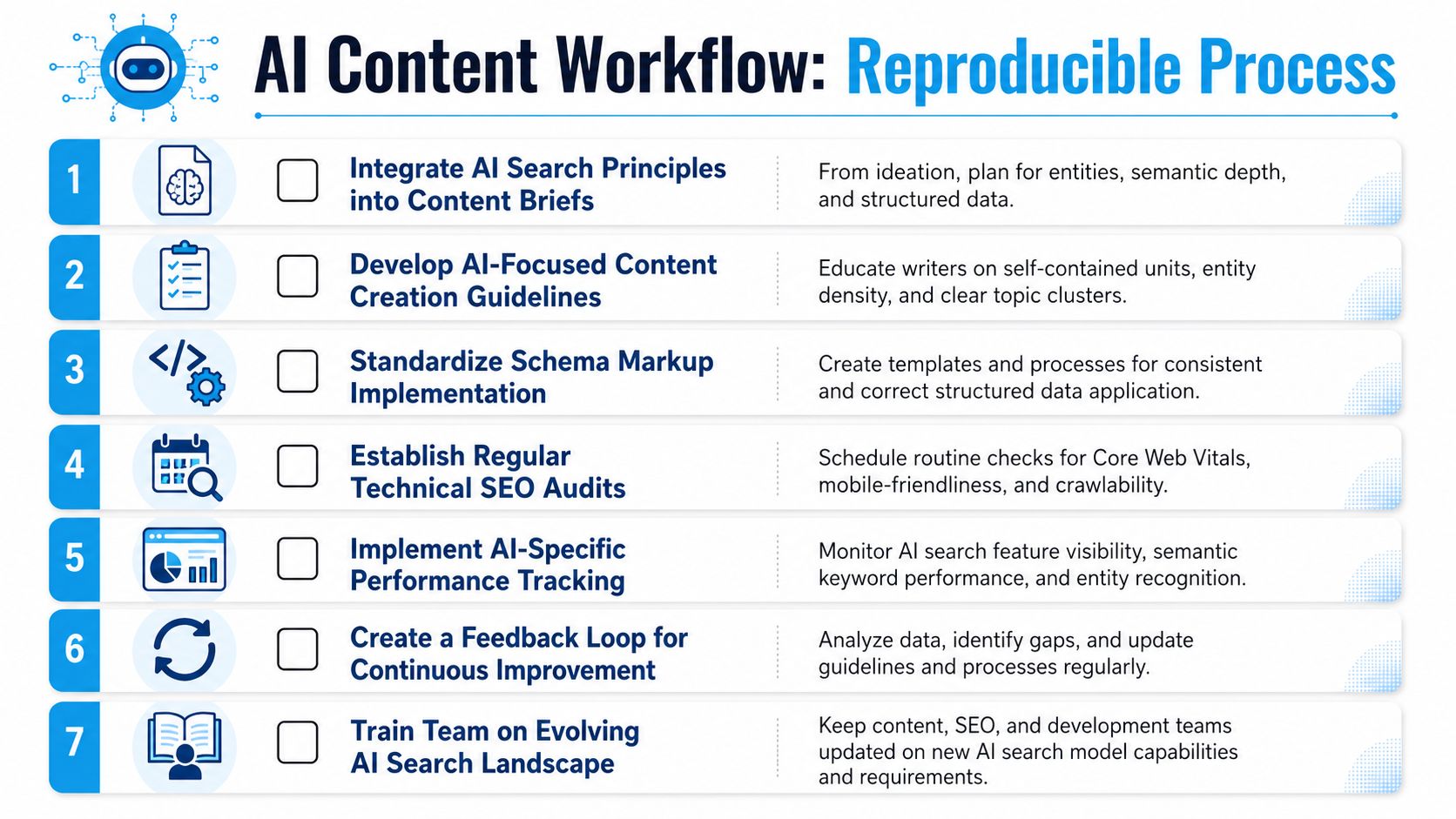
Operationalize the format
Teams need explicit standards for briefs, drafts, and reviews. If you want consistency, don't rely on memory. Put the rules into templates.
The formatting discipline matters at the sentence and paragraph level too. According to To The Web's GEO checklist on mastering content creation for AI search engines, paragraphs should stay between 60 and 100 words so both readers and AI systems can isolate a single idea without context bleeding. That's a useful editorial constraint because it forces tighter thinking.
A practical workflow standard usually includes:
- Brief requirements: Define the primary question, the supporting questions, and the entities that must appear.
- Draft rules: Require an answer-first opening under the H1 and answer-first openings under major sections.
- Review criteria: Check whether each section stands alone without surrounding explanation.
- Refresh cadence: Rework older pages into atomic units before commissioning more content on the same topic.
Build review into production
This kind of content usually improves when multiple disciplines review it together. Strategists can validate intent. Writers can tighten the answer blocks. SEO specialists can check entity coverage and internal links. Developers can confirm that templates and schema support the final structure.
That cross-functional review matters because AI visibility breaks in small ways. A heading becomes vague during editing. A summary paragraph gets buried under a visual. A template inserts generic anchor text. None of those issues feel major in isolation. Together, they weaken extractability.
The strongest AI-ready content doesn't happen by accident. Teams build it on purpose, then review it against a repeatable standard.
The long-term advantage comes from consistency. When every page follows the same structural logic, your site becomes easier to scale, easier to update, and easier to evaluate. That's what turns isolated wins into a durable content system.
If your team needs help turning these standards into a practical production workflow, SharedTEAMS can support the strategy and execution. Their model works well for organizations that need fractional marketing leadership, content operations, SEO and GEO support, and on-demand implementation without building a full in-house department first.